Historic Cemeteries in Tbilisi: Pantheons, Famous Graves and How to Visit
Tbilisi is known for its pantheons, the cemeteries where Georgia buries its poets, painters and national heroes under some of the most expressive gravestones I've seen anywhere. This guide covers the Mtatsminda Pantheon halfway up the funicular, the older Didube Pantheon, 300-year-old Kukia, the Armenian Pantheon beside Sameba, the cemeteries the Soviets cleared, and how to visit each one.
Tbilisi's historic cemeteries at a glance
Tbilisi once had far more cemeteries than it does now. A city guidebook from 1906 listed 15 of them, Georgian Orthodox, Armenian, Muslim, Lutheran and more, and by the end of the 1930s the guidebooks listed none. Many were cleared for parks and buildings, which is why the ones that survived feel so heavy with history.
Five are open and easy to visit. I'd start with Mtatsminda, which sits on the way to the best view in the city anyway, and add the others depending on how much of a day you want to give to graves.
| Cemetery | Where | Who is buried there | Entry | Best for |
|---|---|---|---|---|
| Mtatsminda Pantheon | Halfway up Mtatsminda, above Sololaki | Griboyedov, Ilia Chavchavadze, Vazha-Pshavela, Galaktion Tabidze | Free | Everyone; the one to see if you see one |
| Didube Pantheon | Didube, near Tsereteli metro | Paolo Iashvili, Tengiz Abuladze, Nato Vachnadze, Zurab Zhvania | Free | Fans of Georgian film, poetry and painting |
| Kukia Cemetery | Foot of Mount Makhata, left bank | Kato Svanidze, Dagny Juel, Pirosmani in an unmarked plot | Free | Atmosphere and old stones in many languages |
| Khojavank Armenian Pantheon | Beside Sameba cathedral, Avlabari | Raffi, Hovhannes Tumanyan, Gayane Khachaturian | Free | Pairing with a visit to Sameba |
| Azerbaijani pantheon | Inside the National Botanical Garden | 11 figures of Azerbaijani culture, Mirza Shafi Vazeh | 4 GEL garden ticket | Adding to a garden walk |
The Mtatsminda Pantheon
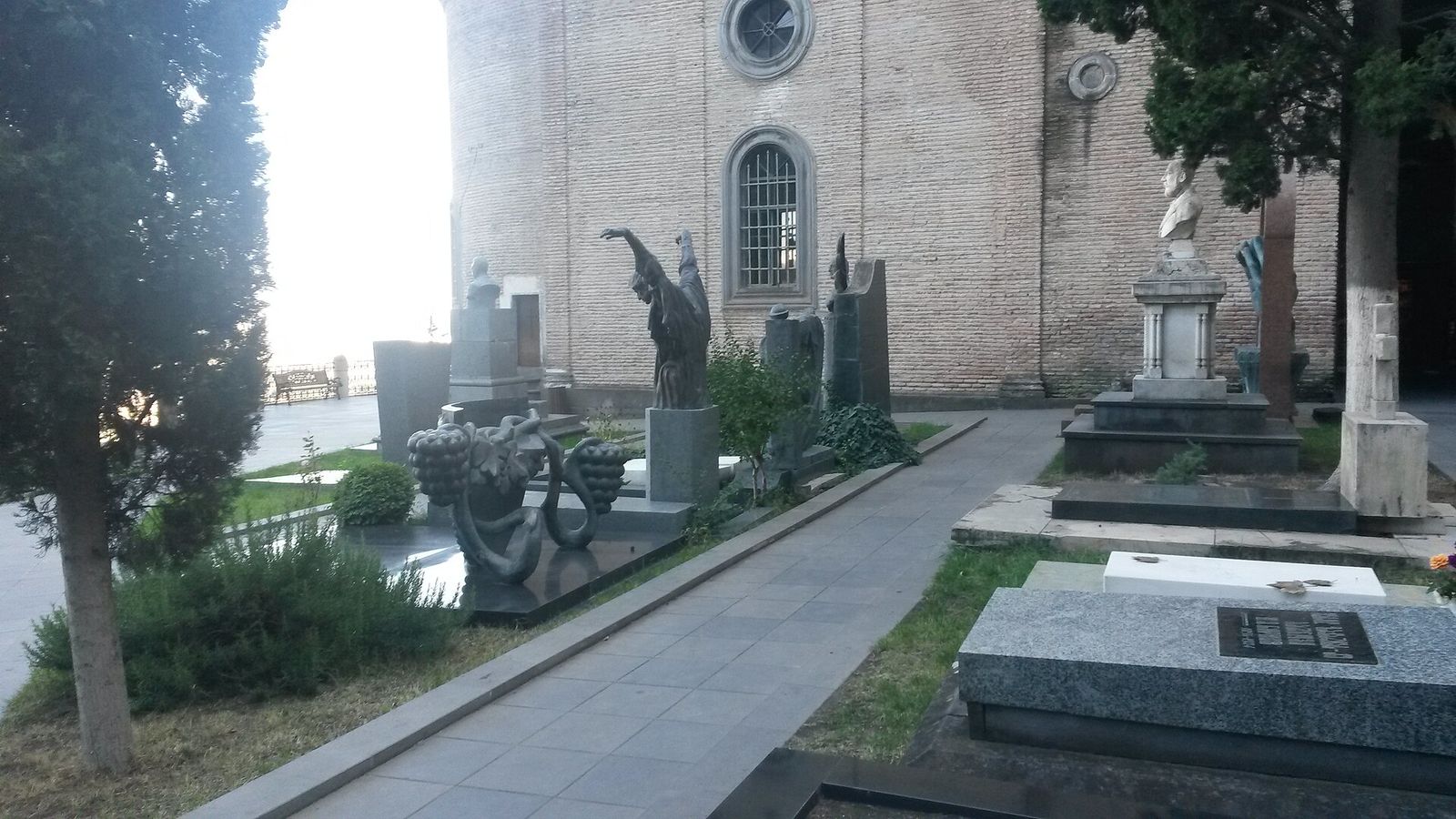
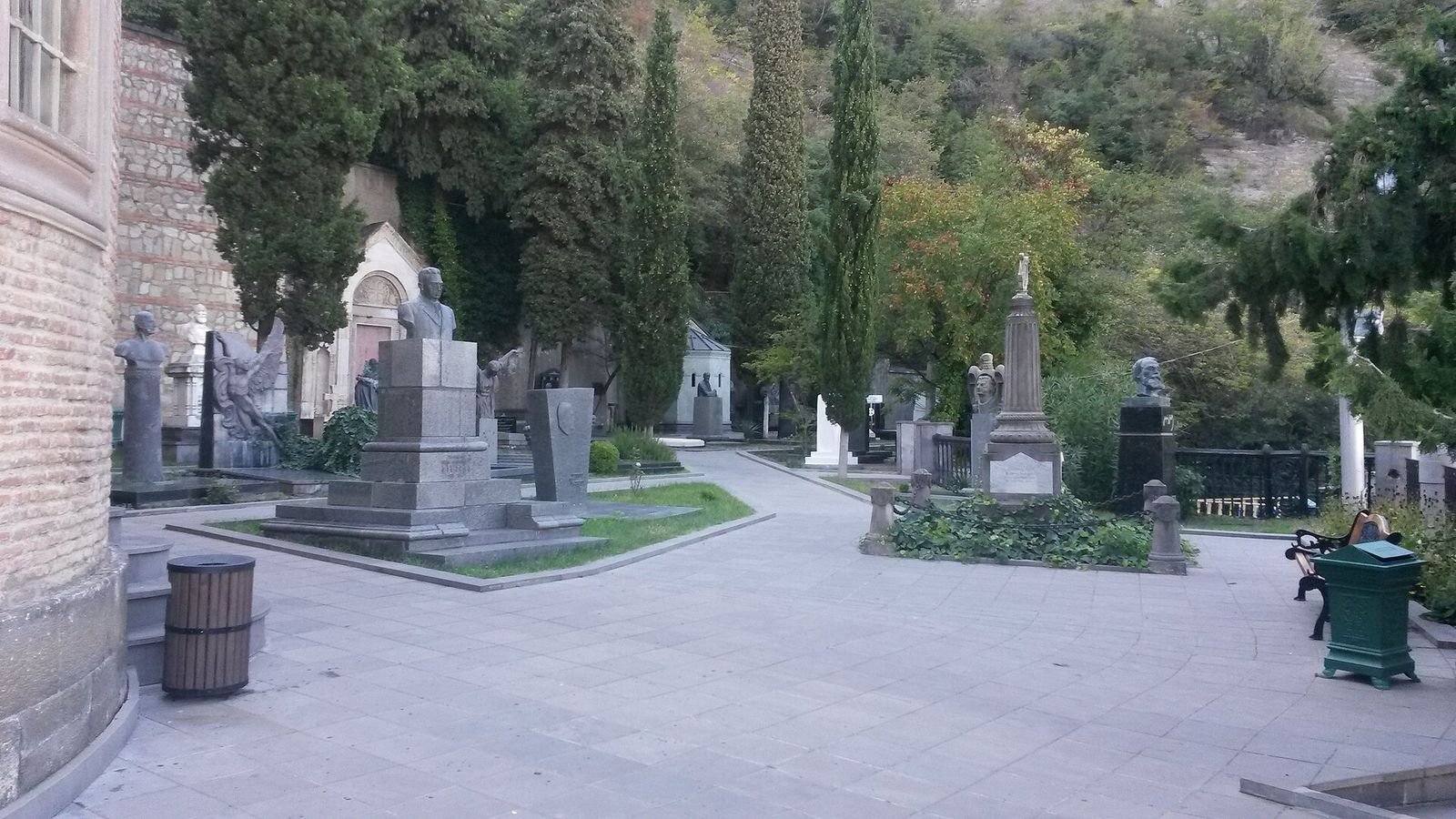
The Mtatsminda Pantheon of Writers and Public Figures is the cemetery most visitors see, partly because it sits halfway up the mountain on the funicular line to Mtatsminda Park. It fills the terraced churchyard around Mamadaviti, the Church of St David, with cypresses, stone paths and the Old Town spread out below.
The first famous grave arrived in 1829, and the pantheon was made official in 1929 to mark that centenary. Through the 20th century the city moved its most honored dead up the hill. Vazha-Pshavela came from Didube in 1935 and Nikoloz Baratashvili in 1938, and much later the heroes of the independence movement came home from abroad: the anti-Soviet fighter Kakutsa Cholokashvili from France in 2005, and Zviad Gamsakhurdia, the first elected president of independent Georgia, from Grozny in 2007. The city declared the terraces full in 2009, and the pantheon is now closed to new burials and open to everyone.
What makes it special is the gravestones. Each one tries to say something about the person under it: busts and full figures, a dancer in flight, poets lost in thought, actors caught mid-gesture. I treat it as an open-air gallery of 20th-century Georgian sculpture as much as a cemetery, and it's the best short lesson I know in who matters in this country and why.
Mamadaviti Church and the spring
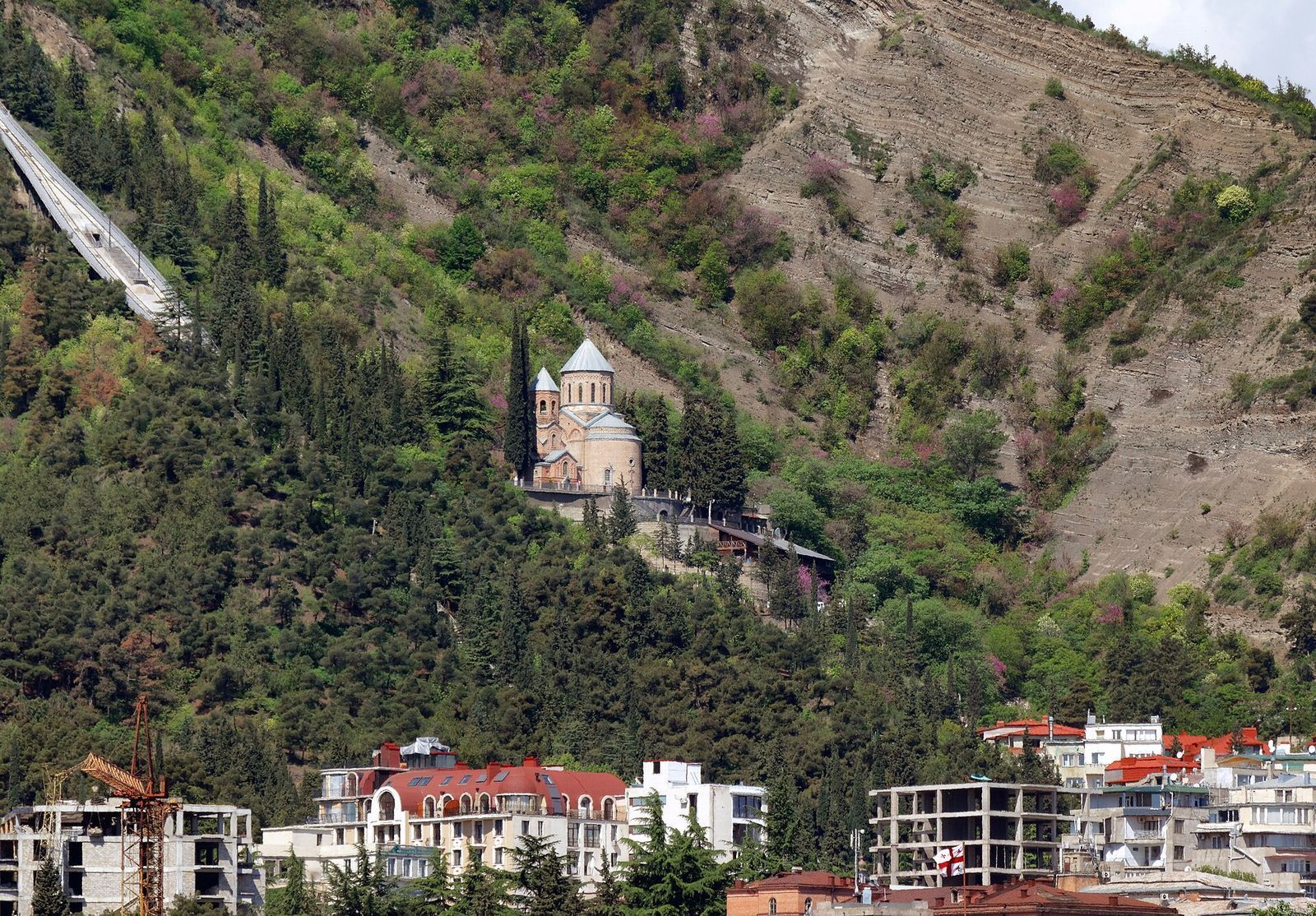
Mamadaviti means "Father David". It is named after St David of Gareja, one of the 6th-century monks who spread monastic life through Georgia, who is said to have lived in a cave on this mountain before founding the desert monastery at David Gareja. The church you see today dates from the 19th century, a small stone building cut into the hillside, with the graves stepping down beneath it.
Behind the church, along the rock wall, a spring trickles out of the mountain. Local tradition links its water to women hoping for a child, and you'll often see someone filling a bottle there or stopping to pray. The terrace in front of the church is one of the calmest viewpoints in the city, looking down over Sololaki's roofs to the river, Narikala's walls and the gold dome of Sameba.
Mamadaviti makes my short list of the best churches in Tbilisi for its setting alone. It is a working church, so services and candle-lighting go on around the visitors.
Famous graves at the Mtatsminda Pantheon
The terraces are compact, and an unhurried hour covers every grave. These are the ones I'd look for.
| Grave | Who they were | Why stop |
|---|---|---|
| Alexander Griboyedov and Nino Chavchavadze | Russian playwright and diplomat, killed in Tehran in 1829, and his Georgian wife | The oldest and most romantic grave here, set in a grotto below the church |
| Ilia Chavchavadze | Writer and leader of the national revival, murdered in 1907 | Often called the father of the nation, now honored as a saint |
| Akaki Tsereteli | Poet, died 1915 | He wrote the words of "Suliko", the song every Georgian knows |
| Vazha-Pshavela | Poet of the mountains, moved here from Didube in 1935 | The voice of Georgia's highlands |
| Nikoloz Baratashvili | Romantic poet who died young in 1845 | Moved here from Didube in 1938 |
| Galaktion Tabidze | Poet, died 1959 | The 20th-century poet most Georgians can still quote |
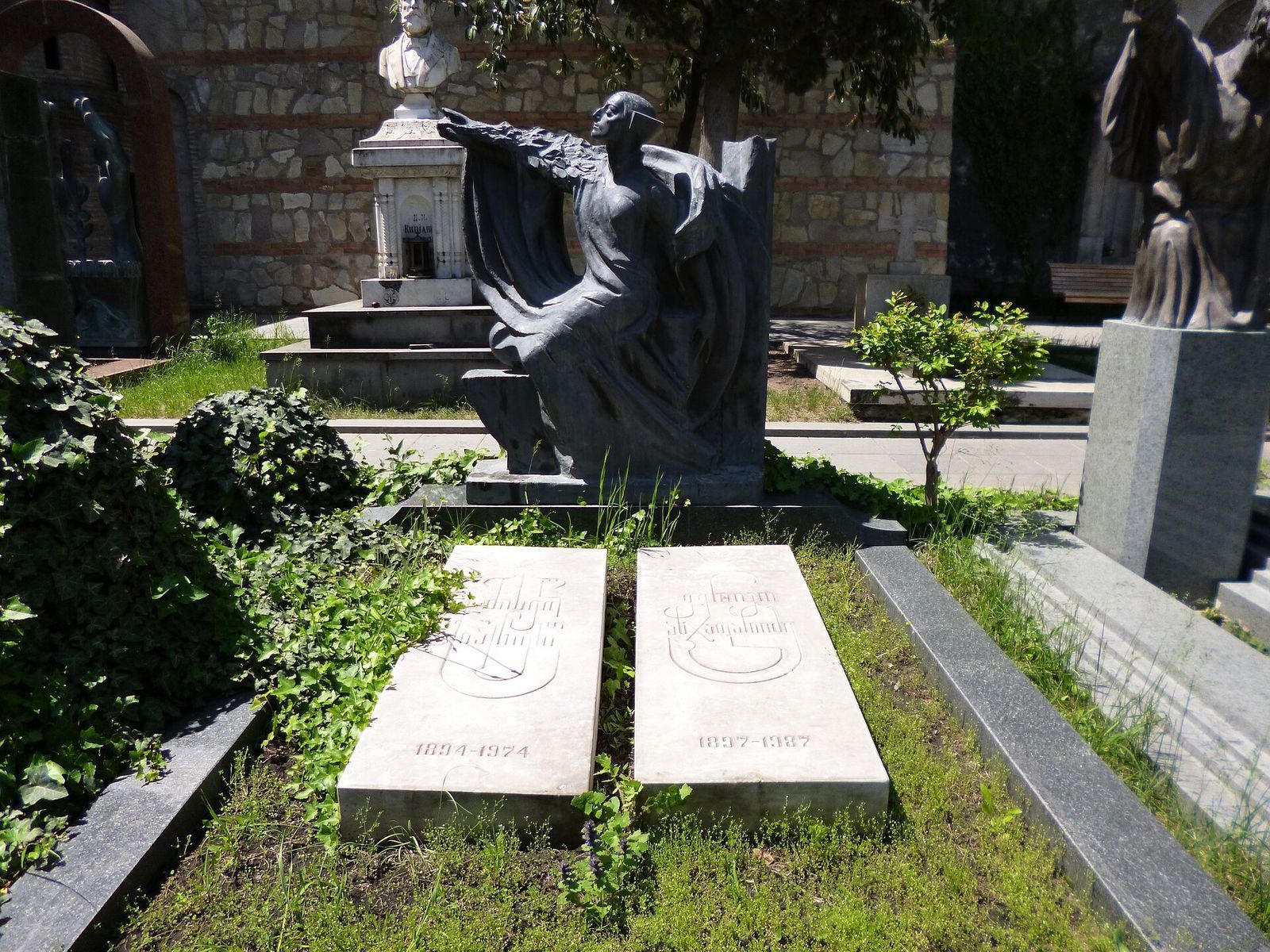
| Vakhtang Chabukiani | Ballet dancer and choreographer, died 1992 | A winged figure in flight, my favorite stone here |
| Niko Pirosmani | Self-taught painter, died 1918 | A symbolic grave; his real one was lost at Kukia |
| Keke Geladze | Stalin's mother, died 1937 | Buried here while her son ruled from Moscow |
| Mikheil Chiaureli and Veriko Anjaparidze | Film director and the leading actress of Georgian stage and screen | Two white slabs under a dark bronze figure |
| Zviad Gamsakhurdia and Merab Kostava | Soviet-era dissidents and national heroes | Reminders of how recent independence is |
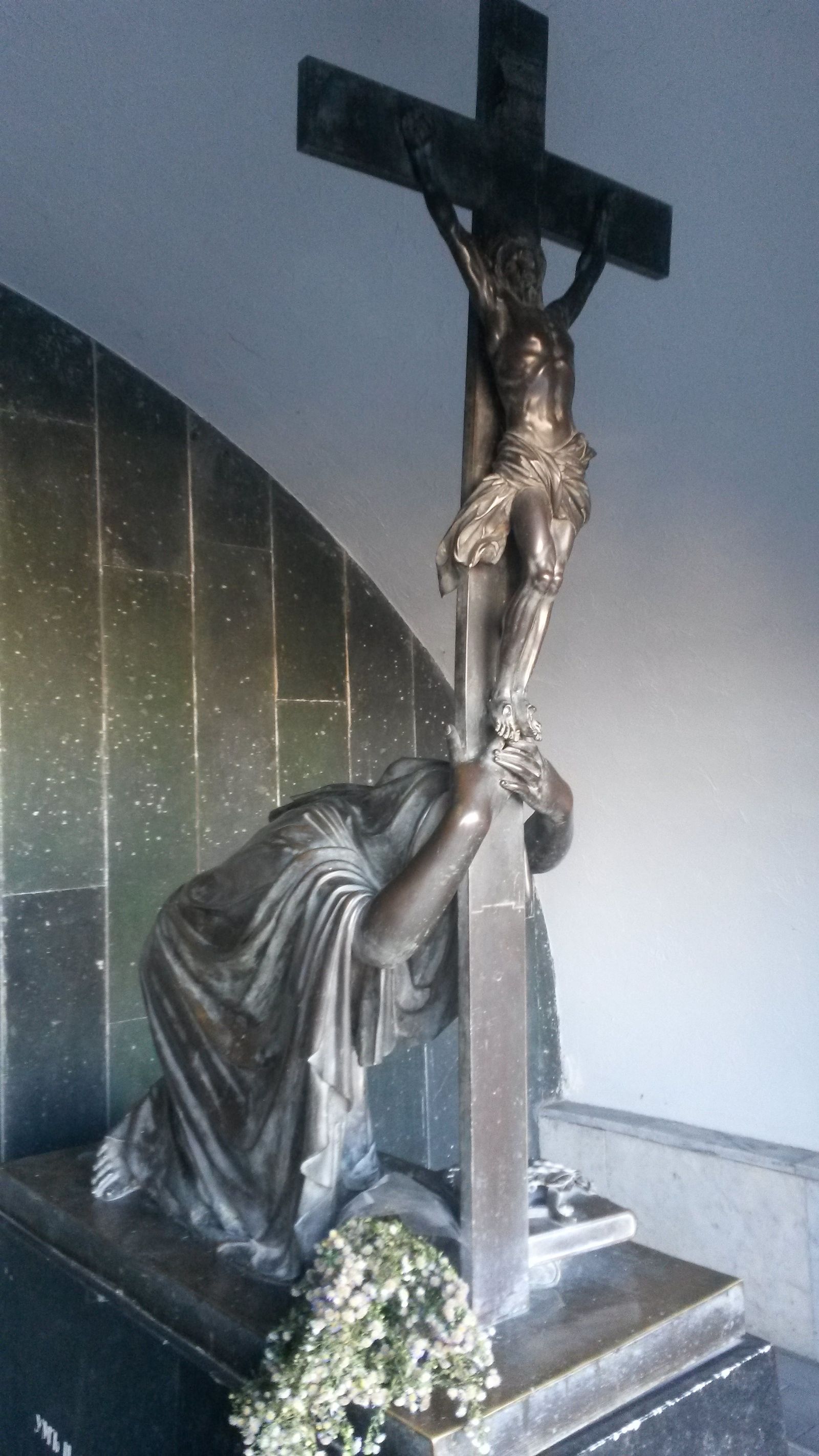
Start with Griboyedov. He married Nino Chavchavadze in Tbilisi in 1828, and months later he was killed when a mob stormed the Russian embassy in Tehran. Nino was widowed as a teenager, never remarried, and had a line carved on his tomb that still stops people: his mind and deeds are immortal in Russian memory, but why did her love outlive him? A bronze widow weeps over a cross in the grotto, and Nino lies beside him.
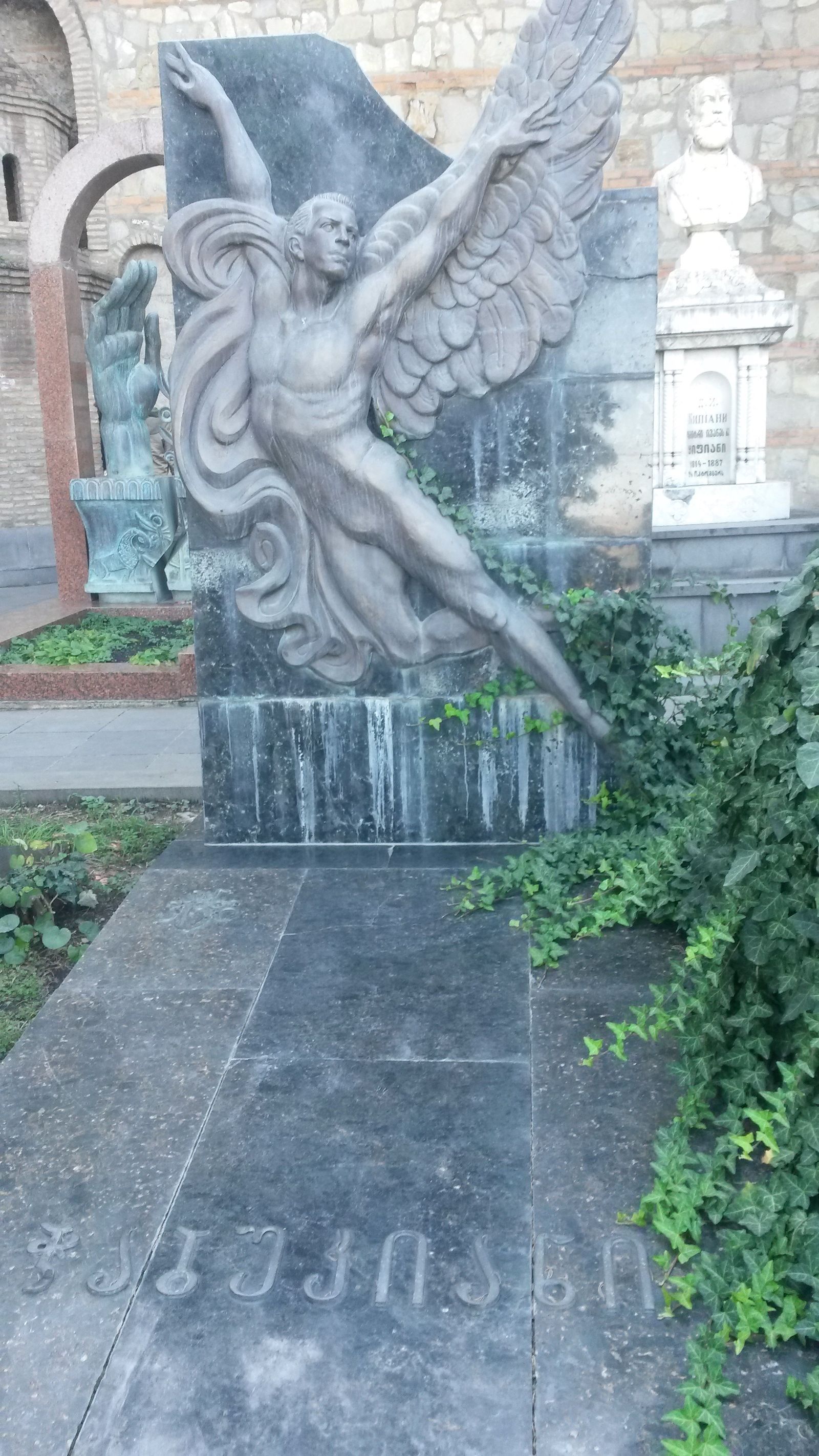
Chabukiani is the other one I always look for. He danced and later led the ballet company at the Tbilisi Opera House on Rustaveli Avenue for decades, and his gravestone, a figure caught mid-leap with wings spread, is the most alive thing on the mountain.
How to get to the Mtatsminda Pantheon
You have three ways up, and the funicular is the easiest.
- The funicular. The lower station is at 22 Daniel Chonkadze Street, a few steep blocks above Rustaveli Avenue. The car makes one stop halfway, at the Pantheon. A one-way ride costs about 10 to 12 GEL, paid on a 2 GEL Mtatsminda Park card bought at the station; Metromoney and cash don't work at the gate.
- The paved path. From the lower funicular station, a paved path of about 1.5 km climbs to the summit, and the Pantheon sits partway up it. It's steady, shaded in places and fine in ordinary shoes.
- From Sololaki. The stepped lanes at the top of Sololaki, the old merchant quarter right under the mountain, climb toward the church along Mama Daviti Rise.
The Didube Pantheon
Didube is the older of the two city pantheons. It opened in 1915 in the north of the city, and for its first two decades this was where Georgia buried its writers and public figures. In 1934 the order came to move the most celebrated of them to Mtatsminda, Vazha-Pshavela and Baratashvili among them, and Didube settled into its role as the second pantheon. It still holds about 650 notable people, and it has run out of room for more.
It feels different from Mtatsminda: flatter, more crowded, less groomed, a city cemetery with a pantheon inside it. There's no view and almost never a tour group. I like it for that, and for the 20th-century names that fill it.
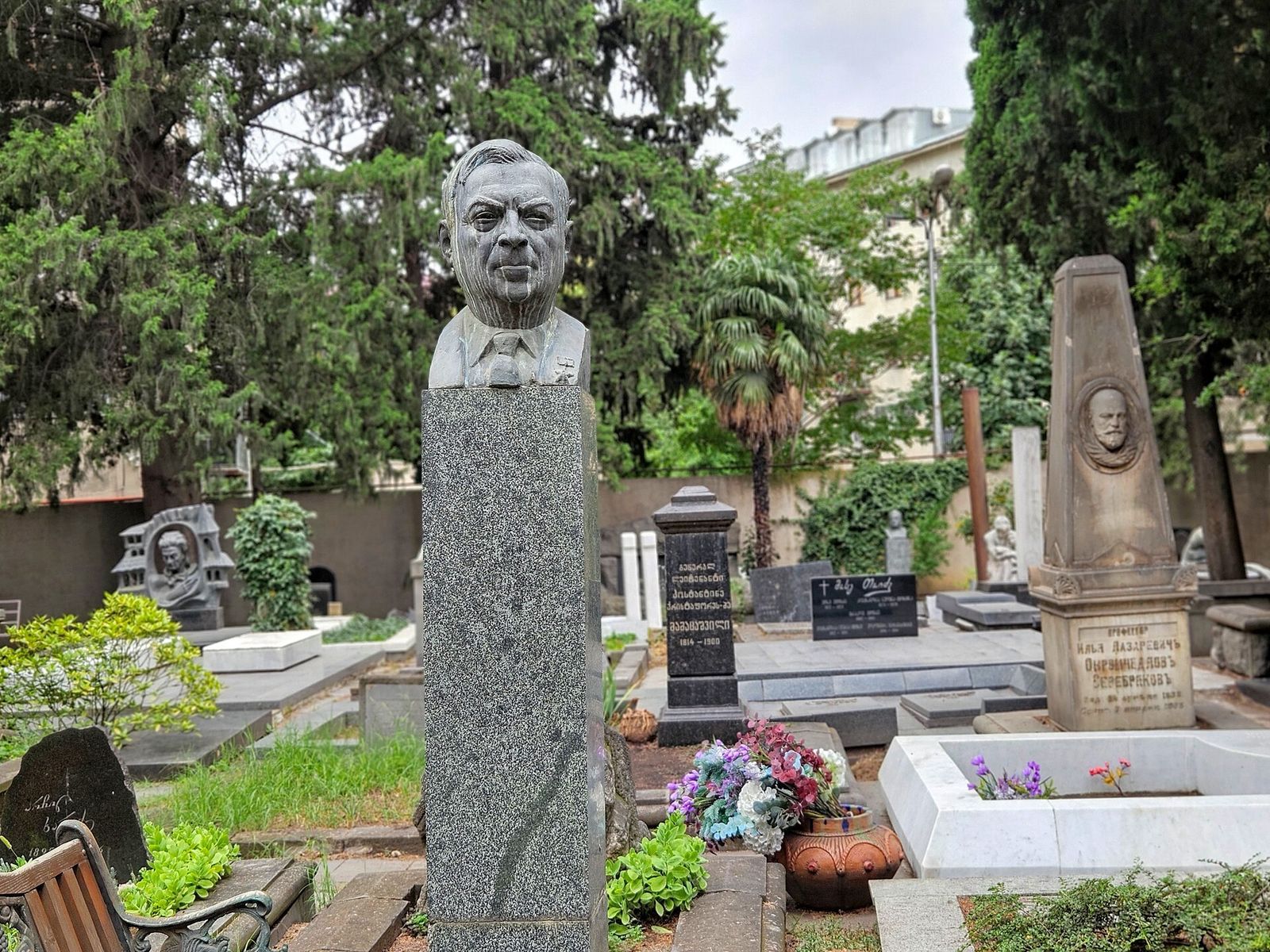
The graves I'd look for:
- Paolo Iashvili (1894 to 1937), the poet who led the Blue Horns group and died in 1937, the worst year of Stalin's purges.
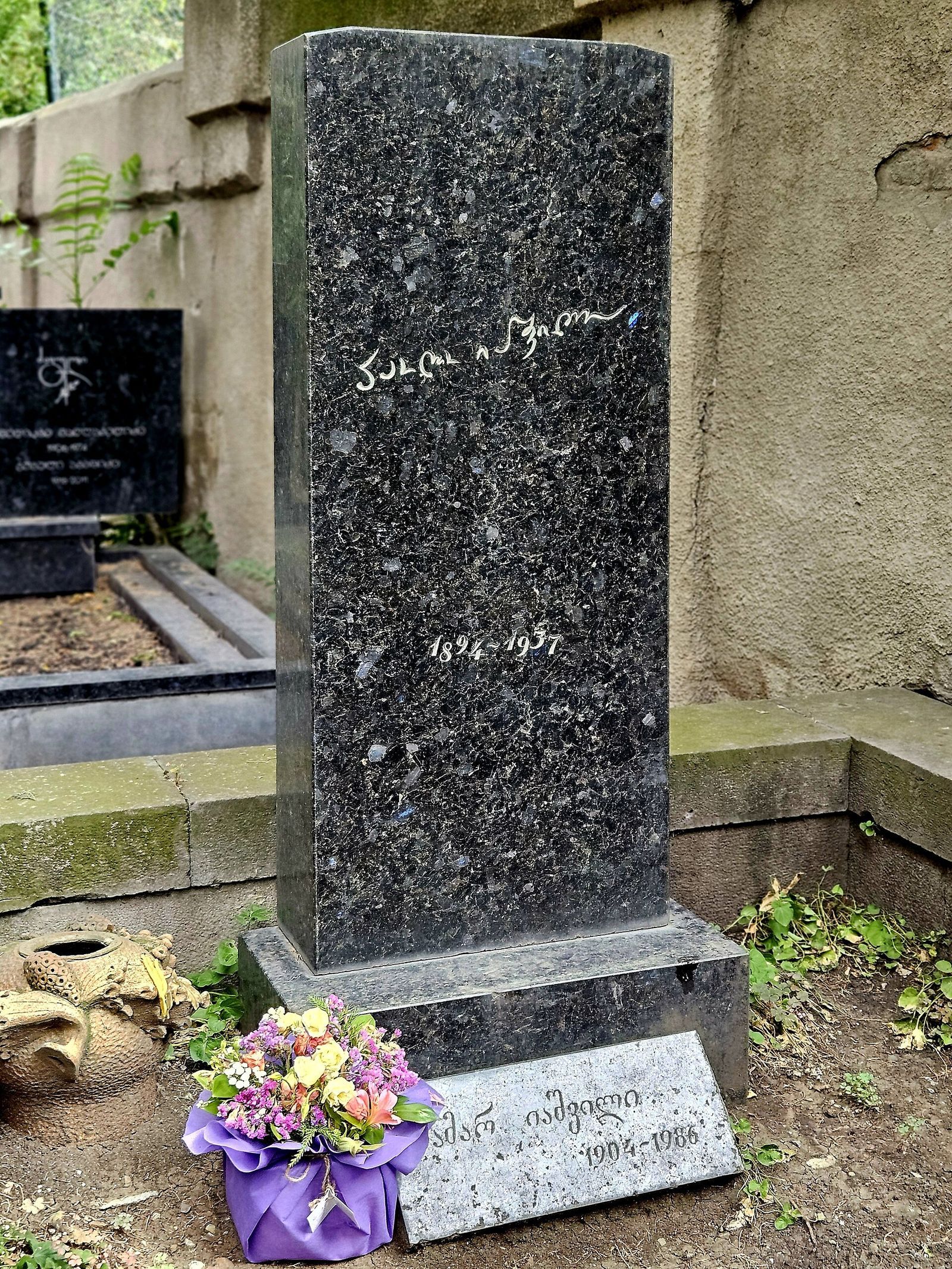
- Lado Asatiani (1917 to 1943), a poet who died young in the middle of World War II.
- Tengiz Abuladze (1924 to 1994), the film director behind "Repentance", the film that cracked open the Stalin years for Soviet audiences.
- David Kakabadze (1889 to 1952), one of the great Georgian modernist painters.
- Nato Vachnadze (1904 to 1953), the star of Georgian silent film.
- Zurab Zhvania (1963 to 2005), prime minister of Georgia in 2004, whose death in 2005 shook the country.
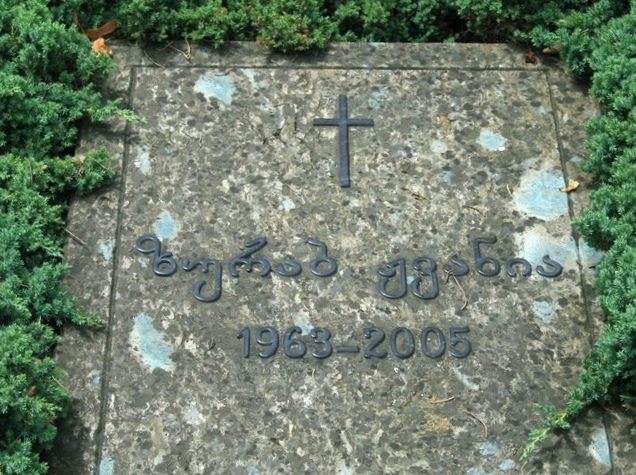
Entry is free and the gates are open in the daytime, roughly 09:00 to 18:00. The pantheon is a short walk from Tsereteli station on the Tbilisi metro, so from the center ride to Station Square and change for one stop on the Saburtalo line.
Kukia Cemetery
Kukia is the oldest cemetery still standing in Tbilisi, with graves going back about 300 years, and it's the one I find most moving. It sits at the foot of Mount Makhata on the left bank, north of the center, and it survived the Soviet clearances that erased the cemeteries closer in. So the layers are still here. Until the 1920s it had separate sections for Orthodox Christians, Catholics, Lutherans, Yezidis and Molokans, and you can read epitaphs in Georgian, Armenian, Assyrian, French, Italian, Polish and Ukrainian.
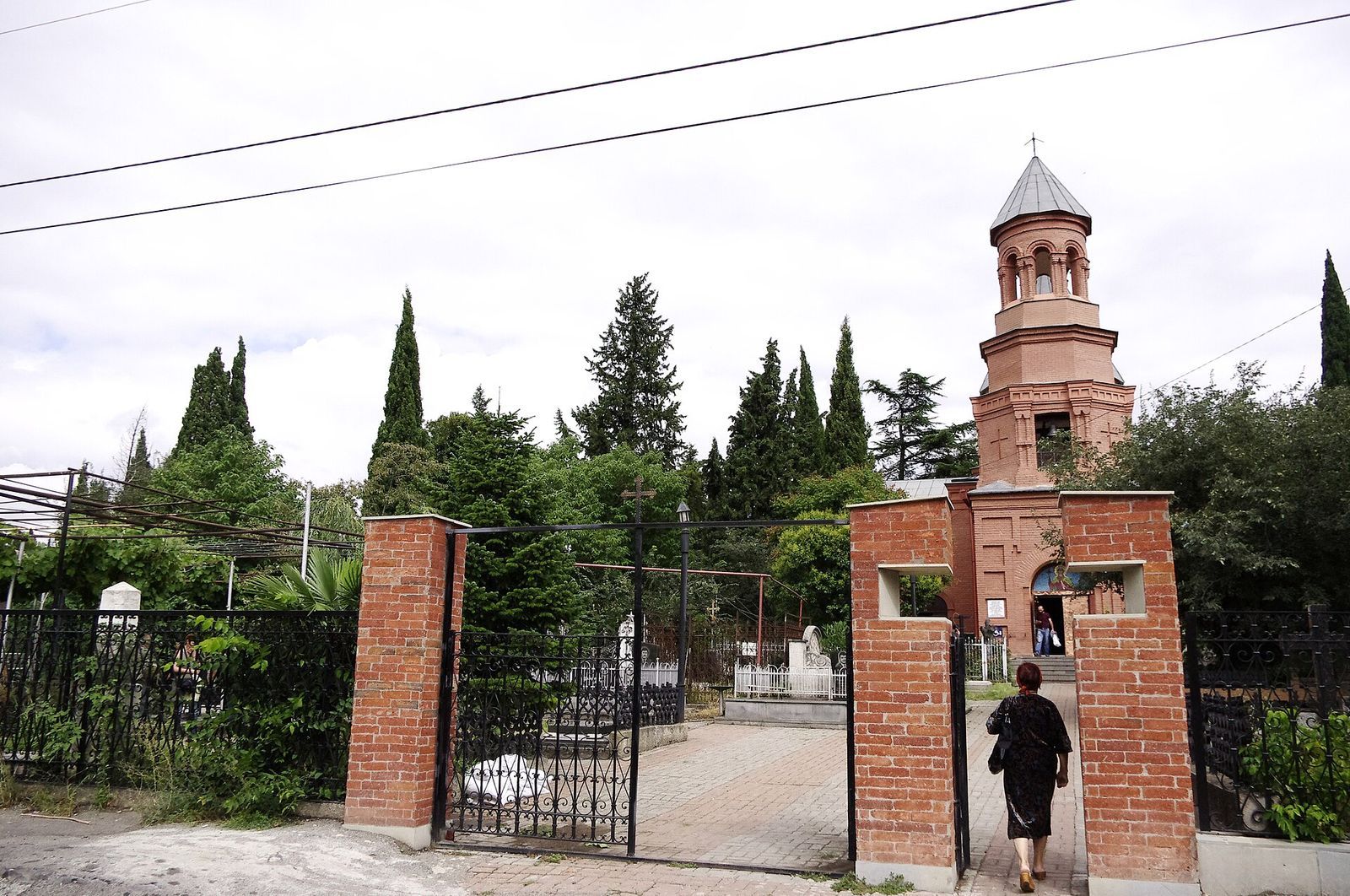
Walk in past the Church of St Nino and the cemetery opens into a maze of statues, faded enamel photographs, iron railings and the odd headless bust. Near the entrance lie 19th-century Italians, a German obelisk remembers soldiers who died in the Caucasus in World War I, and the Catholic church that once stood here was pulled down in the 1930s.
The people buried at Kukia:
- Niko Pirosmani, the self-taught painter, died poor in 1918 and is believed to lie here in an unmarked plot. Nobody knows exactly where, which is why his grave at Mtatsminda is symbolic.
- Ekaterine "Kato" Svanidze, Stalin's first wife, who died in 1907.
- Anastasia Sazonova, revered by Orthodox believers for miracles attributed to her, whose grave still draws pilgrims.
- Dagny Juel, the Norwegian writer and muse of Edvard Munch, who was shot in Tbilisi in 1901.
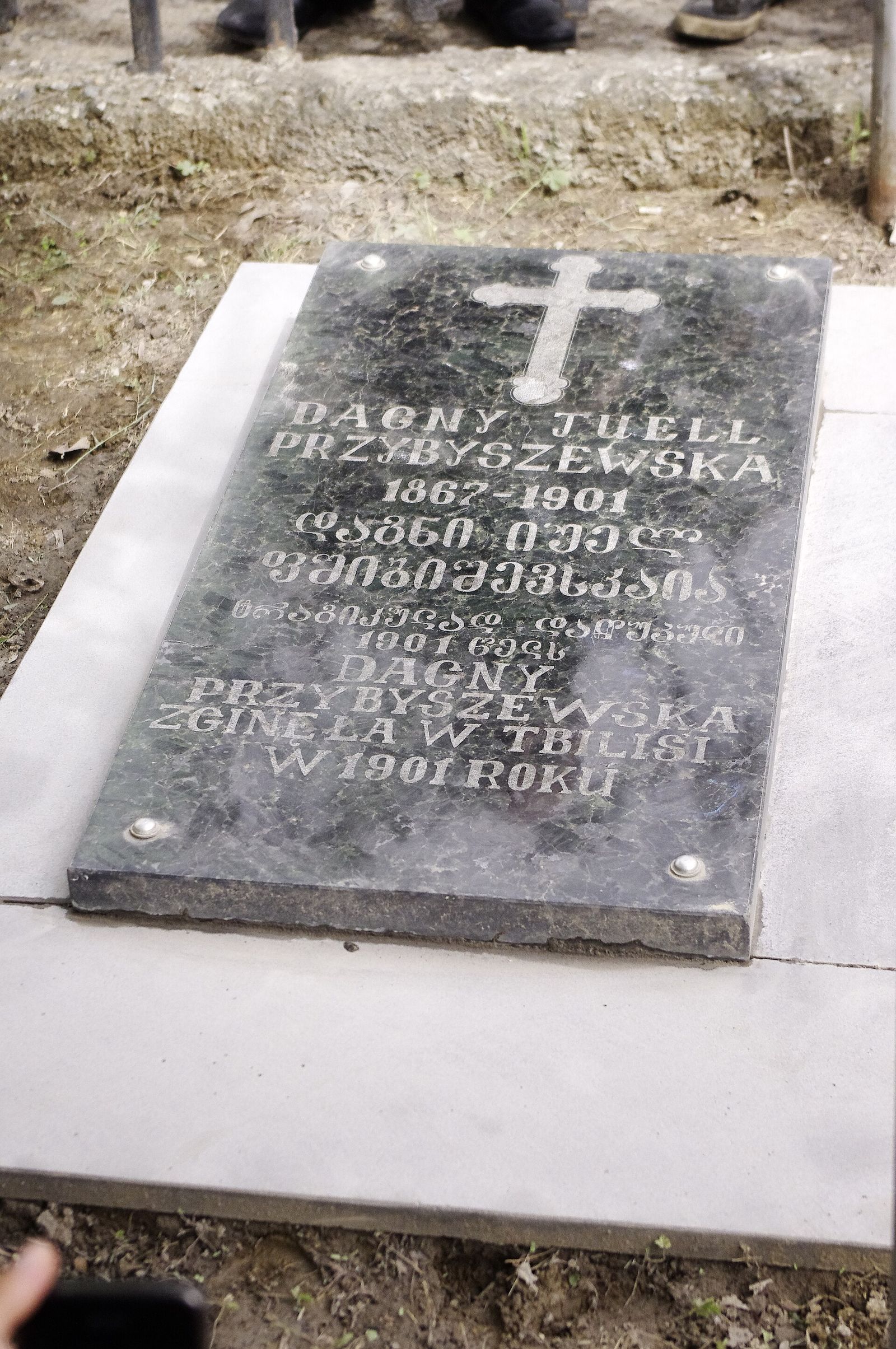
Kukia also had its own pantheon from about 1900, before Didube and Mtatsminda took over that role; it was gone by the 1950s. A Bolt taxi from the center is the easy way there.
The Armenian Pantheon at Khojavank
Avlabari, across the river from the Old Town, was the heart of Armenian Tbilisi for centuries, and its cemetery, Khojavank, was vast: in use for about 300 years, with around 90,000 graves. In the 1930s the 17th-century church at its center was demolished and most of the graveyard was bulldozed for a park. What survives is a small pantheon of Armenian writers and artists, laid out in 1961.
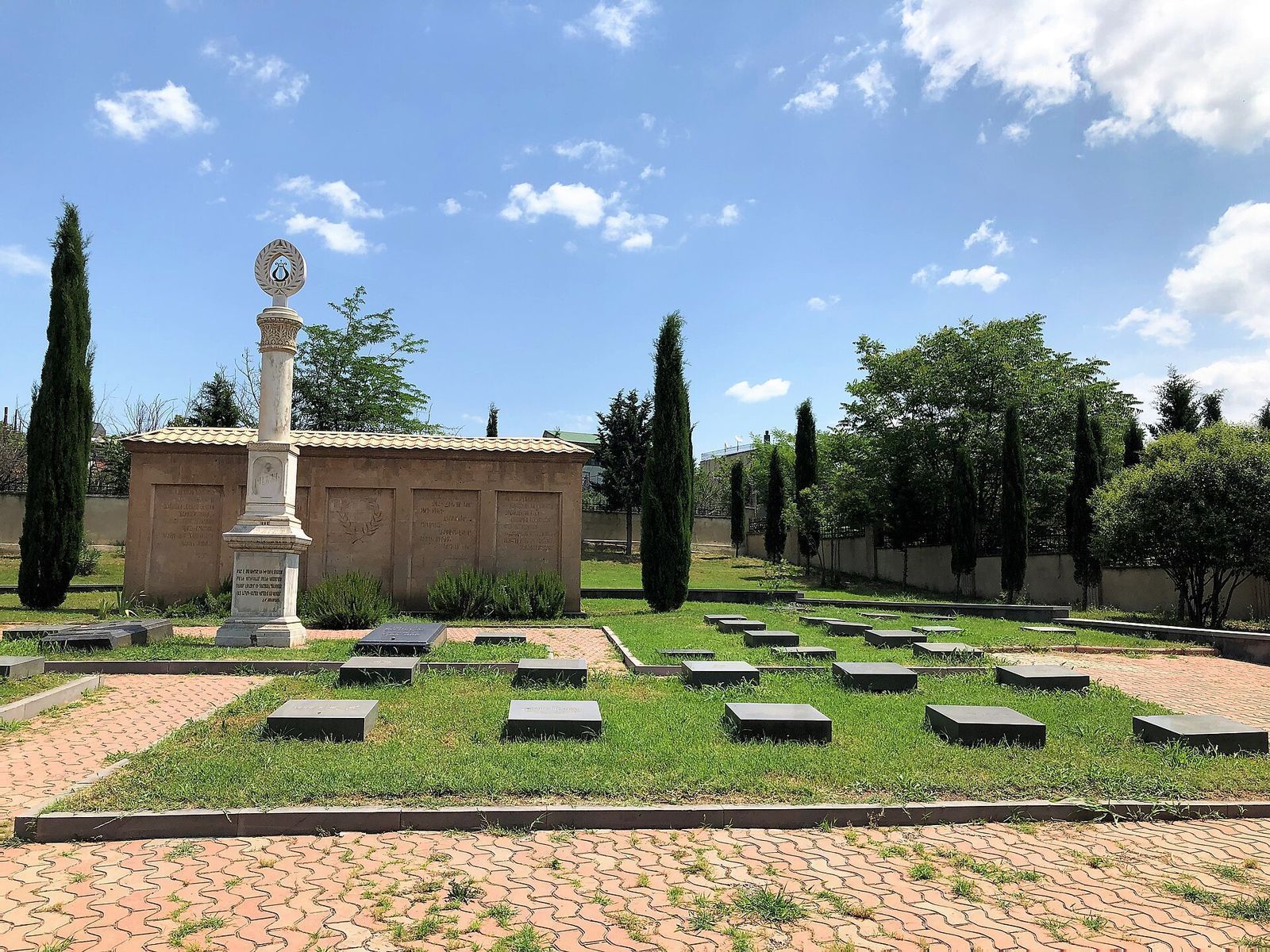
It sits on the edge of the grounds of Holy Trinity Cathedral, Sameba, which was finished in 2004 on part of the old cemetery land. Here lie Raffi, the Armenian novelist who died in Tbilisi in 1888, the poet Hovhannes Tumanyan, and the painter Gayane Khachaturian. Recent building work beside the cathedral exposed old graves and then stalled, leaving an excavation pit next to the pantheon.
It's a quiet 15 minutes, and it changes how the cathedral looks. Sameba is the symbol of modern Georgian Orthodoxy, and the pantheon beside it is what's left of a community that shaped this city for centuries.
The Azerbaijani pantheon in the Botanical Garden
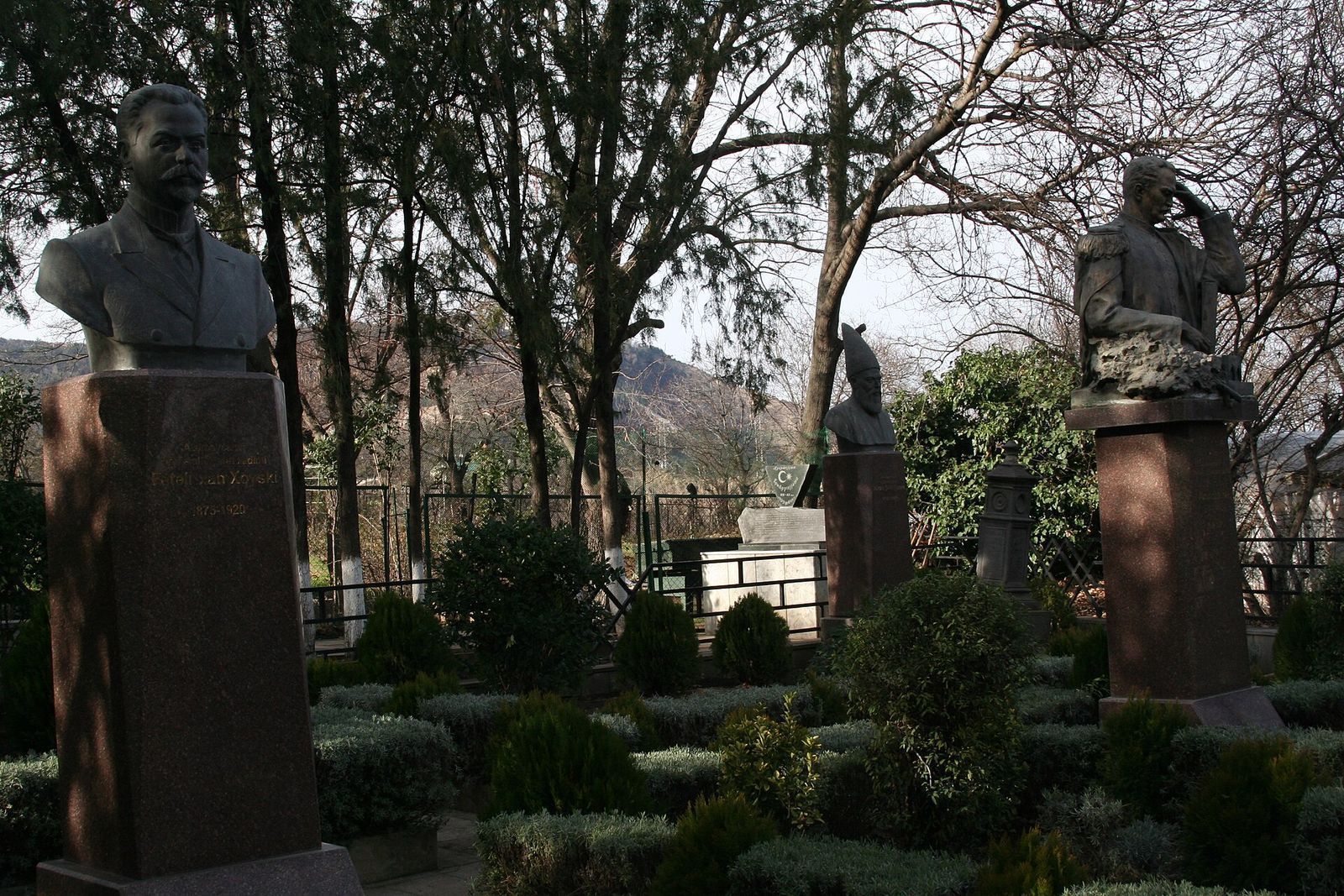
Few visitors know there's a cemetery inside the National Botanical Garden. The garden's slopes once held a Muslim cemetery for Persians, Arabs, Azerbaijanis and others. In the early 1950s the Soviets razed a nearby mosque and then the headstones, reportedly within a few days, and burials stopped for good in the 1970s.
What remains is a pantheon of 11 figures of Azerbaijani culture, built in the 1970s and renovated most recently in 2013, with a statue of the poet Mirza Shafi Vazeh, who died in 1854. To find it, buy your garden ticket and walk uphill toward the greenhouses. There are no signs, and because the stones face Mecca you see their backs first. Nearly every one is carved in Arabic script.
Tbilisi's lost cemeteries: Vera Park and the Soviet clearances
From the 1930s, Soviet planners treated cemeteries as obstacles to a modern city. Some became parks, others simply vanished, and only a few graves of well-known figures were spared. You can still read that history in a few places if you know where to look.
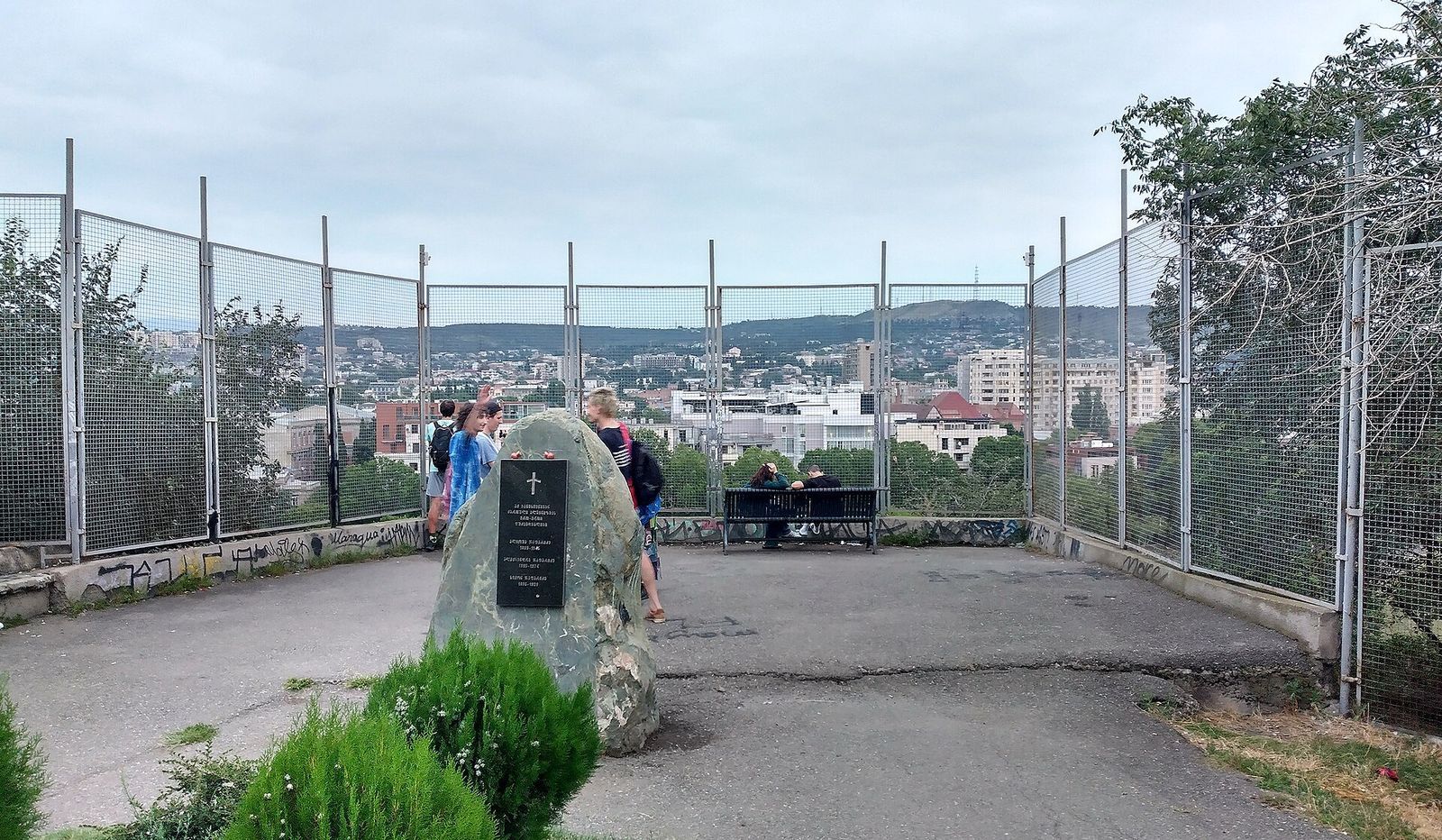
Vera Park. The park in Vera, one of the city's leafy older neighborhoods, was a Christian cemetery with Armenian and Georgian graves until it was cleared in the 1930s. Look closely at the benches: some are 19th-century gravestones turned on their side. A few memorials survived, including the graves of mountaineer Alesha Japaridze (1899 to 1946), the father of Georgian mountaineering, and his sister Aleksandra (1895 to 1974), and a memorial to the historian Ekvtime Takaishvili went up in the 1990s. The Chess Palace stands in the same park, one of the stops on any tour of Soviet architecture in Tbilisi.
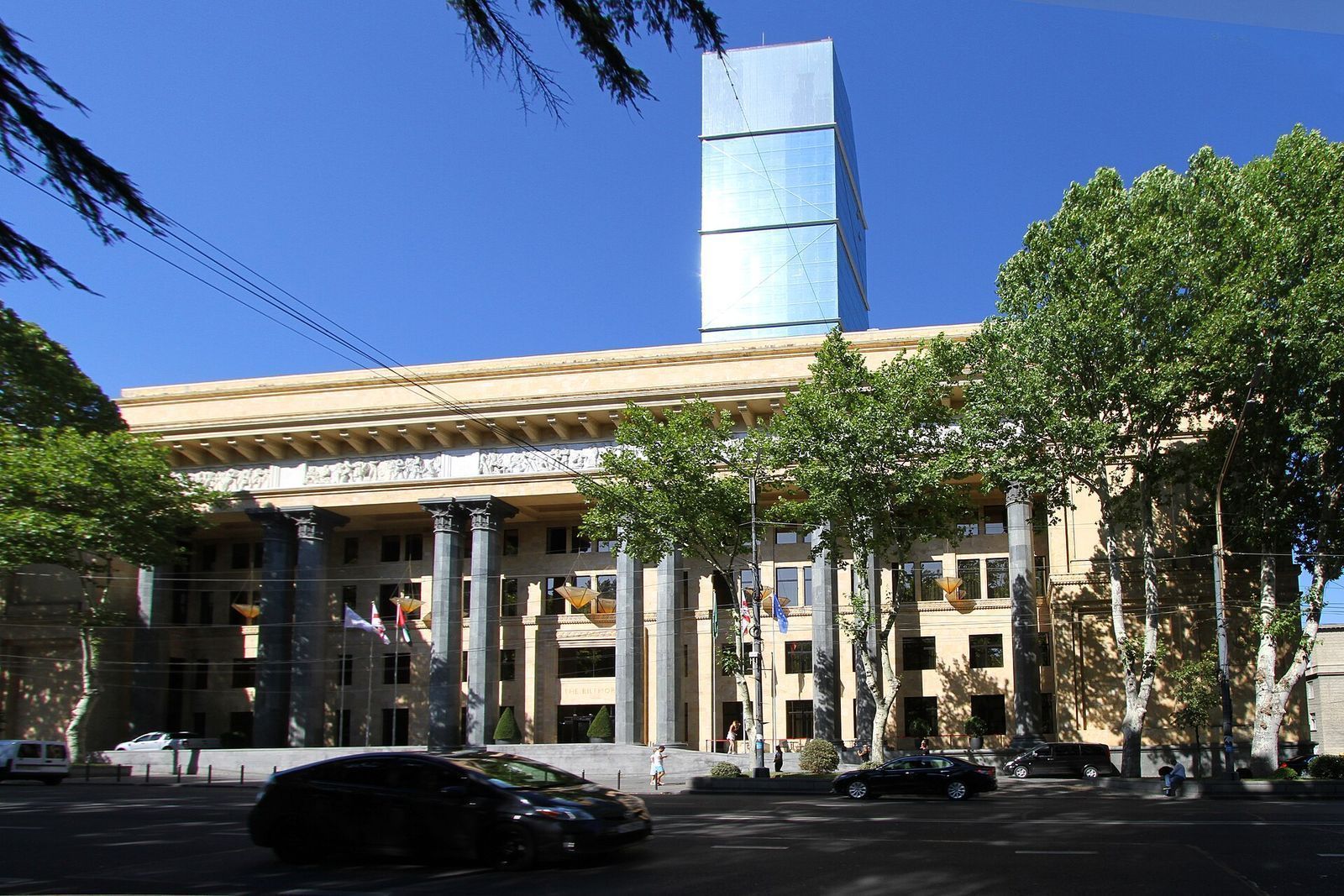
The Biltmore building. When the Stalin-era institute on Rustaveli Avenue was turned into the Biltmore Hotel, the builders found gravestones reused in its walls.
Saints Peter and Paul, Avlabari. After Khojavank was destroyed, Armenian families began burying their dead here, beside the Georgian Orthodox church of Saints Peter and Paul. It's a mixed cemetery of small fences and crowded stones, with a section for soldiers of World War I, and it gives a truer picture of the old Avlabari than the pantheon does.
The Jewish cemeteries. Navtlugi, in the Samgori district east of the center, survived the closures of the 1960s. Ortachala is full and kept up by the city and the Jewish community, which now buries its dead at Dampalo, out in an industrial district.
Today the city runs four pantheons: Mtatsminda, Didube, Khojavank and a new one on Mount Makhata. Together the graves track Georgian history closely: the Russian empire in Griboyedov's grotto, the purges at Didube, the Soviet clearances in Vera Park and independence in the reburials at Mtatsminda.
Cemetery etiquette in Tbilisi
Georgian cemeteries are visited, tended and lived with, and that changes how you behave in them. Most of the rules match Georgian etiquette in any church.
- Dress for church. Mamadaviti, St Nino at Kukia and the church at Didube are all working churches. Cover shoulders and knees; women usually cover their hair inside.
- No photos inside the churches. Outside, photographing gravestones is fine. Photographing mourners is not.
- Step aside for a funeral. If a burial or a memorial service is under way, leave that part of the cemetery for later.
- Leave the tables alone. Many Georgian graves have a small table and bench inside the railing, and they belong to the family.
- Read the stones. Most inscriptions are in Mkhedruli, the Georgian script, and a few letters of the Georgian alphabet let you sound out the names under the busts.
A half-day cemetery route
If the graves pull you in, this is the half day I'd plan. It starts at the easiest and best-known, then works out to the oldest.
| Stop | How to get there | Time there |
|---|---|---|
| Mtatsminda Pantheon | Funicular from Daniel Chonkadze Street to the halfway stop | 45 minutes |
| Walk down through Sololaki | Stepped lanes down to Rustaveli Avenue | 20 minutes |
| Didube Pantheon | Metro to Tsereteli, changing at Station Square | 30 minutes |
| Kukia Cemetery | Bolt taxi | 45 minutes |
That's about 4 hours with the travel. For a shorter version on the other side of the river, pair Sameba and the Khojavank pantheon with the Saints Peter and Paul cemetery in Avlabari, all within walking distance of each other, and finish with the view back across to Narikala.
Key takeaways
- The Mtatsminda Pantheon is free, halfway up the funicular, and holds the graves most visitors come for, from Griboyedov to Ilia Chavchavadze.
- Didube, opened in 1915, is the older and quieter pantheon, about 650 notable burials near Tsereteli metro.
- Kukia is the oldest surviving cemetery, about 300 years of graves in many languages, and the lost grave of Pirosmani.
- The Armenian Pantheon at Khojavank and the Azerbaijani pantheon in the Botanical Garden are what remain of much larger cemeteries cleared in the Soviet years.
- Dress as for church, skip photos of mourners, and leave the family tables at the graves alone.
Frequently asked questions
Who is buried in the Mtatsminda Pantheon?
Georgia's most honored writers and public figures. They include the Russian playwright Alexander Griboyedov and his wife Nino Chavchavadze, Ilia Chavchavadze, Akaki Tsereteli, Vazha-Pshavela, Galaktion Tabidze, the dancer Vakhtang Chabukiani, President Zviad Gamsakhurdia and Stalin's mother, Keke Geladze.
Is the Mtatsminda Pantheon free?
Yes. There is no ticket for the Pantheon or Mamadaviti Church, and it is open daily from roughly 08:00 to 19:00. The only cost is the funicular, about 10 to 12 GEL one way on a 2 GEL park card.
How do you get to the Mtatsminda Pantheon?
Take the funicular from 22 Daniel Chonkadze Street, above Rustaveli Avenue, and get off at its halfway stop. You can also walk up the paved path from the lower station or climb the stepped lanes from the top of Sololaki.
Where is Niko Pirosmani buried?
He is believed to lie in an unmarked plot at Kukia Cemetery, where he was buried after his death in 1918. The exact spot was never recorded, so his grave at the Mtatsminda Pantheon is symbolic.
What is the oldest cemetery in Tbilisi?
Kukia Cemetery, at the foot of Mount Makhata, is the oldest still standing, with graves going back about 300 years. It survived the Soviet clearances that removed most of the older cemeteries closer to the center.
Where is Stalin's mother buried?
Keke Geladze, Stalin's mother, is buried at the Mtatsminda Pantheon. She died in 1937. His first wife, Kato Svanidze, lies at Kukia Cemetery.
What is the Didube Pantheon?
It is Tbilisi's older pantheon, opened in 1915, where about 650 notable Georgians are buried. Its best-known graves belong to the poet Paolo Iashvili, the director Tengiz Abuladze, the actress Nato Vachnadze and former prime minister Zurab Zhvania.
Can tourists visit Georgian cemeteries?
Yes, and visitors are welcome at all of them. Dress as you would for church, keep your voice down, and don't photograph funerals or families visiting their graves.
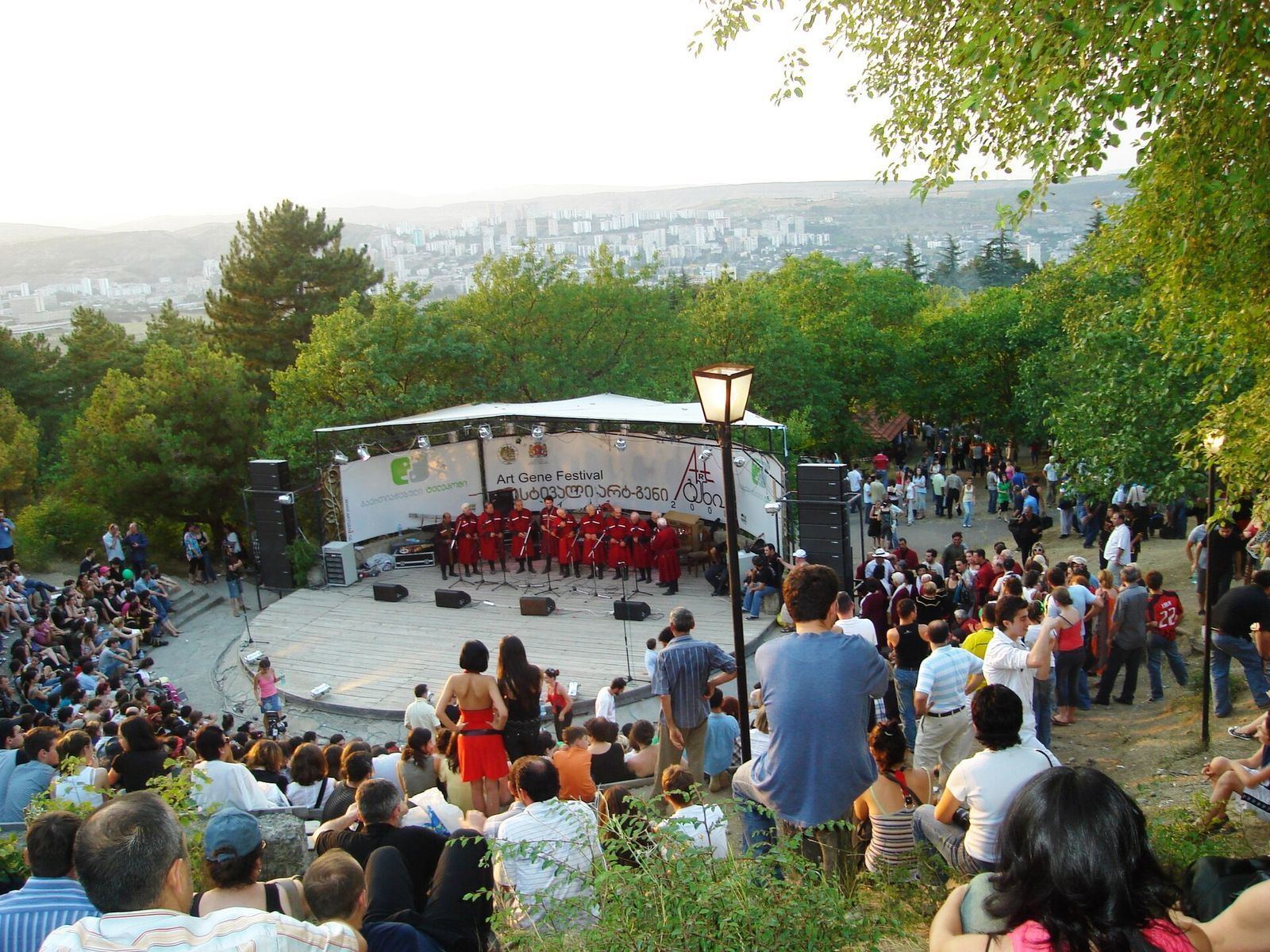
Georgian Culture and Traditions: A Visitor's Guide to Customs, Feasts, Faith and Song
Georgian culture is known for feasts, wine and song. Here's what visitors should know about its customs and traditions.
Read the guide
Basic Georgian Phrases for Travelers, with Pronunciation
Georgian has its own alphabet and a hello that means victory. Here are the phrases to learn and how to say them.
Read the guide
A Short History of Georgia and Tbilisi, From the Falcon Legend to Today
Tbilisi has been burned and rebuilt for 1,500 years. Here is Georgia's story in short, and where to see it today.
Read the guide