Soviet Architecture in Tbilisi: 18 Buildings and Where to Find Them
Tbilisi is known for its Soviet architecture: Stalin-era arcades on Rustaveli Avenue, a bank headquarters built like a stack of concrete beams, and metal bridges strung between apartment towers 14 floors up. Here's what you need to know about the styles, the 18 buildings I'd go out of my way for, which ones you can actually walk into, and how to see the best of them in a single day.
Soviet architecture styles in Tbilisi
Georgia spent 70 years inside the USSR, from the Red Army's arrival in 1921 to independence in 1991, and every decade left a layer on the city. What makes Tbilisi different from most former Soviet capitals is how far its architects pushed the later styles. Moscow set the rules, but Georgian designers bent them into buildings that look like nothing else in the old Union.
You don't need the theory to enjoy them, but knowing the five broad styles helps you date a building at a glance.
| Style | Years | What it looks like | Where to see it in Tbilisi |
|---|---|---|---|
| Stalinist | 1930s to 1950s | Stone fronts, columns, arcades, spires | Parliament, Biltmore Hotel, Academy of Sciences |
| Khrushchev era | 1950s to 1960s | Plain 4 to 5 floor panel blocks, no elevators | Kavtaradze Street in Saburtalo, Gldani |
| Soviet Modernism | 1960s to 1980s | Bold engineering, domes, glass, mosaics | Sports Palace, Chess Palace, metro stations |
| Brutalism | 1970s to 1980s | Raw concrete, cantilevers, sculptural blocks | Bank of Georgia building, Archaeological Museum, Skybridge |
| Mass housing | 1960s to 1980s | Whole microdistricts of high-rise towers | Saburtalo, Gldani, Varketili, Vazisubani |
Stalinist buildings wanted to impress, and they borrowed from classical palaces to do it. Khrushchev reversed course and built cheap, fast and identical, to get families out of shared flats. The brutalist and modernist decades are the ones people fly in for: raw concrete, buildings lifted off the ground, and engineering that seems to dare gravity. Most of Tbilisi's famous Soviet landmarks date from the 1970s and 1980s.
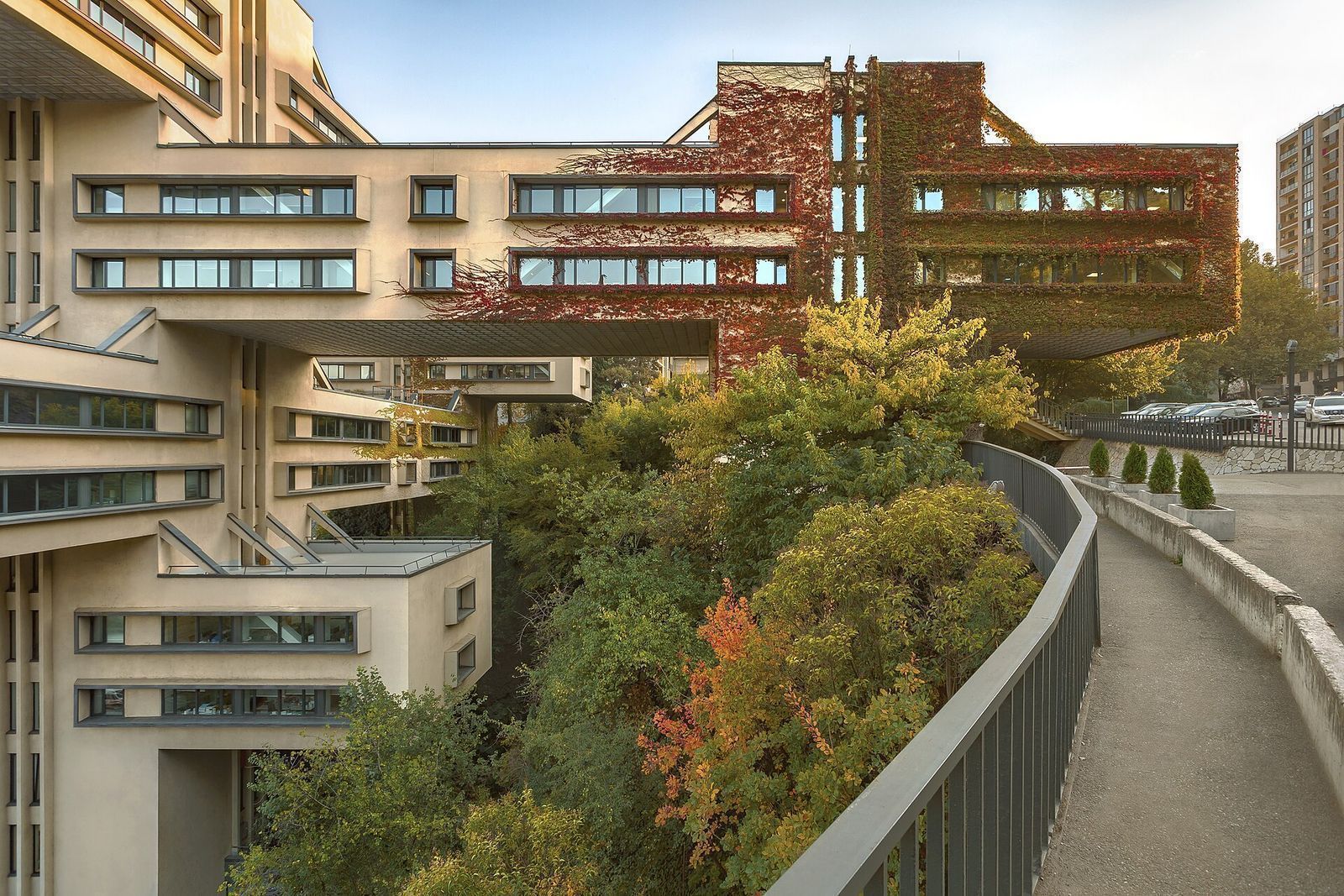
The Bank of Georgia building (the former Ministry of Highways)
This is the building on every poster, and it deserves it. It was built for the Ministry of Highway Construction of the Georgian SSR, designed in 1975 by Giorgi Chakhava and Zurab Jalaghania, and it looks like nothing that should stand up: long blocks of raw concrete stacked crosswise, each one cantilevered out from three core pillars, climbing a steep slope. Chakhava was also the deputy minister who commissioned it, which is about as close as Soviet planning came to an architect hiring himself.
The idea behind it was Chakhava's "Space City": buildings that rise up and leave the ground underneath free for trees and people. You can see the influence of Japanese Metabolism, the 1960s movement of modular, stacked megastructures, and on a summer day the green slope running under the cantilevers is the best proof that the idea worked. The Bank of Georgia bought it in 2007 and has run its headquarters from it ever since.
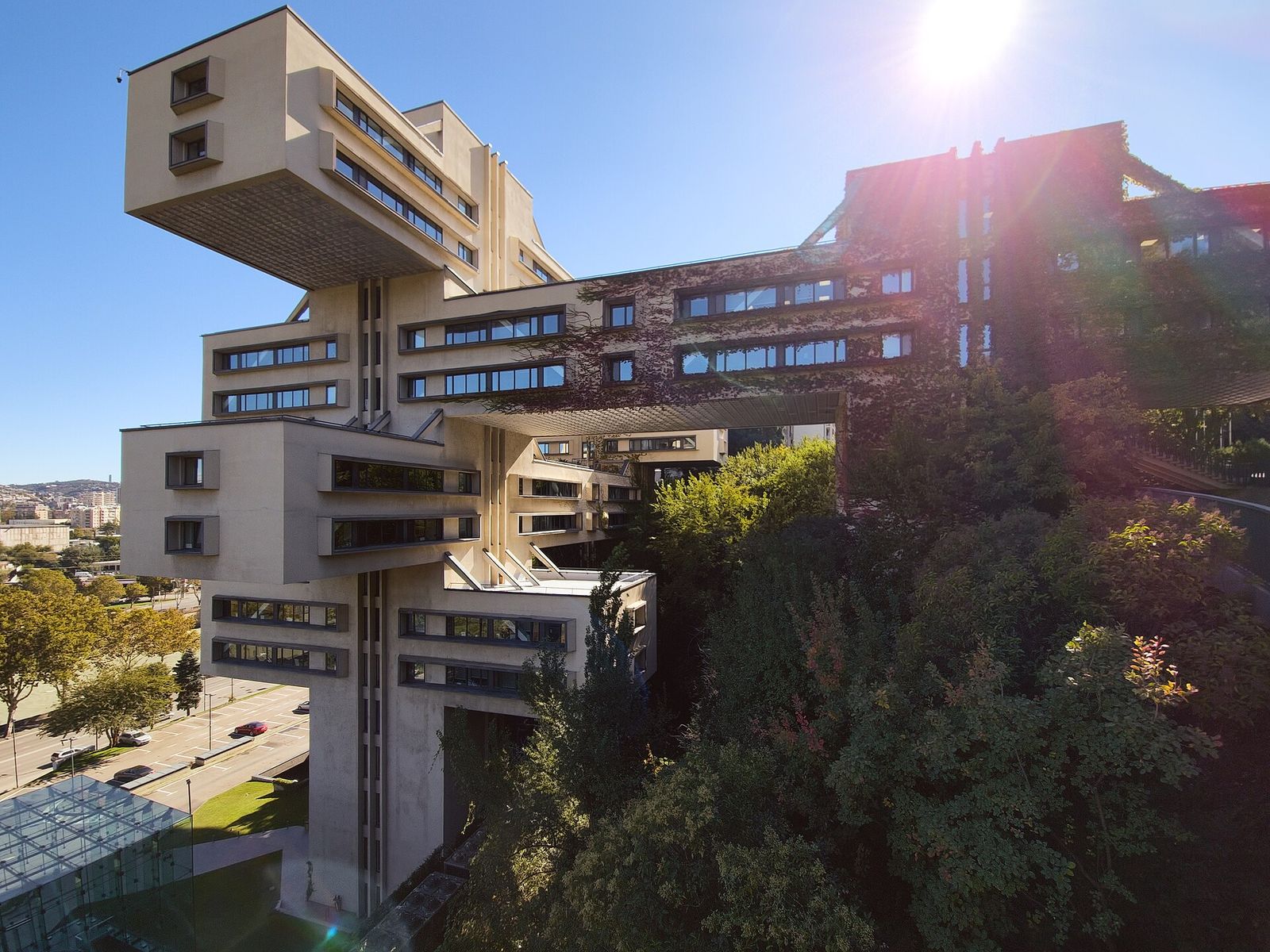
It's a working bank headquarters, so this is an outside-only visit. That suits it fine, because the building makes most sense from a distance, where you can read the crossing blocks as a single shape. My favorite view is from across the Kura river, and my favorite time is after dark, when the building is lit and the cantilevers seem to float.
Stalinist Tbilisi on Rustaveli Avenue
If brutalism is the Soviet era at its boldest, Rustaveli Avenue is the Soviet era at its most formal. Four of the city's best Stalin-era buildings stand within a 15-minute walk of each other here, between Rustaveli and Liberty Square metro stations, and you can see all of them on the way to somewhere else.
The Parliament building
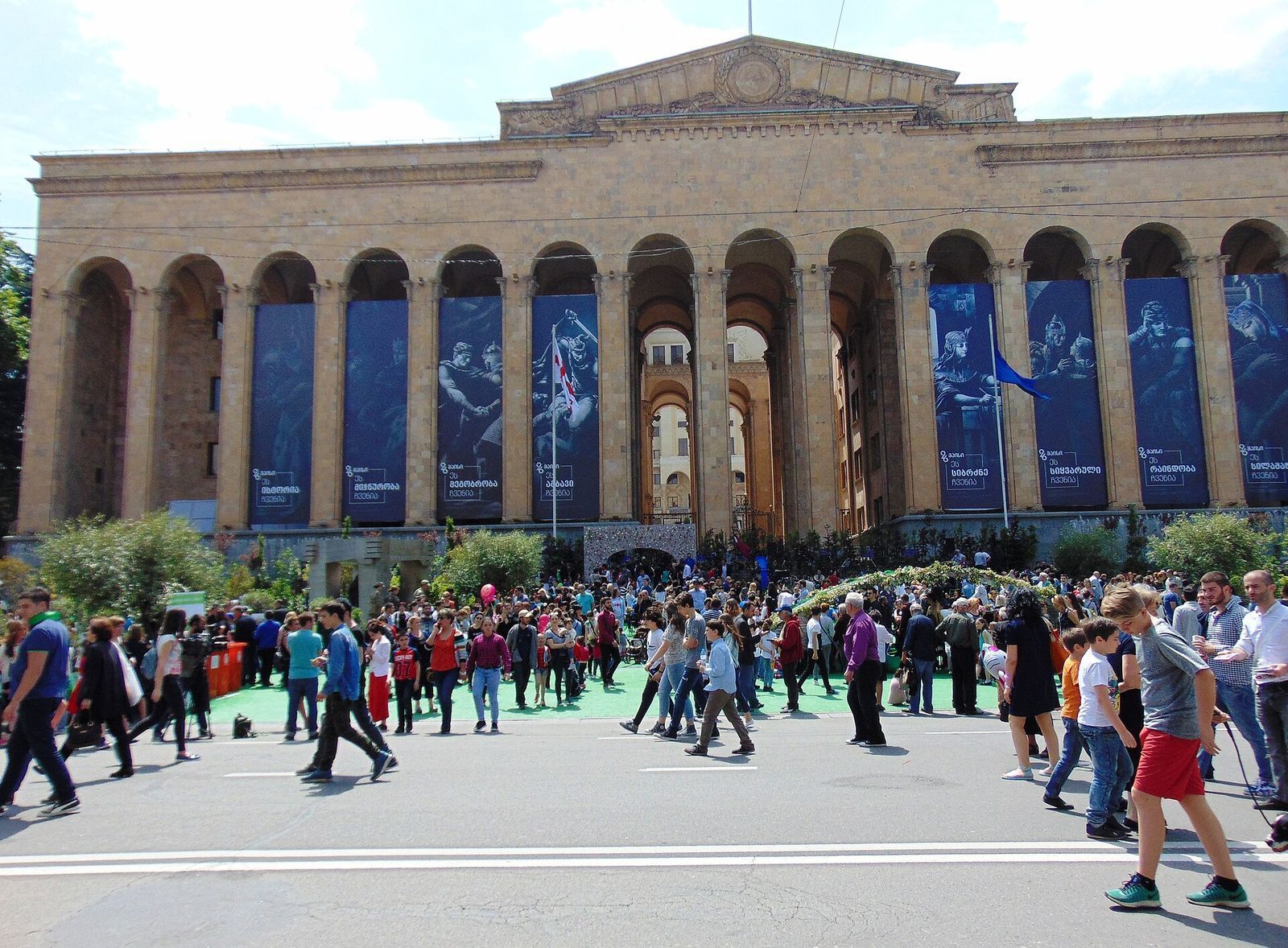
The arcaded stone building at the heart of the avenue went up in two phases between 1933 and 1953, designed by Viktor Kokorin and Giorgi Lezhava for the Supreme Soviet of the Georgian SSR. After independence the hammers, sickles and other communist symbols came off the facade, but the shape is pure Stalinist civic architecture: a long colonnade, heavy stone and steps built for parades.
It's also the building where the end of Soviet Georgia started. On 9 April 1989, Soviet troops broke up a peaceful protest on the avenue in front of it and at least 19 people died, a turning point in Georgia's road to independence.
The Biltmore Hotel (the former IMELI)
The Biltmore is my favorite Soviet story in the city. The colonnaded building was designed by Alexey Shchusev, the architect of Lenin's Mausoleum, and built from 1934 to 1938 for the Marx-Engels-Lenin Institute. Its front is about 81 m wide with columns 17 m tall, pure Stalinist theater, while the back is plainer Constructivist work.
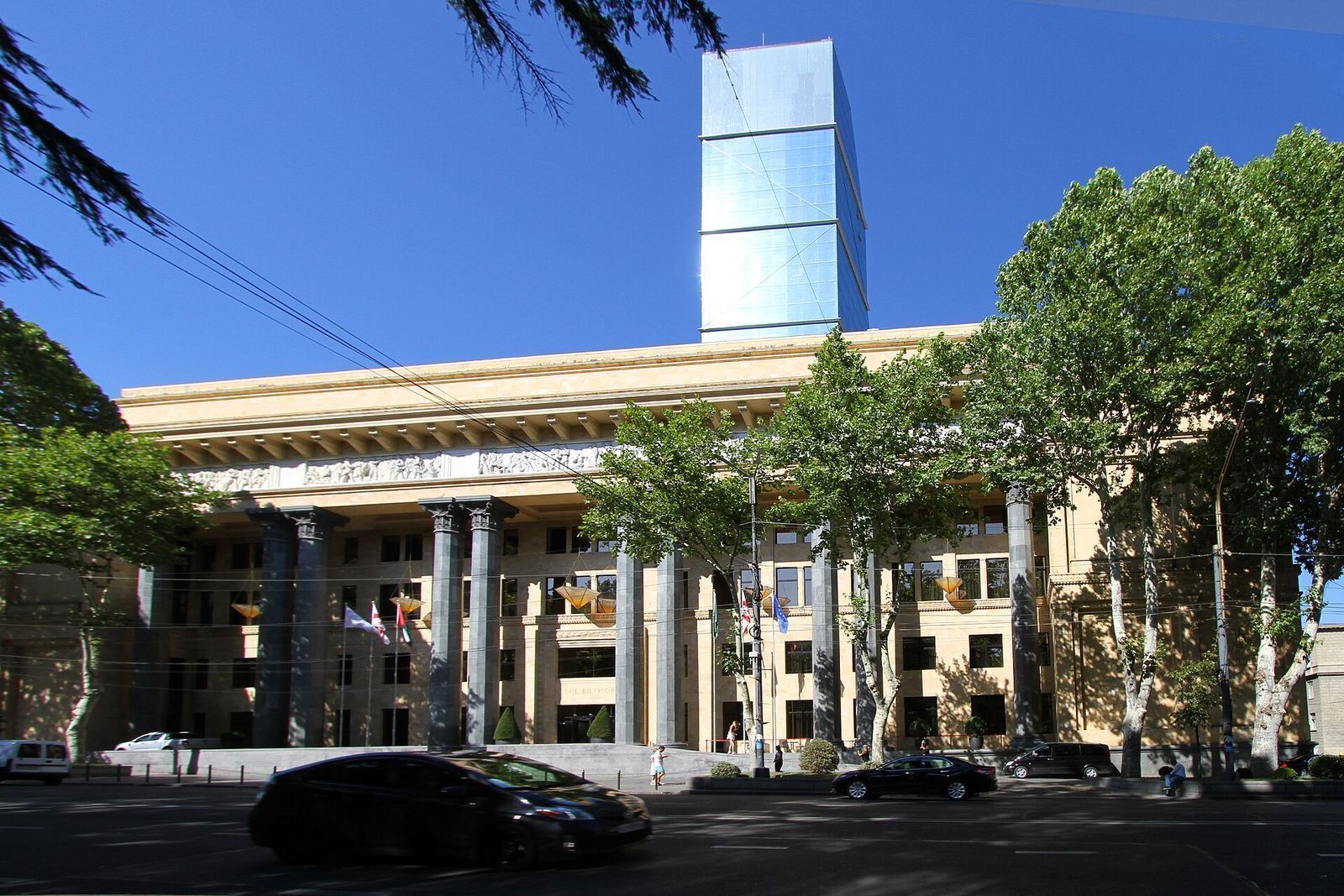
The building served as Georgia's Parliament from 1992 to 1995. When it was renovated into a hotel, which opened in 2016, the builders found Stalin-era prison cells and old gravestones reused in the walls. A modern glass tower now rises behind it, so stand across the avenue to see the original front on its own.
The Academy of Sciences
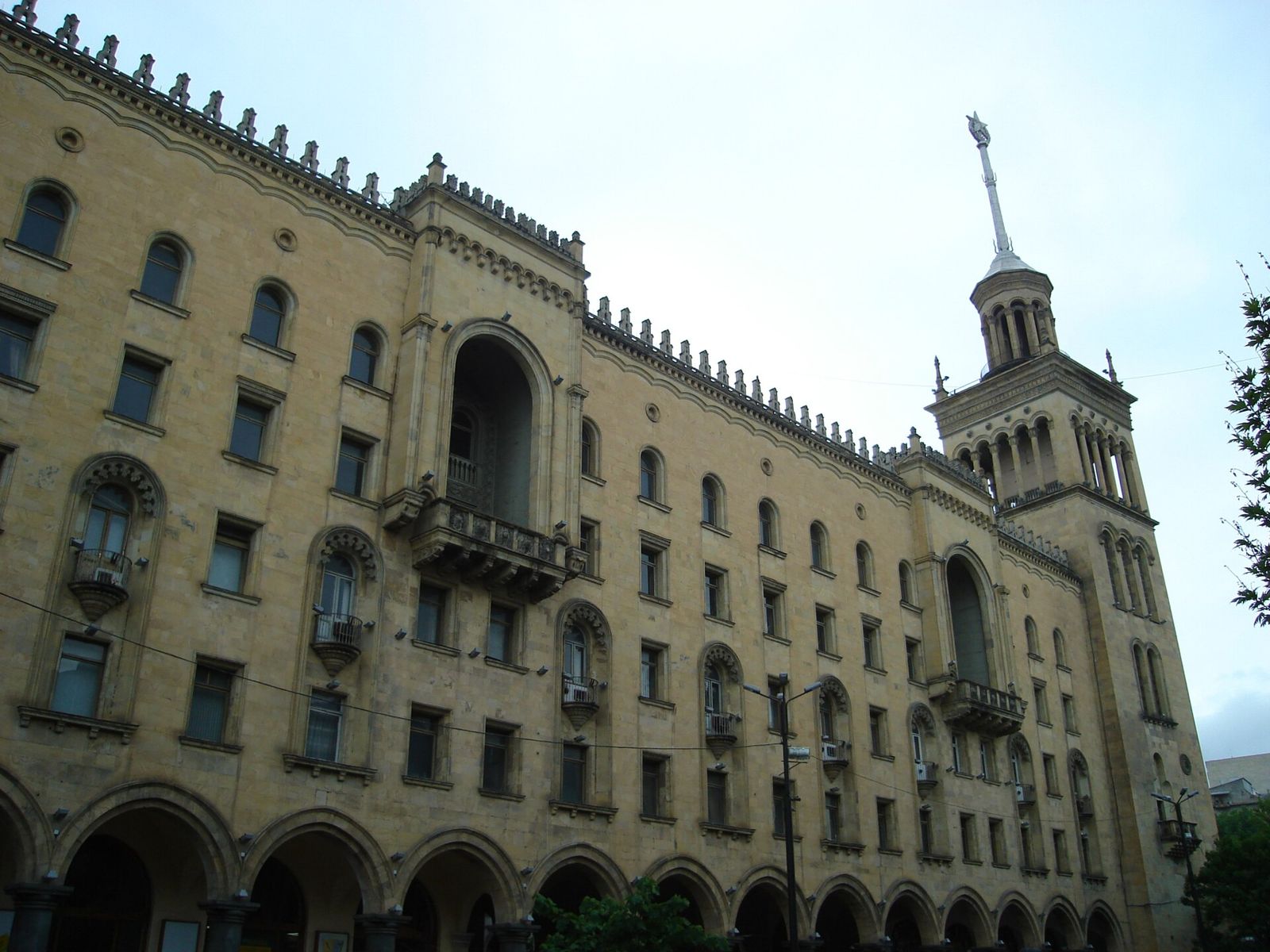
A few minutes up the avenue, the Georgian Academy of Sciences was begun in 1949, mostly finished by 1953 and completed in the 1960s. It's five floors of Bolnisi tuff, a soft pinkish volcanic stone, with an arcade that opens into a courtyard. Its 55 m spire once carried a Soviet star. Walk through the arcade rather than past it: the courtyard behind is where the next building hides.
The Rustaveli to Mtatsminda cable car station
In the Academy's backyard sits the lower station of the Rustaveli to Mtatsminda cable car, built in 1959 for the city's 1,500th anniversary. It's an oval tower with tall glazed arches and two spiral walkways, closer to a 1950s exhibition pavilion than a transport stop. The line closed after an accident on 1 June 1990 that killed 19 people, and the station sat empty for decades until a two-year restoration finished in 2024.
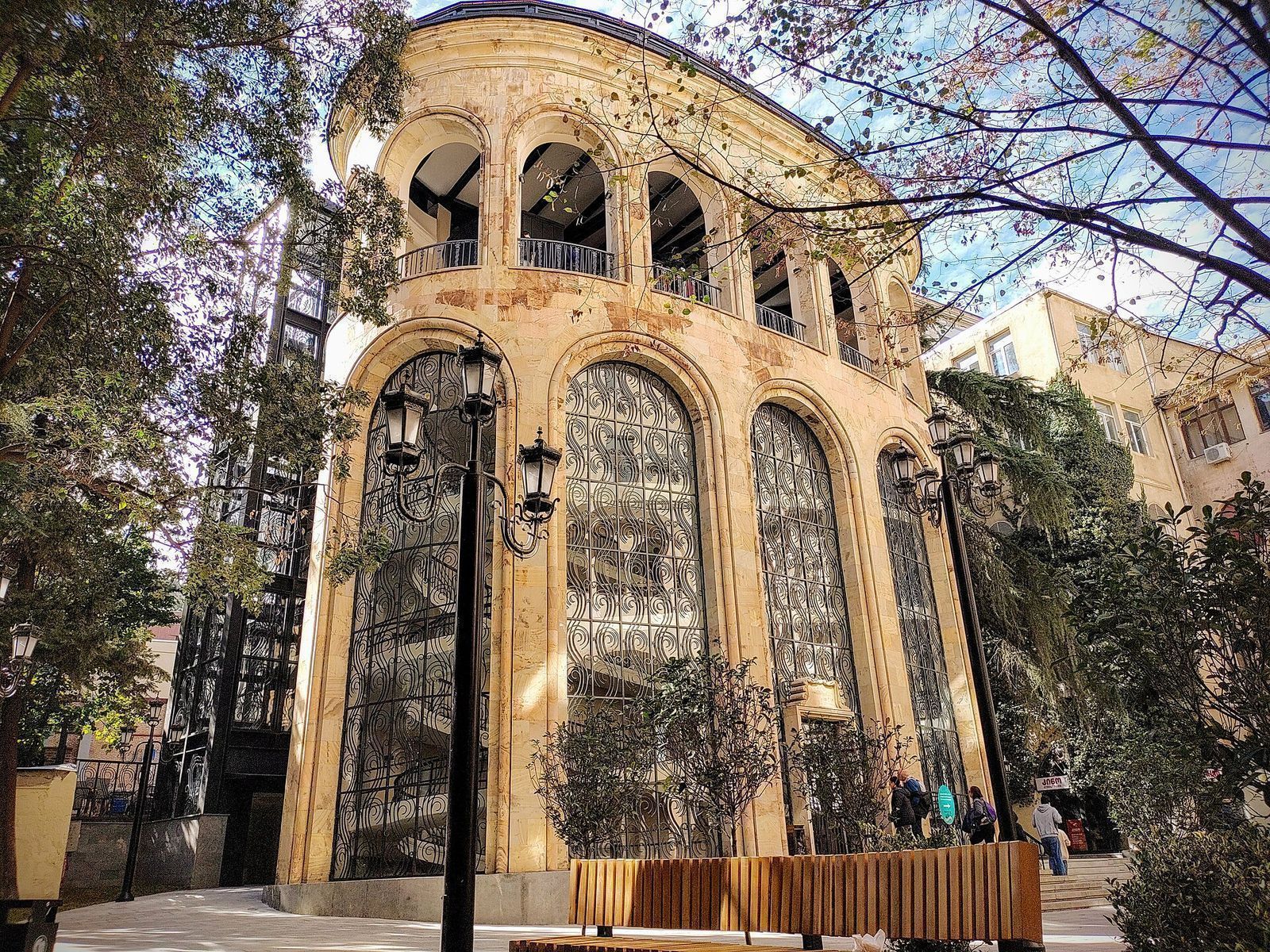
The cabins run again, about 4 minutes up to Mtatsminda Park, for 12 GEL one way for visitors. Even if you don't ride, step inside the station to see the restored hall.
Saburtalo: the Skybridge, the Sports Palace and the dormitory towers
Saburtalo is where Soviet Tbilisi lived and studied, and it holds more good buildings per block than anywhere else in the city. Start at State University metro and everything below is a walk, a bus or a short taxi ride away.
The Nutsubidze Skybridge
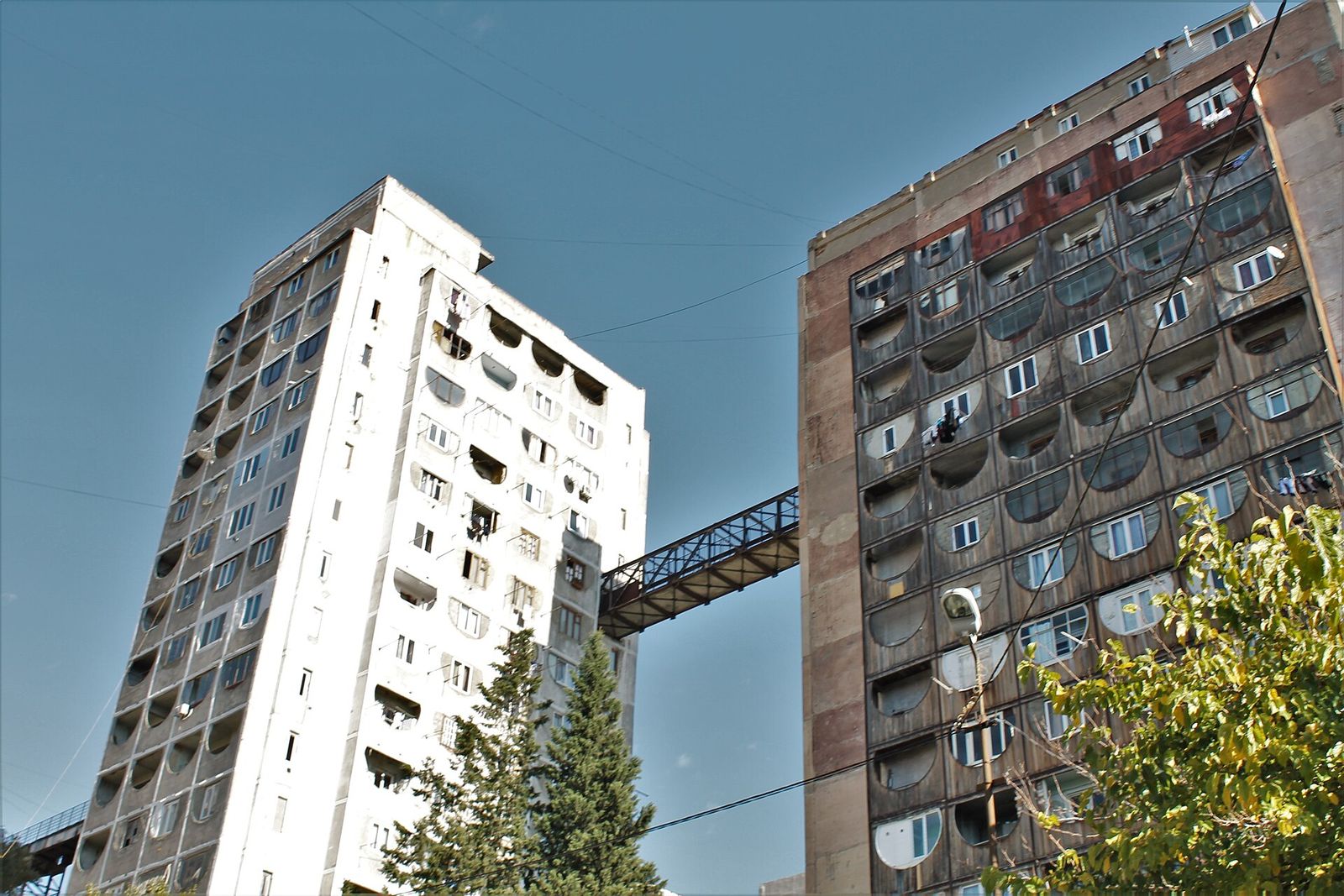
Three apartment towers on the Nutsubidze Plateau, joined high up by metal bridges: that's the Skybridge, built from 1974 to 1976 and designed by Otar Kalandarishvili and Gizo Potskhishvili. The idea came from Shatili, a mountain village in northeast Georgia where the houses are stacked into one another and joined by passages. Here the bridges save residents a long walk around the hillside, and locals still use them as a shortcut.
It's about a 10-minute walk from State University metro, behind the police station on Nutsubidze Street. This is the one Soviet icon in Tbilisi you use rather than look at: you ride up, cross the bridge and look down over Saburtalo from 14 floors up.
The Tbilisi Sports Palace
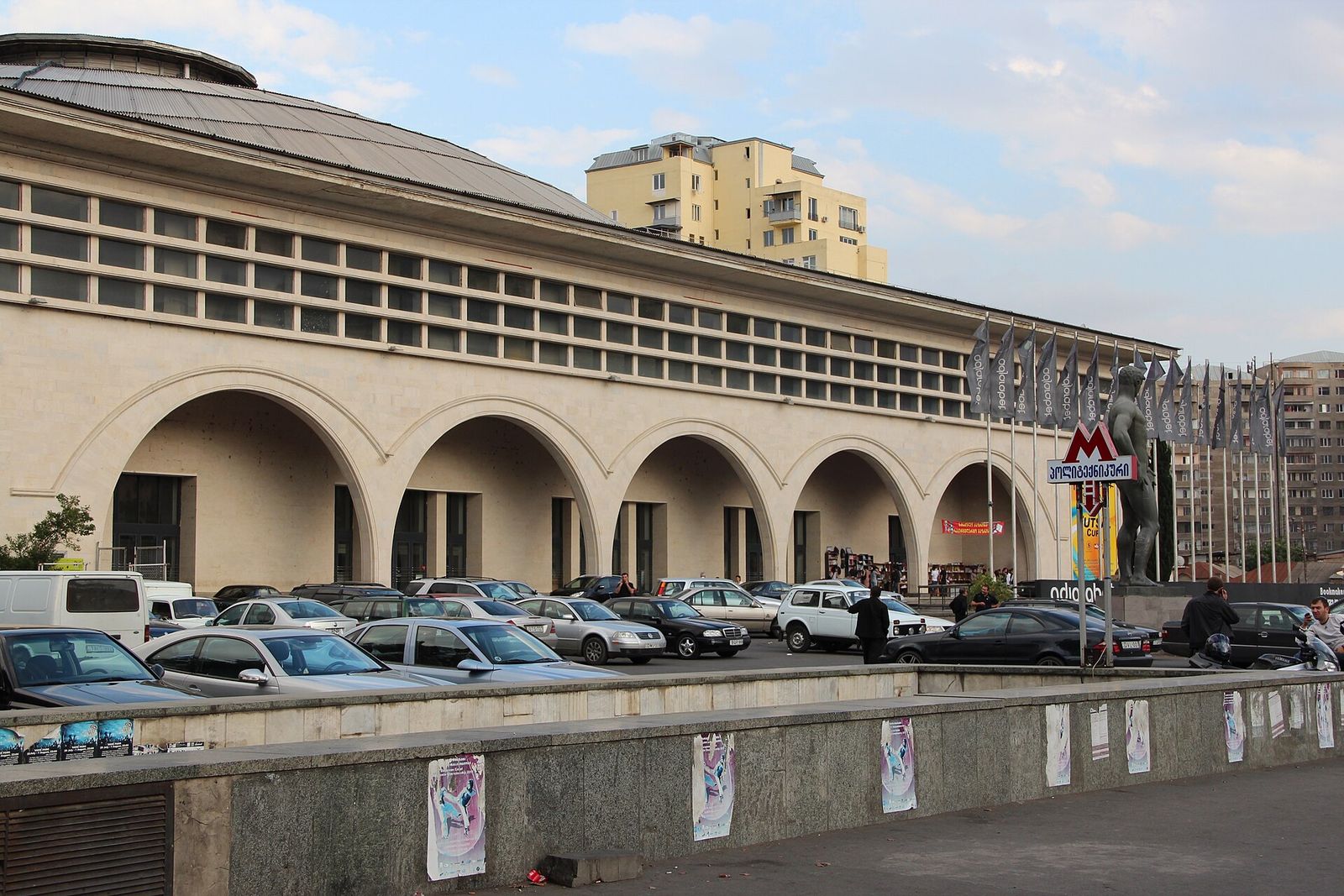
Opened in 1961 and designed by Lado Aleksi-Meskhishvili and Yuri Kasradze, the Sports Palace is a concrete dome 76 m across that covers about 11,000 seats without a single column. It's still the home of Dinamo Tbilisi basketball and a regular concert venue, so a game night is the easy way to see the inside, and it's the best piece of 1960s engineering in the city.
The Georgian Technical University
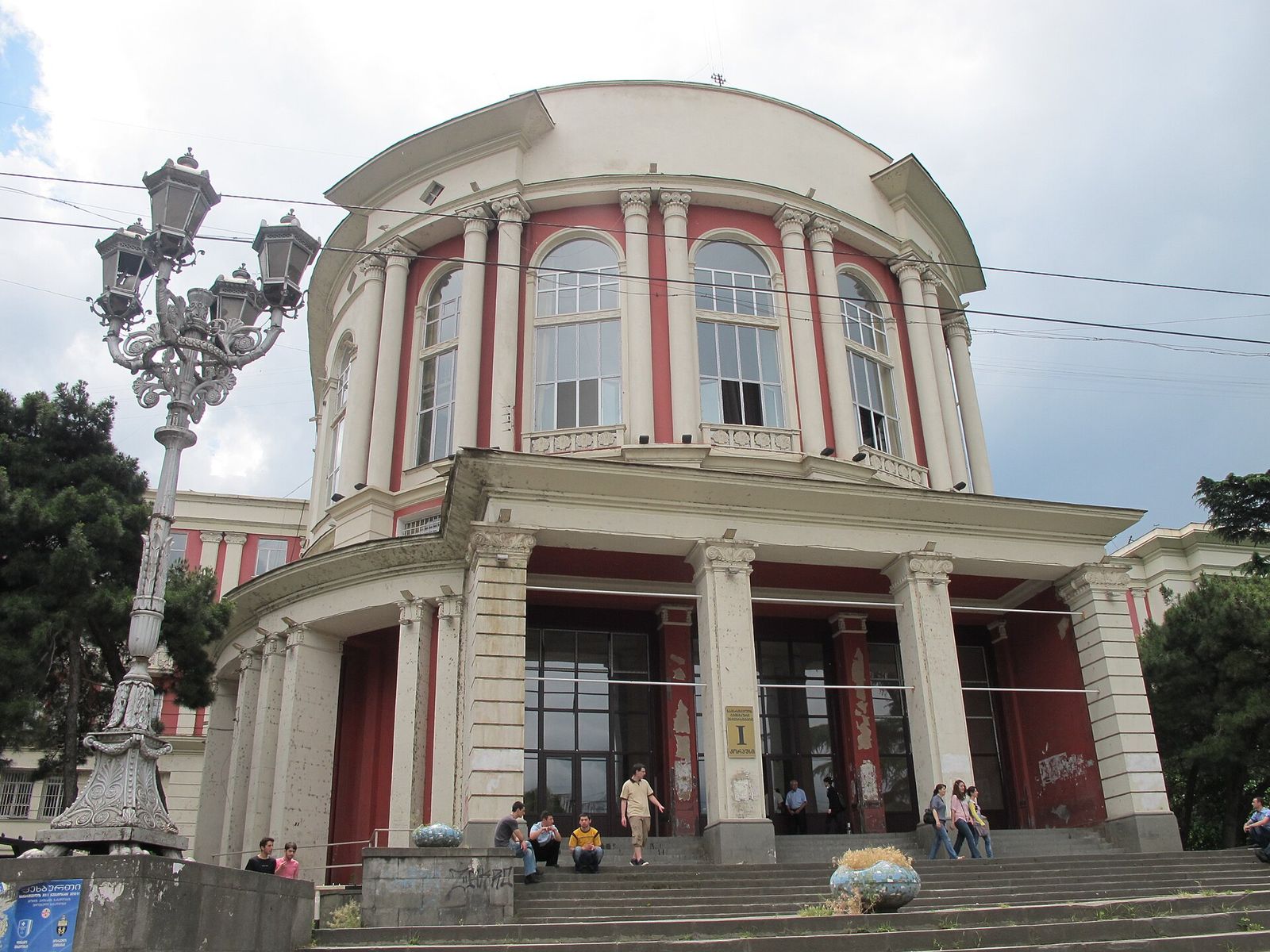
Across from the Sports Palace, the Georgian Technical University's Building 1, the old Polytechnic Institute, turns its corner with a red-and-white Stalinist rotunda: tall arched windows, paired columns and a heavy portico over the main steps. Behind it, plainer concrete wings run back into the campus, and they reward a slow walk around the outside. The story goes that the plan, seen from above, forms a hammer and sickle. You can't check that from the ground, but the rotunda alone is reason enough to stop.
The Bagebi student dormitory and its cable car
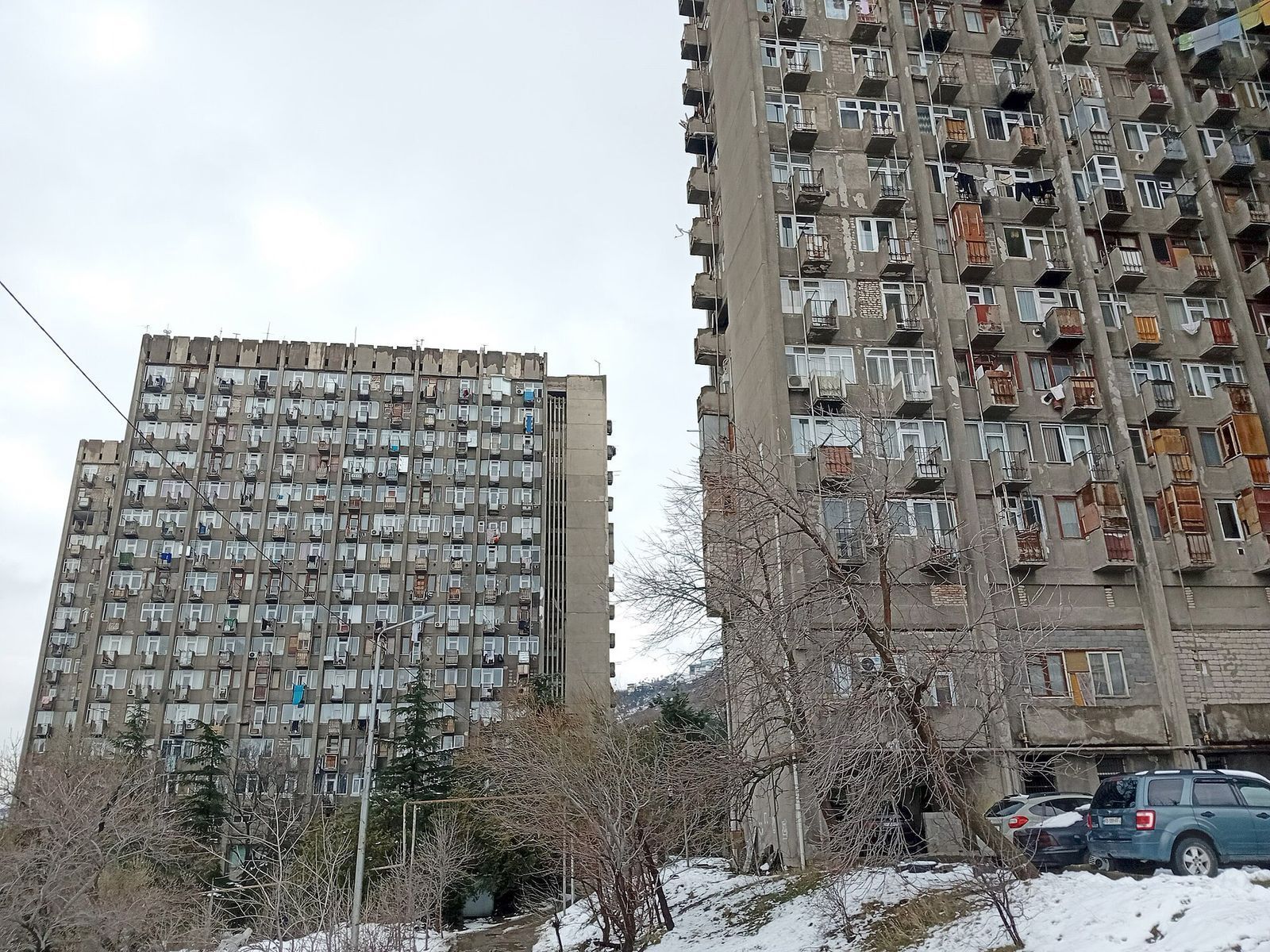
The Bagebi dormitory, in the Maglivi area at the edge of the city, was built in the 1970s for Tbilisi State University students: two tall, thin towers with cube balconies stepping out of the facade. Families displaced from Abkhazia have lived here since the 1990s, and the cube balconies are full of their laundry and plants.
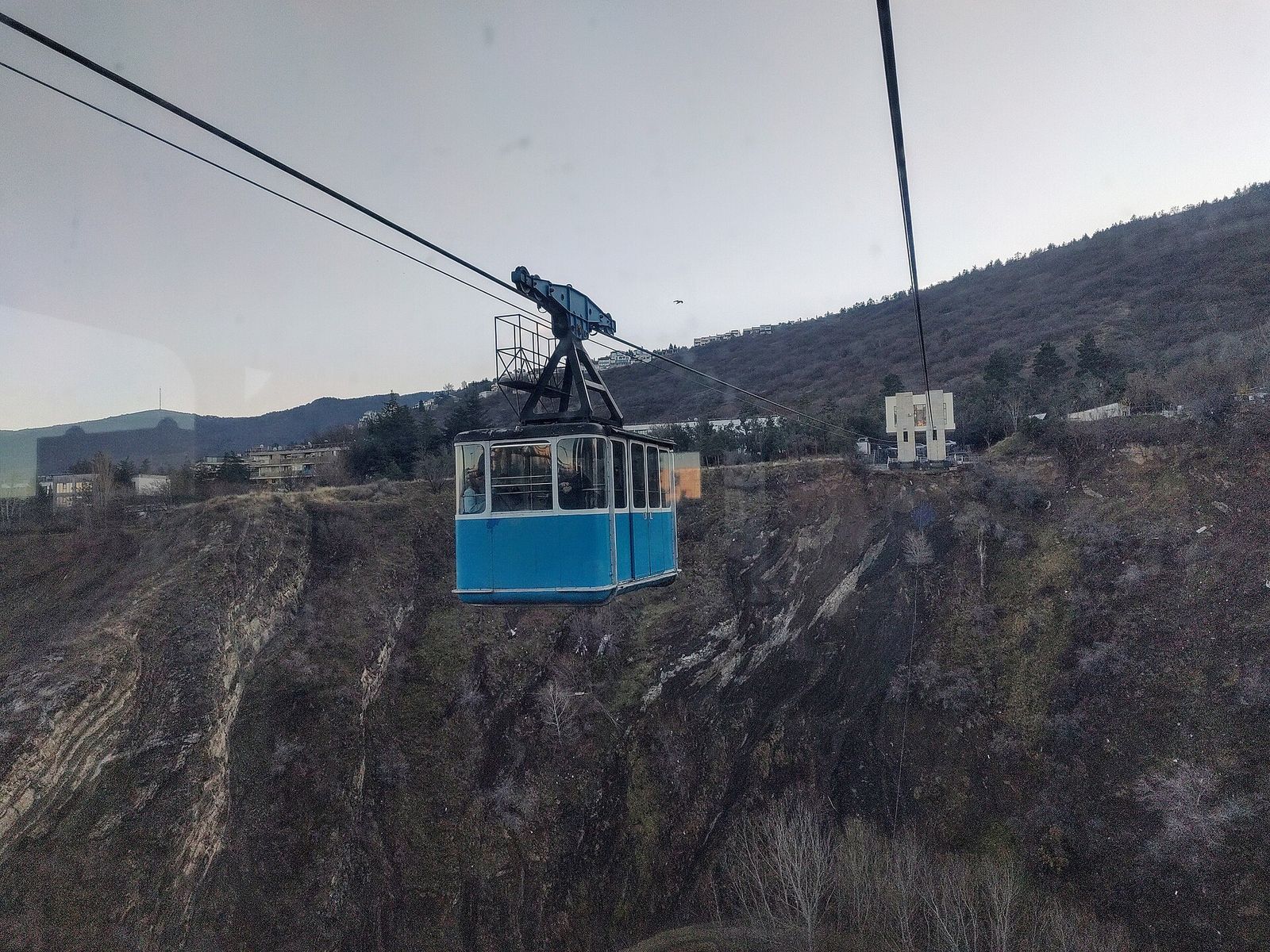
The fun part is getting there. From State University metro, take a bus or walk to the cable car, then ride over the Vere valley for 1 GEL, paid by Metromoney, a travel card or a bank card. It's the short local line among the city's cable cars, and the ride is half the reason to come.
Khrushchevkas and the Soviet apartment blocks
The Khrushchevka is the building most Georgians grew up in: a 4 to 5 floor block assembled from factory-made concrete panels, with no elevator, flats of up to 58 square meters and kitchens of about 5 square meters. A crew could put a block up in about 12 days. The oldest ones in Tbilisi line Kavtaradze Street in Saburtalo, and Gldani has whole streets of them.
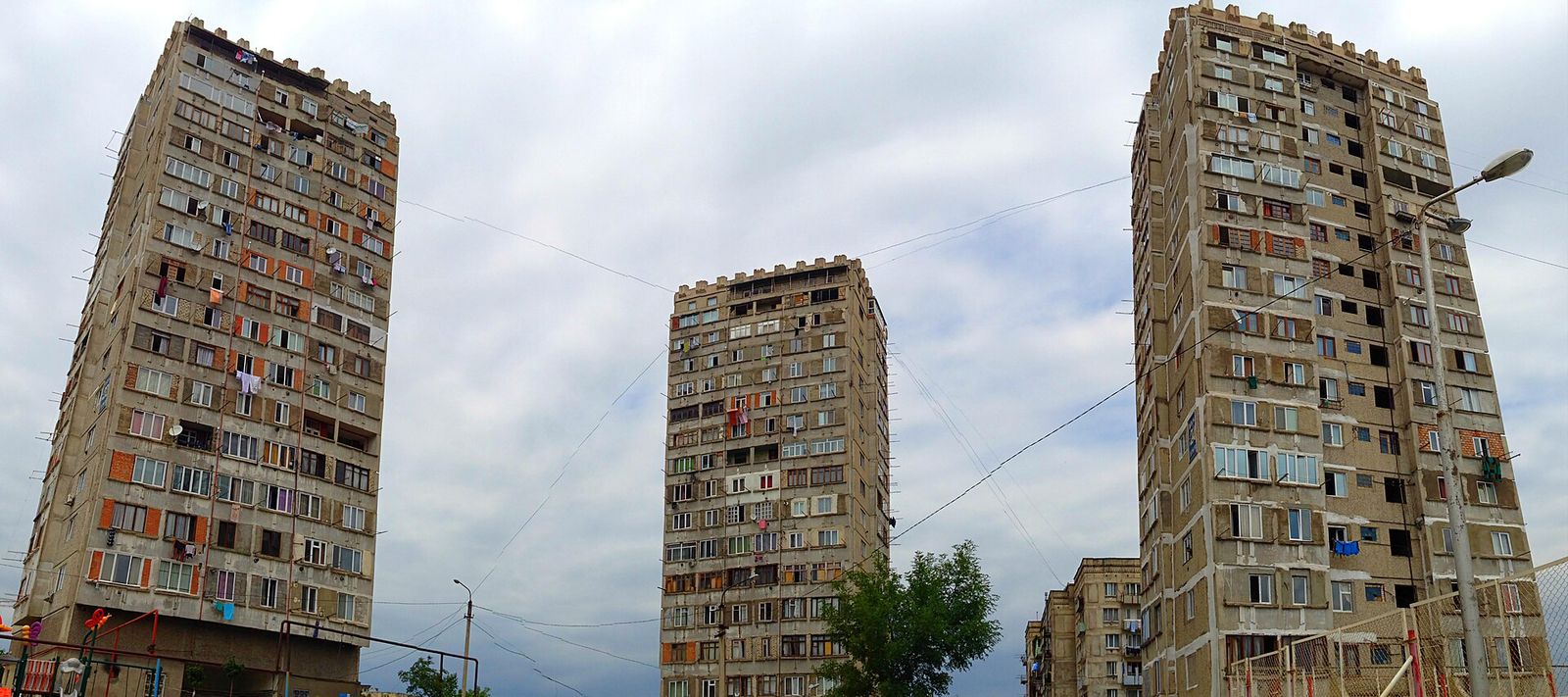
From the 1960s to the 1980s the city grew in microdistricts of taller towers: Saburtalo, Avlabari, Ortachala, Varketili, Vazisubani, Gldani and the Nutsubidze Plateau. Look for the closed-in balconies, the extensions bolted onto the facades and the ground-floor shops cut into the blocks. For an older layer, the Stalin-era apartment blocks on Paliashvili Street in Vake show the grander, stone-fronted housing of a generation earlier.
North Tbilisi: the Archaeological Museum, the Chronicles and Arashenda
The north of the city holds three of the most photographed Soviet sites, and they sit close enough to see in one taxi loop.
The Archaeological Museum
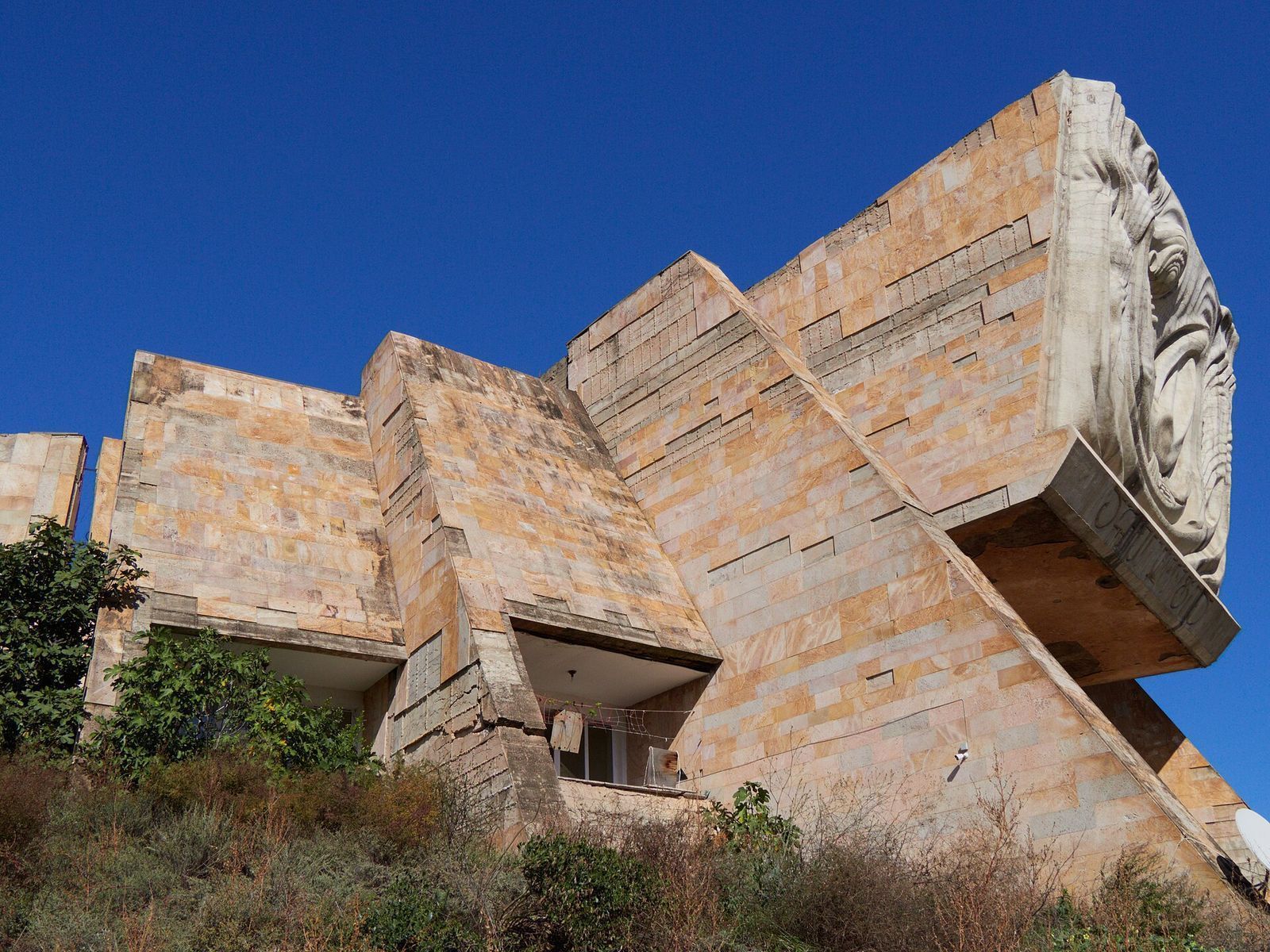
On a hill in Dighomi, near Didube metro, the Archaeological Museum (1988, by Shota Kavlashvili and Shota Bostanashvili) is a round building shaped like a burial mound, wrapped in a long bas-relief by Tengiz Kikalishvili. It's one of the late Soviet era's strangest and best buildings, half monument, half museum, and the relief is worth walking the whole way around.
The Chronicles of Georgia
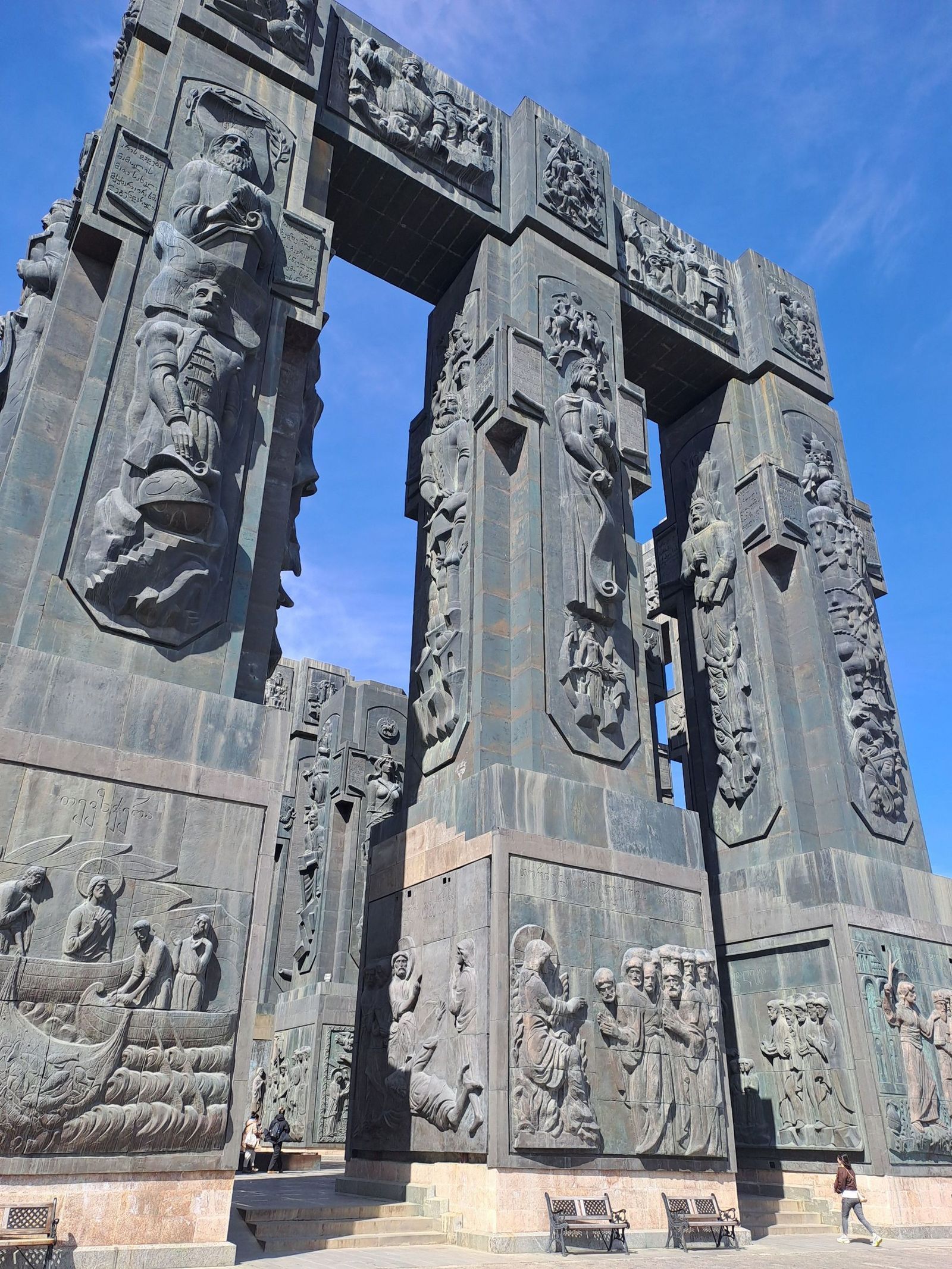
Above the Tbilisi Sea, the Chronicles of Georgia is Zurab Tsereteli's unfinished 1980s monument: 16 pillars, 30 to 35 m tall, faced with bronze reliefs of Georgian kings and queens and scenes from the Bible. It's free, open at all hours and about 20 minutes by car from the center, around 10 to 16 GEL each way in an app taxi. Come before sunset, when the bronze turns warm and the view runs over the reservoir.
The Arashenda building
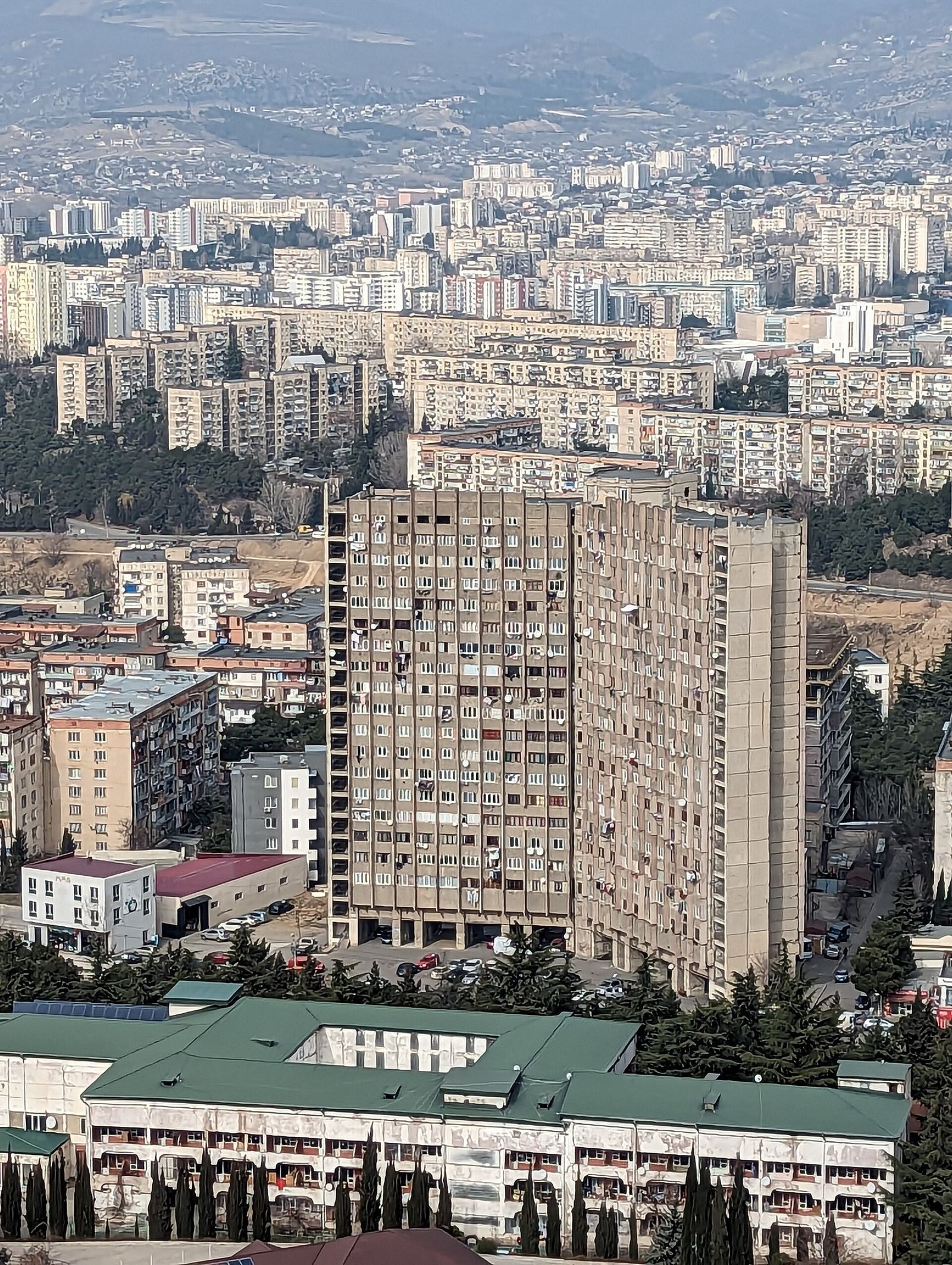
Close to the Chronicles stands the Arashenda building, begun in 1982 as the Hotel Odishi and designed by Dimitri Odisharia and Medea Edzgveradze to look like an open book. It was never finished, which is where the nickname comes from: "arashenda" means roughly "never built". Families displaced from Abkhazia live in it now. The view of the Chronicles from the 17th floor is famous, but this is people's home, so if you go up, go quietly.
Expo Georgia
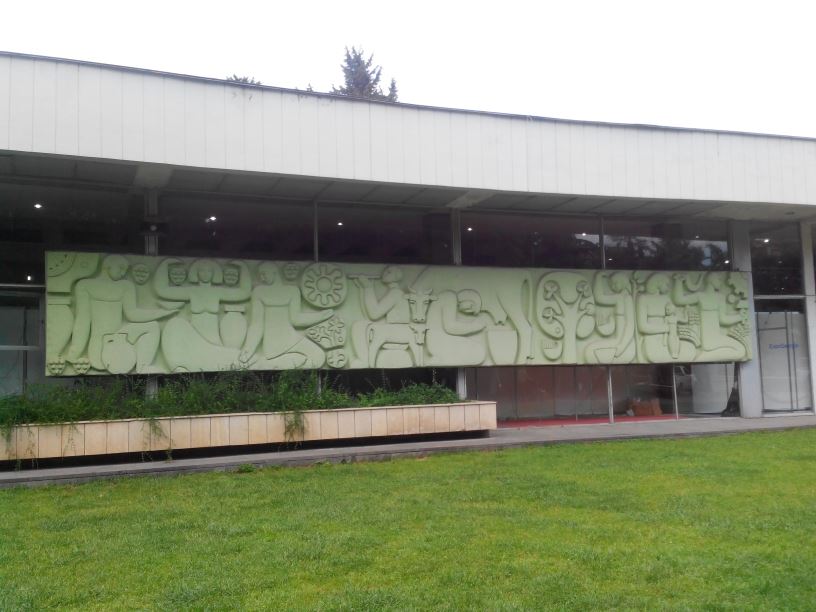
Expo Georgia is the city's Soviet exhibition grounds, laid out in the 1960s in the style of Moscow's VDNKh: 15.3 hectares with 11 halls, an orangery, fountains and mosaics. Look for the long relief on the gallery pavilion, a frieze of farm workers, cattle, grapes and a hammer and sickle. It's busiest during the Tbilisi Book Festival and the wine fairs, and that's the time to go, because you see the halls in use with the grounds open.
The Palace of Rituals in Ortachala
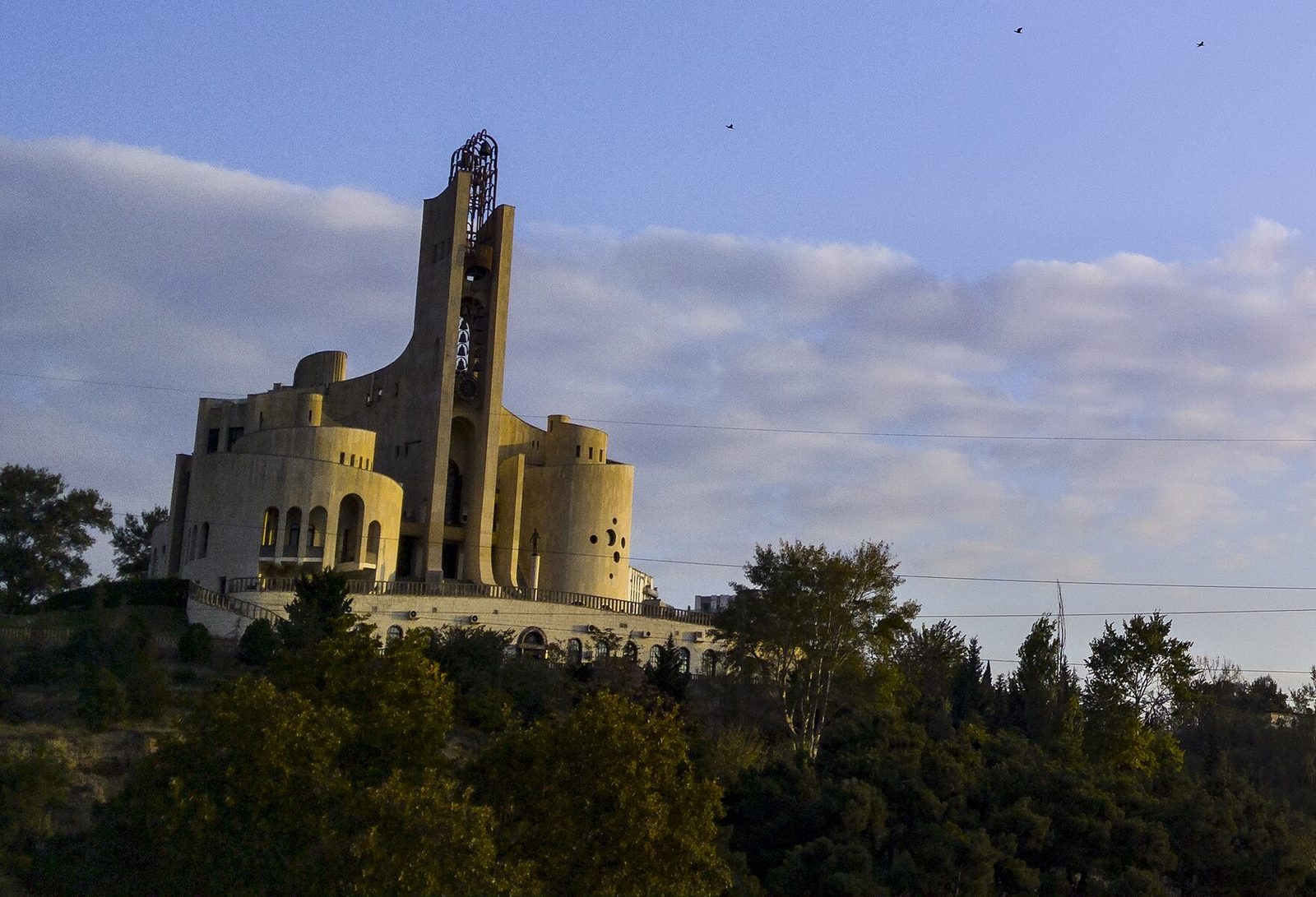
The Palace of Rituals, also called the Wedding Palace, sits on a hill above Ortachala in the southeast of the city. Victor Jorbenadze and Vazha Orbeladze designed it as a place for Soviet weddings; it was commissioned in 1979 and finished in 1985. Its curving towers and swelling roofline are wildly un-Soviet, and the story goes that the plan echoes the female reproductive system, a detail local guides love to share.
In 2002 the businessman Badri Patarkatsishvili bought it, and it has been a private residence ever since. His family occasionally opens it for tours, and some Soviet-themed tours add it as an optional stop. Outside those, you see it from the road below, where the towers stack up against the sky.
Metro stations, Soviet mosaics and a bunker
The Tbilisi metro opened in 1966, the fourth in the USSR, and it's the cheapest Soviet architecture tour in the city at 1 GEL a ride. It runs 2 lines, 27.3 km and 23 stations, many of them very deep, with long escalators into halls of stone, bronze and mosaic. The stations I'd ride to for the architecture alone are 300 Aragveli, Technical University, Grmagele and Station Square.
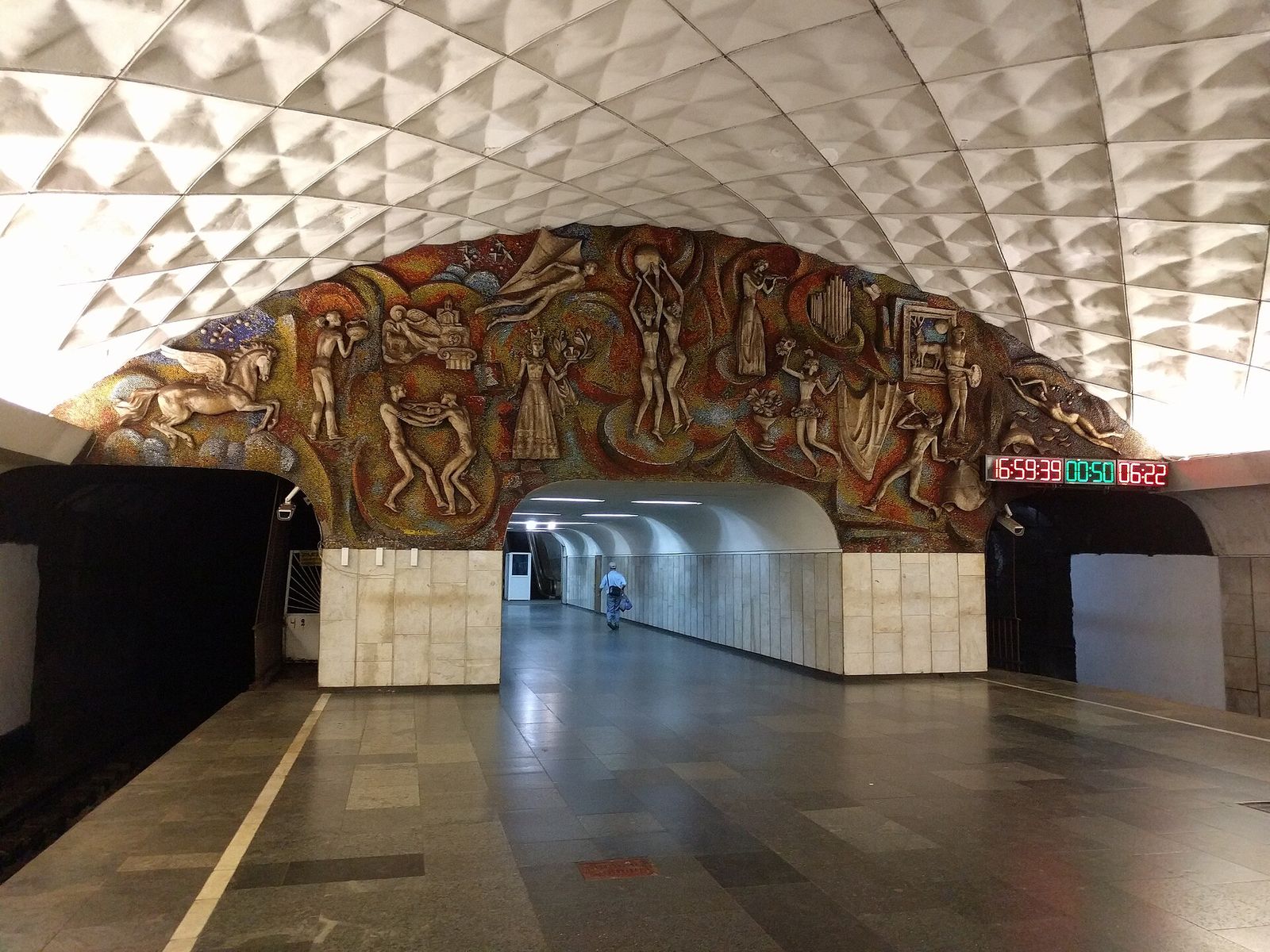
Soviet mosaics are the easiest part of this heritage to stumble on. They cover the sides of apartment blocks, metro stations, schools and old factories across the city, showing science, space flight, industry and Georgian folk motifs, often side by side. Keep your eyes on the facades of the housing blocks as you ride through the outer districts.
Below ground there's a stranger layer still. Tbilisi has an estimated 482 Soviet bunkers, and one in Nadzaladevi opened legally to the public a few years ago. The only way in is a guided bunker tour, and it's the one Soviet site in this guide I wouldn't try to see on my own.
The Chess Palace and the Scientific Technical Library
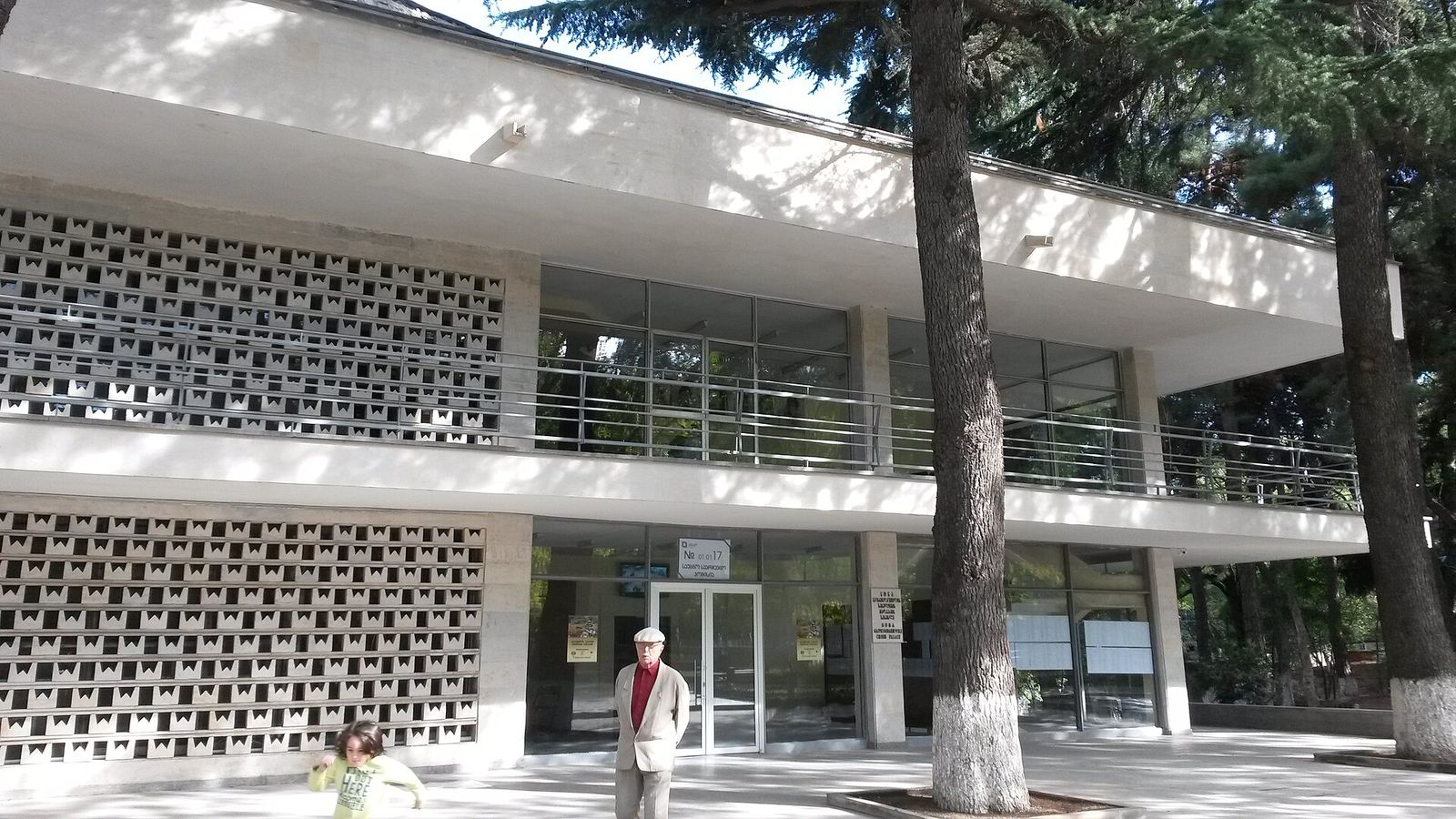
Two more buildings round out the list for anyone who wants the full set. The Chess Palace in Vere Park opened in 1973 and is named for Nona Gaprindashvili, the Georgian women's world chess champion; its 520-seat hall made it a home for tournaments. It became a protected heritage monument in 2019 and is under renovation, so for now it's a look from the park.
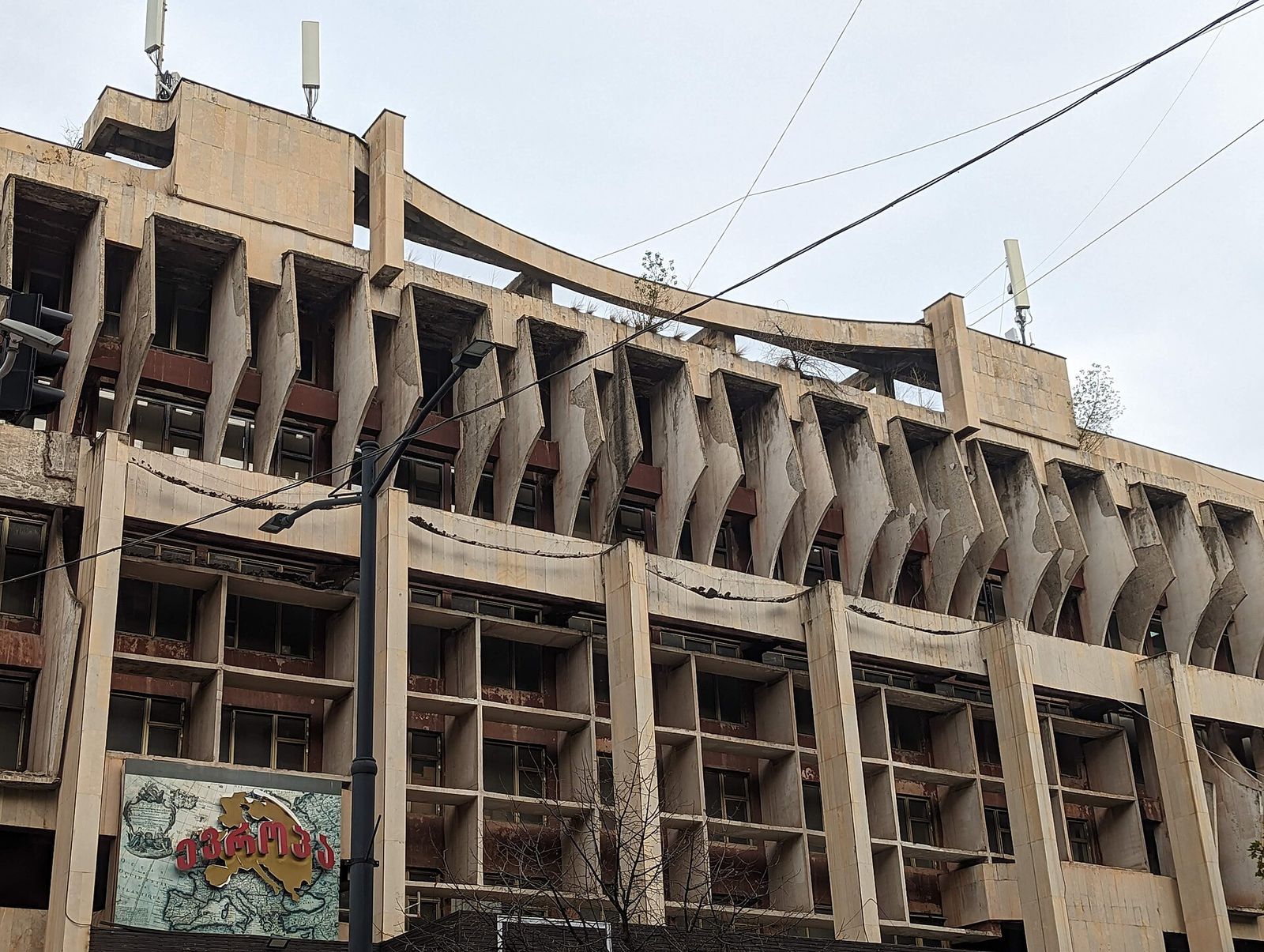
The former National Scientific Technical Library, designed by Georgiy Bichiashvili and finished in 1985, is a brutalist block of tall vertical concrete slabs. It's weathered and worn, and that's part of the appeal: this is what Tbilisi's late Soviet concrete looks like without a bank's restoration budget behind it.
Which Soviet buildings can you go inside?
Most of Tbilisi's Soviet architecture is an outside visit. This is how the 18 buildings in this guide stand in 2026.
| Building | Area | Go inside? | Cost |
|---|---|---|---|
| Bank of Georgia building | North, above the river | No, outside only | Free |
| Parliament | Rustaveli Avenue | No, outside only | Free |
| Biltmore Hotel | Rustaveli Avenue | As a hotel guest or diner | Hotel prices |
| Academy of Sciences | Rustaveli Avenue | The arcade and courtyard | Free |
| Rustaveli cable car station | Rustaveli Avenue | Yes, and ride the line | 12 GEL one way |
| Nutsubidze Skybridge | Saburtalo | Yes, by the elevator | 20 tetri |
| Sports Palace | Saburtalo | During games and concerts | Ticket price |
| Technical University | Saburtalo | Outside | Free |
| Bagebi dormitory | Bagebi | Outside, from the cable car | 1 GEL ride |
| Khrushchevkas and microdistricts | Saburtalo, Gldani | Outside | Free |
| Archaeological Museum | Dighomi | No, closed and sealed | Free |
| Chronicles of Georgia | Above the Tbilisi Sea | Yes, open 24 hours | Free |
| Arashenda building | Near the Chronicles | A residential building; go quietly | Free |
| Expo Georgia | North | During fairs and festivals | Event tickets |
| Palace of Rituals | Ortachala | Only on rare family or tour openings | Tour price |
| Metro stations | Citywide | Yes | 1 GEL a ride |
| Chess Palace | Vere Park | No, under renovation | Free |
| Scientific Technical Library | Off the main circuit | Outside | Free |
A DIY Soviet architecture day in Tbilisi
You can see the best of Soviet Tbilisi in one long day on your own, with the metro for the central stops and app taxis for the rest. I'd go in this order, which keeps the walking for the morning and leaves the Bank of Georgia building for after dark.
| Time | Area | Getting there | Buildings |
|---|---|---|---|
| Morning | Rustaveli Avenue | Metro to Liberty Square, walk to Rustaveli | Parliament, Biltmore, Academy of Sciences, cable car station |
| Late morning | Saburtalo | Metro to State University | Skybridge, then the Bagebi cable car and dormitory |
| Early afternoon | Saburtalo | Short taxi | Sports Palace and Technical University |
| Late afternoon | North | App taxi | Archaeological Museum, Chronicles of Georgia, Arashenda |
| Evening | North, by the river | App taxi | Bank of Georgia building, lit up |
The metro ride from Liberty Square to State University changes lines at Station Square and stops at Technical University, so two of the best stations come with the 1 GEL fare. For the northern loop, order a taxi in an app so the fare is fixed before you get in; street taxis out here charge whatever they like.
Soviet architecture tours
Guided tours exist for every taste. A 4-hour brutalist tour covers the Ministry of Highways, the Chronicles, the Skybridge, the Maglivi dormitory and a retro cable car. An urbex-style Soviet tour adds Stalin's underground printing house and an optional stop at the Palace of Rituals, and a separate tour runs the legal bunker in Nadzaladevi.
My rule: if you only care about the big names, a DIY day beats a tour, because nothing on the main circuit needs a key. If you want the backstories in depth, the underground sites and a driver for the far-flung stops, a guide is money well spent, and the wider list of tours in Tbilisi has walking, food and day-trip options that pair well with it.
Key takeaways
- The Bank of Georgia building, the former Ministry of Highway Construction designed in 1975, is Tbilisi's top Soviet sight; see it from outside, ideally lit up at night.
- Rustaveli Avenue holds the Stalinist layer (Parliament, the Biltmore, the Academy of Sciences, the restored cable car station) within a 15-minute walk.
- The Nutsubidze Skybridge in Saburtalo costs 20 tetri in exact coins and is the one icon you use like a resident.
- The Archaeological Museum is sealed, the Palace of Rituals is private and the Chess Palace is under renovation, so plan those as outside stops or tour stops.
- One day with the metro and 2 or 3 app taxis covers the main circuit; book a tour only for the bunker or the Palace of Rituals.
Frequently asked questions
What is the famous Soviet building in Tbilisi with stacked concrete blocks?
It's the Bank of Georgia headquarters, built as the Ministry of Highway Construction of the Georgian SSR and designed in 1975 by Giorgi Chakhava and Zurab Jalaghania. Its concrete blocks are stacked crosswise on three core pillars over a steep slope, and the Bank of Georgia has used it as its headquarters since 2007.
Can you go inside the Bank of Georgia building?
No, it's a working office, so visitors see it from outside. The building reads best from a distance anyway: from across the Kura river, or after dark when the cantilevered blocks are lit.
Is there brutalist architecture in Tbilisi?
Yes, plenty. Tbilisi has some of the best-known brutalist buildings of the former USSR, mostly from the 1970s and 1980s: the Bank of Georgia building, the Nutsubidze Skybridge, the Archaeological Museum and the former National Scientific Technical Library.
How do you get onto the Nutsubidze Skybridge?
Walk about 10 minutes from State University metro to the towers behind the police station on Nutsubidze Street. Take the back right elevator, pay 20 tetri per person in exact coins and press 14 for the bridge level. People live there, so keep it quiet.
Can you visit the Palace of Rituals in Tbilisi?
Only occasionally. The former Wedding Palace above Ortachala has been a private residence since 2002, and the owner's family opens it for tours now and then; some Soviet architecture tours list it as an optional stop. The rest of the time you see it from the road.
Is a Soviet architecture tour in Tbilisi worth it?
It's worth it if you want the bunker, the Palace of Rituals or the full backstories, since those need a guide. For the Bank of Georgia building, Rustaveli Avenue, the Skybridge and the Chronicles, a DIY day with the metro and app taxis works just as well and costs a fraction of the price.
Where are the most Soviet buildings in Tbilisi?
Saburtalo has the highest concentration, with the Skybridge, the Sports Palace, the Technical University and the oldest Khrushchevkas on Kavtaradze Street. Rustaveli Avenue holds the Stalinist landmarks, and Gldani, Varketili and Vazisubani are the big housing districts of the 1970s and 1980s.
Georgian Culture and Traditions: A Visitor's Guide to Customs, Feasts, Faith and Song
Georgian culture is known for feasts, wine and song. Here's what visitors should know about its customs and traditions.
Read the guide
Basic Georgian Phrases for Travelers, with Pronunciation
Georgian has its own alphabet and a hello that means victory. Here are the phrases to learn and how to say them.
Read the guide
A Short History of Georgia and Tbilisi, From the Falcon Legend to Today
Tbilisi has been burned and rebuilt for 1,500 years. Here is Georgia's story in short, and where to see it today.
Read the guide