Georgian Desserts and Sweets: What to Try and Where to Buy Them in Tbilisi
Georgia is known for churchkhela, the strings of walnuts dipped in grape must that hang over every market stall, but the sweets go well beyond it: a grape pudding made at harvest, honey and walnut gozinaki for New Year, fruit leather, honey cake and an ice cream from Sokhumi. Here's what each Georgian dessert is, when it's in season, what it costs and where I'd buy or order it in Tbilisi.
Georgian desserts at a glance
Georgian sweets come in three families. The oldest are made from the grape harvest: churchkhela, pelamushi and tklapi. Then the walnut and honey sweets, gozinaki and kaklucha, that come out for holidays. Then the bakery and cafe desserts, from qada and pakhlava to the Soviet-era honey cake that every patisserie still sells.
| Sweet | What it is | Best season | Where I'd find it in Tbilisi |
|---|---|---|---|
| Churchkhela | Walnuts or hazelnuts on a string, dipped in thickened grape must | All year, freshest from October | Dezerter Bazaar, Badagi |
| Pelamushi (tatara) | Grape must pudding set with flour, topped with walnuts | Autumn harvest | Restaurant menus in season |
| Gozinaki | Toasted walnuts set in caramelized honey | New Year to 7 January | Supermarkets, sweet shops |
| Tklapi | Sun-dried sheets of fruit puree | All year | Dezerter Bazaar |
| Kaklucha | Walnuts in caramelized sugar | All year | Cafe Leila, Shemomechama |
| Qada | Sweet bread or pastry with a butter and sugar filling | Holidays | Bakeries, supermarkets |
| Pakhlava | Georgian baklava with walnuts and honey syrup | Holidays | Bakeries |
| Nazuki | Spiced raisin bread from a tone oven | All year | Roadside bakeries in Surami |
| Medoki | Layered honey cake | All year | Matasse 1822, cafes |
| Sokhumi ice cream | Plombir with tangerine jam and grated nuts | Summer | Amra, Saburtalo |
| Ponchiki | Custard-filled doughnuts dusted with sugar | All year | Puri Guliani |
| Matsoni with honey | Thick fermented milk with honey and walnuts | All year | Supermarkets, guesthouses |
If you only have room for three, I'd pick churchkhela from the market, kaklucha in a cafe and whatever grape dessert is on the menu that week.
Churchkhela, Georgia's best-known sweet
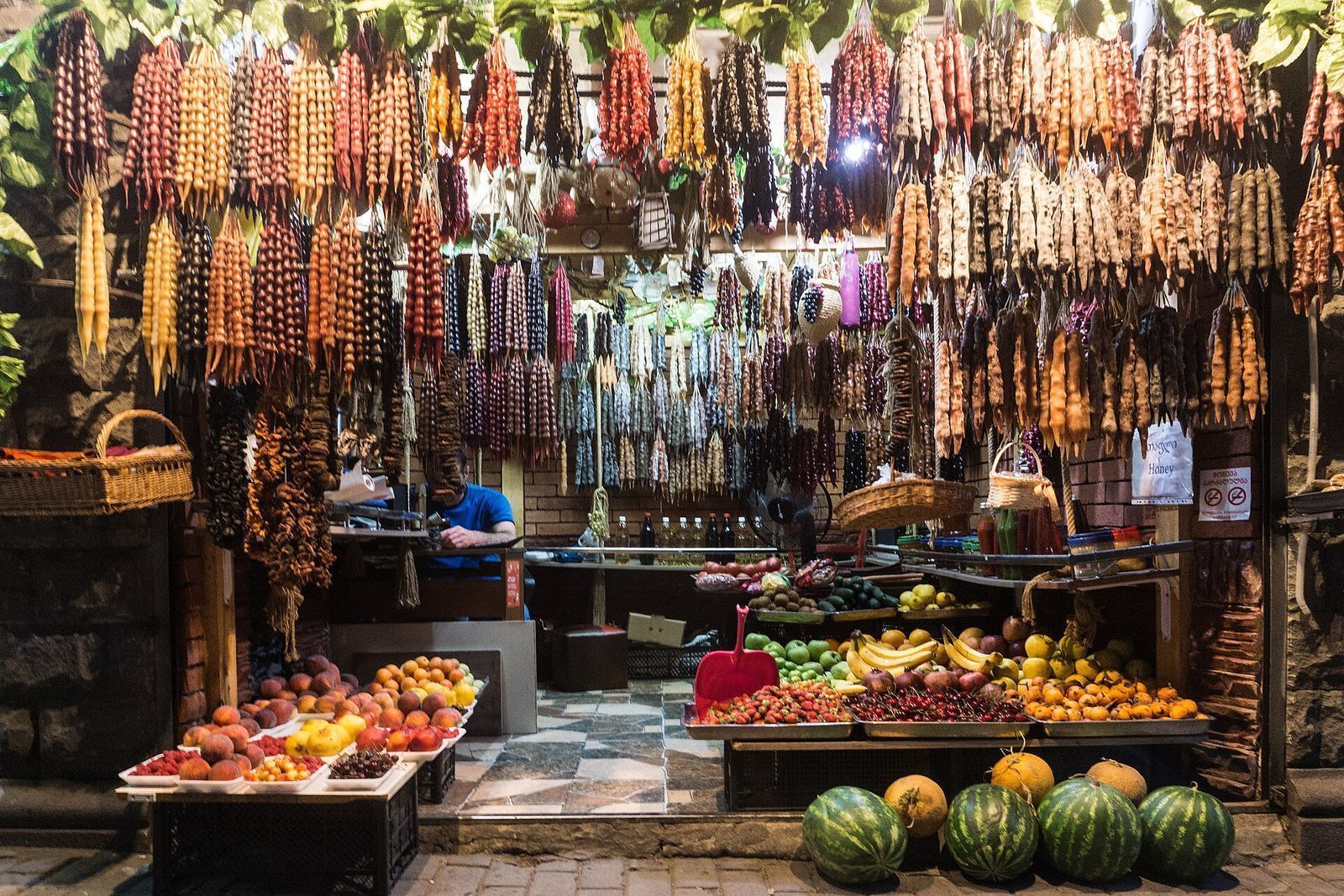
Churchkhela looks like a candle or a knobbly sausage, and it's the sweet you'll see first: strings of red, purple and gold hanging from market awnings, souvenir stalls and roadside stands. Inside is a line of walnut halves or hazelnuts on a thread. Outside is a chewy, fudge-like coat of grape must and flour, and the taste is closer to dried grapes and toasted nuts than to candy.
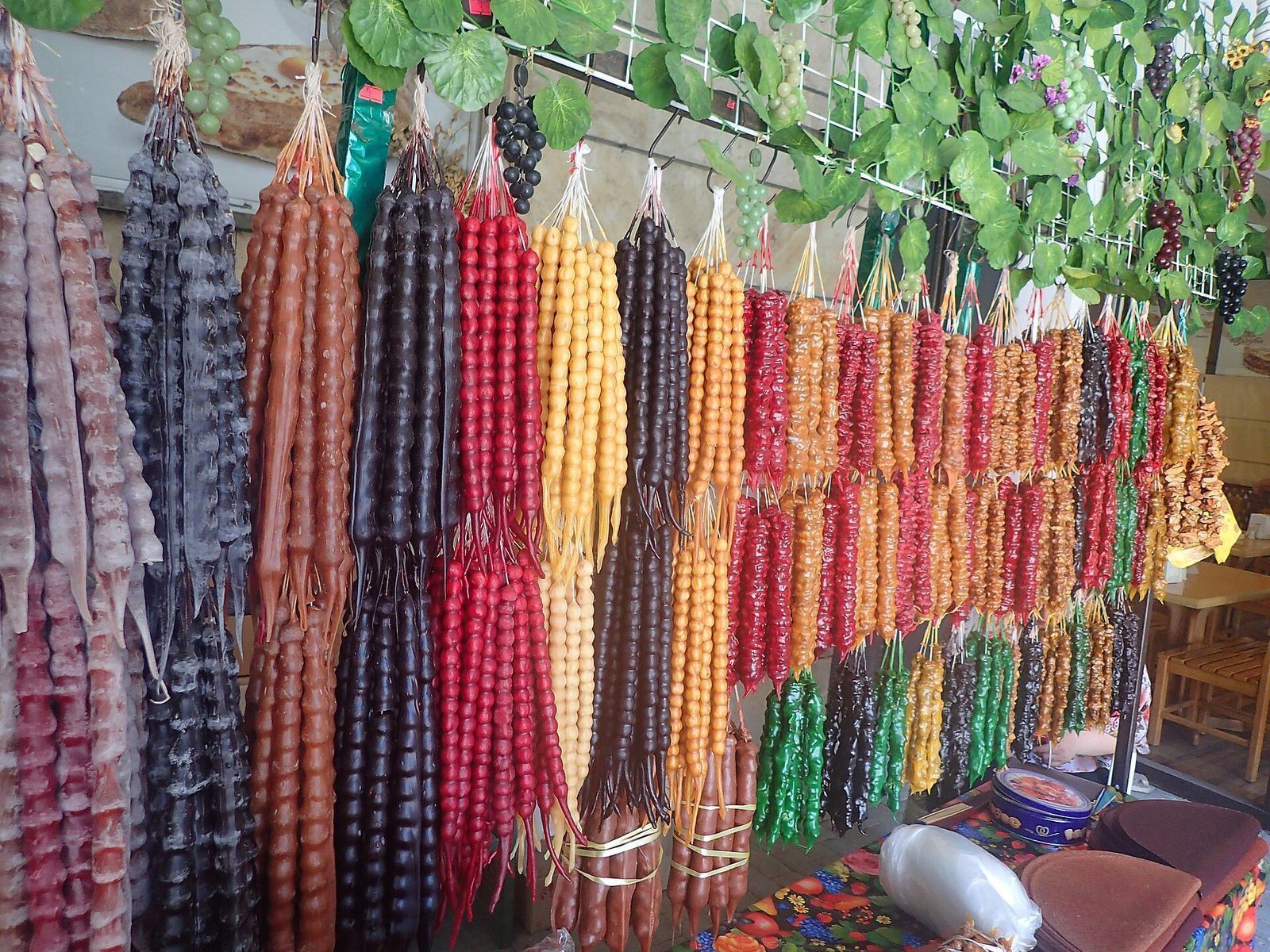
It's also the one Georgian sweet I'd call a proper snack. It keeps for weeks, it survives a day bag, and on a long day trip a piece of churchkhela and a bottle of water does the job of lunch. Walnuts run through most of Georgian food, churchkhela is the sweet end of that, and it happens to be vegan.
How churchkhela is made
Churchkhela is a harvest job. During rtveli, the grape harvest in September and October, the fresh grape must is boiled down and thickened with flour into a dense, glossy paste called tatara. Meanwhile, walnut halves are threaded onto long strings with a needle. Each string is dipped into the warm tatara, hung to set, and dipped again, 3 to 5 times in all, until the coat is thick. Then the strings are hung to dry for 2 to 3 weeks.
That timing is why the new season's churchkhela reaches the markets from October onward, and why it's tied to the wine villages. Kakheti, the main wine region, makes the most, and a trip there for the grape harvest is the best time to taste it straight from the maker. The grapes matter too: the classic strings are made from Saperavi, Rkatsiteli, Tsolikauri or Adesa must.
Walnut or hazelnut: the regional styles
East and west Georgia make it differently. In the east, and above all in Kakheti, churchkhela is made with walnuts and wheat flour, and this is the classic version you'll find in Tbilisi. In the west it's usually hazelnuts. In Guria, where it goes by the name janjukha, it's made with white grape must and corn flour, and Racha versions sometimes add dried fruit to the string.
I prefer the walnut kind: softer, a little bitter, and better with the grape. Hazelnut churchkhela is milder, and it's the better pick for anyone who finds walnuts too bitter.
What churchkhela costs and how to pick a fresh one
At Dezerter Bazaar a piece costs about 3 GEL, and a big, nut-heavy one from a good maker runs 3 to 5 GEL. On Leselidze Street in Old Tbilisi, the same piece goes for 5 to 7 GEL.
Pelamushi (tatara), the grape harvest pudding
Pelamushi is churchkhela without the nuts inside. The same grape must is cooked down with flour, poured into molds or bowls and left to set into a soft, wobbly pudding, then scattered with crushed walnuts. There's no added sugar; all the sweetness comes from the grapes. Saperavi makes it deep purple, Rkatsiteli turns it amber.
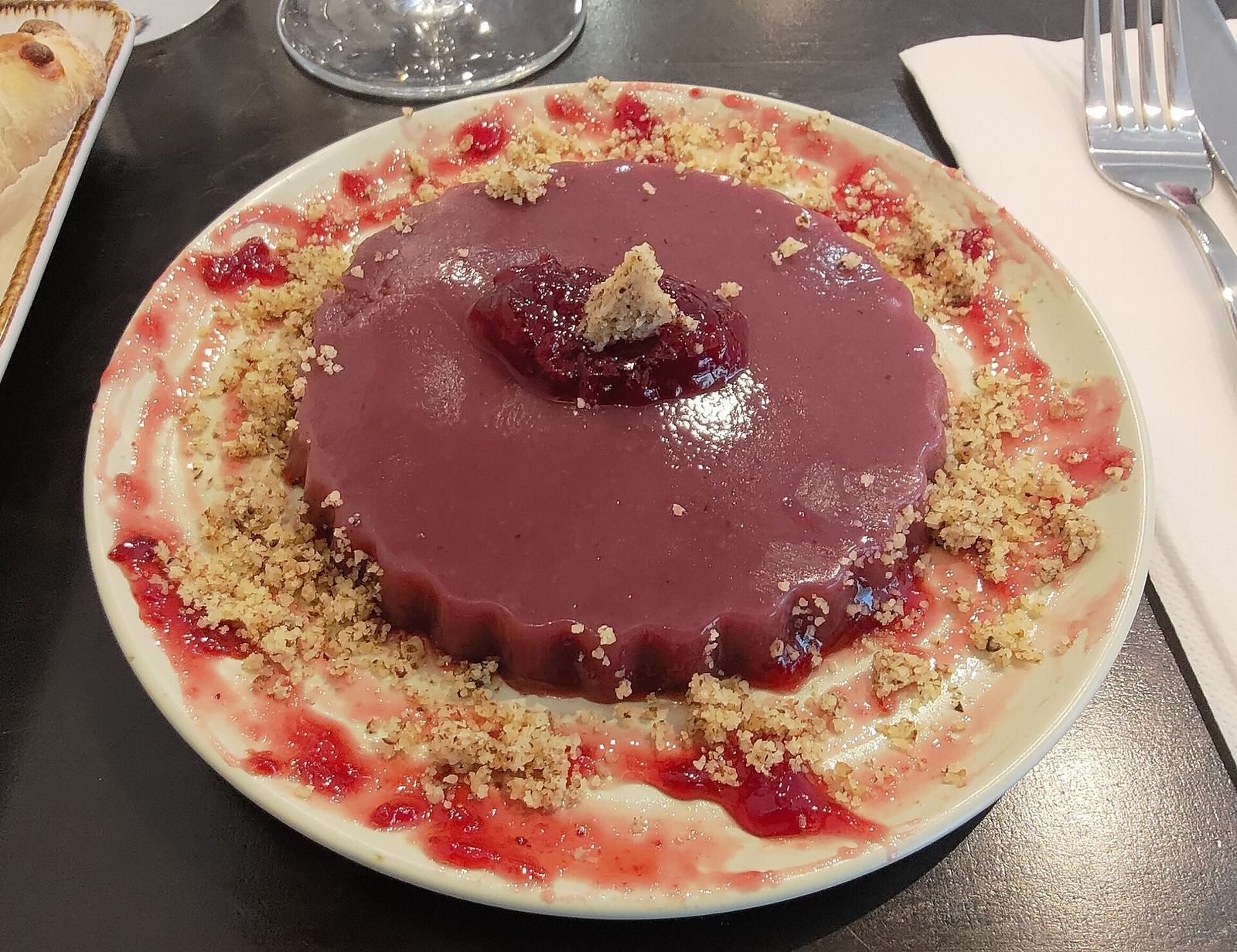
The name changes across the country. In the west it's pelamushi, usually made with corn flour; in the east it's often called tatara and made with wheat flour, the same word used for the paste churchkhela is dipped in. Either way it's made fresh at harvest time and eaten within a few days, so autumn is when you'll find it on menus. It's served warm or chilled, and I like it cold, with a glass of Georgian wine from the same grape.
Outside the season it's a lottery. If a restaurant has it in spring, it's worth asking whether it was made that week.
Gozinaki, the New Year sweet
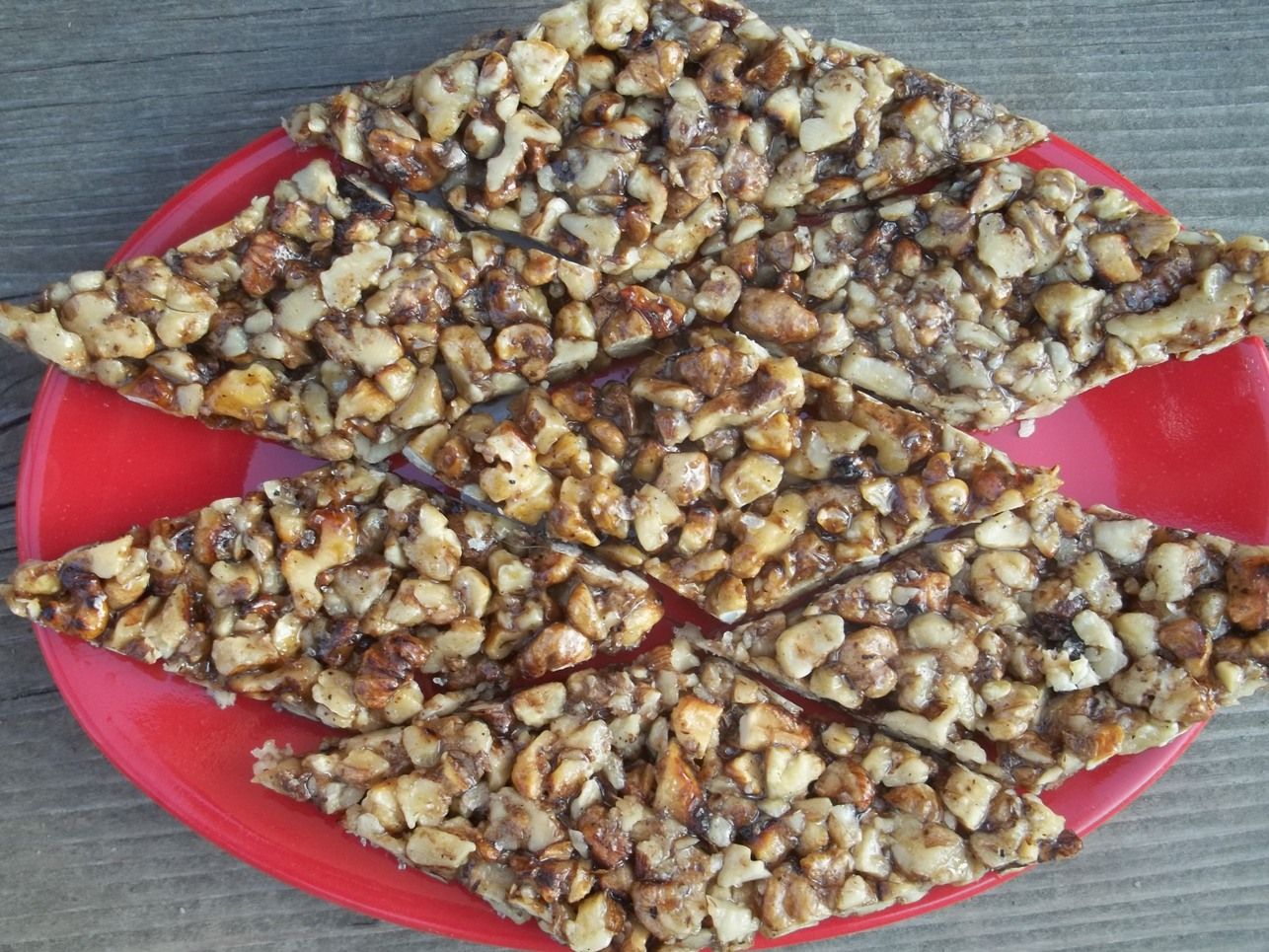
Gozinaki has two ingredients: toasted walnuts and honey. The honey is cooked until it caramelizes, the walnuts go in, and the mix is spread out and cut into diamonds that set hard and shatter when you bite them. It's sticky, nutty and much sweeter than churchkhela.
It's the sweet of the holidays. Georgians make it for New Year's Eve, and it stays on the table through Orthodox Christmas on 7 January, alongside dried persimmons and figs. If you're in town for Christmas and New Year in Tbilisi, you'll find it everywhere: homemade at markets, in gift boxes at sweet shops and packed in plastic at every supermarket.
Tklapi and dried fruit
Tklapi is Georgian fruit leather: fruit puree spread thin on wooden boards and dried in the sun until it can be rolled up like paper. Sour plum, cornelian cherry, apricot and grape are the usual flavors, and in Meskheti they make it from mulberries.
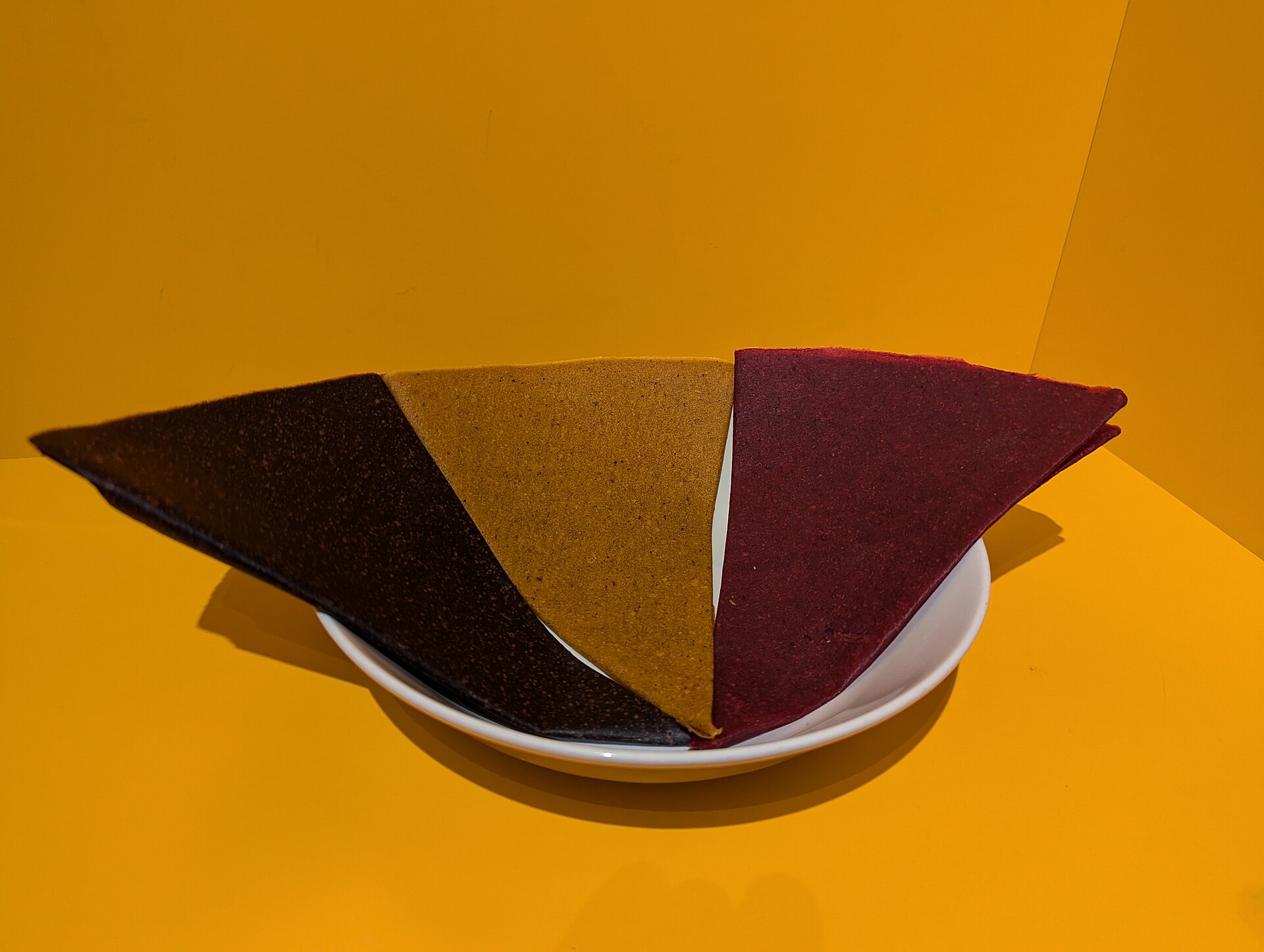
Not all of it is a sweet. The sour plum tklapi is a cooking ingredient that goes into kharcho to give it its tang, so taste before you buy a whole roll. The apricot and cherry ones are the snacking kind, and at 2 to 4 GEL a sheet they're one of the cheapest things you can bring home.
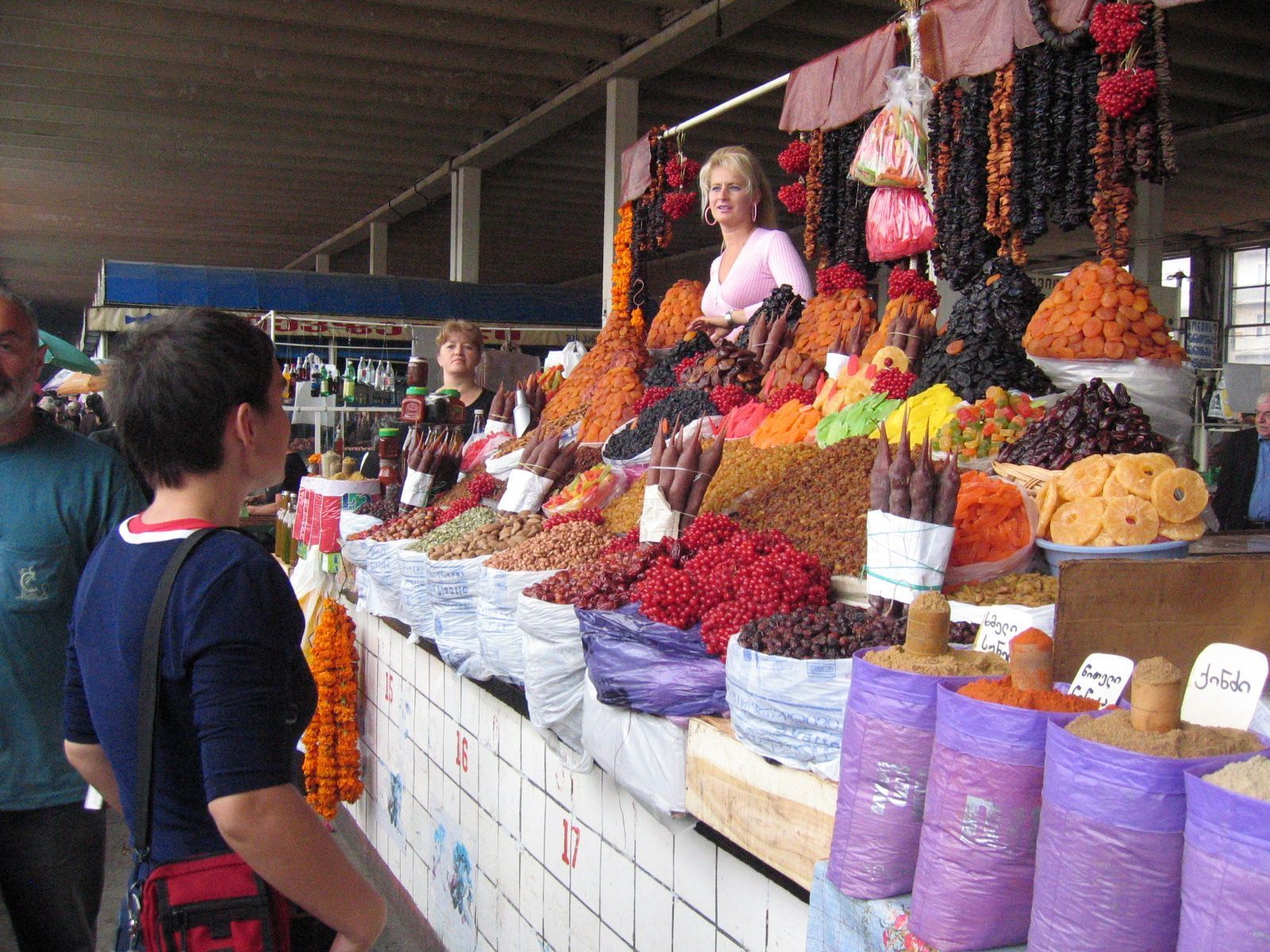
Next to the tklapi at any market you'll find chiri, sun-dried fruit: apples, apricots, plums, quince, figs and persimmons. The dried persimmons and figs are the ones that make it onto the New Year table.
Georgian pastries and sweet breads
Georgian bakeries lean savory, so the sweet pastries take a little looking for. These are the three I'd look out for.
Qada
Qada is a sweet bread or pastry wrapped around a filling of butter and sugar that bakes into a rich, crumbly layer. It comes flat, round or layered depending on the region, and a nine-layer qada is the special-occasion version. It's an eastern Georgian holiday bake, and it travels well, so it's what people pack for long journeys. You won't see it in restaurants: buy it at bakeries and supermarkets.
Nazuki
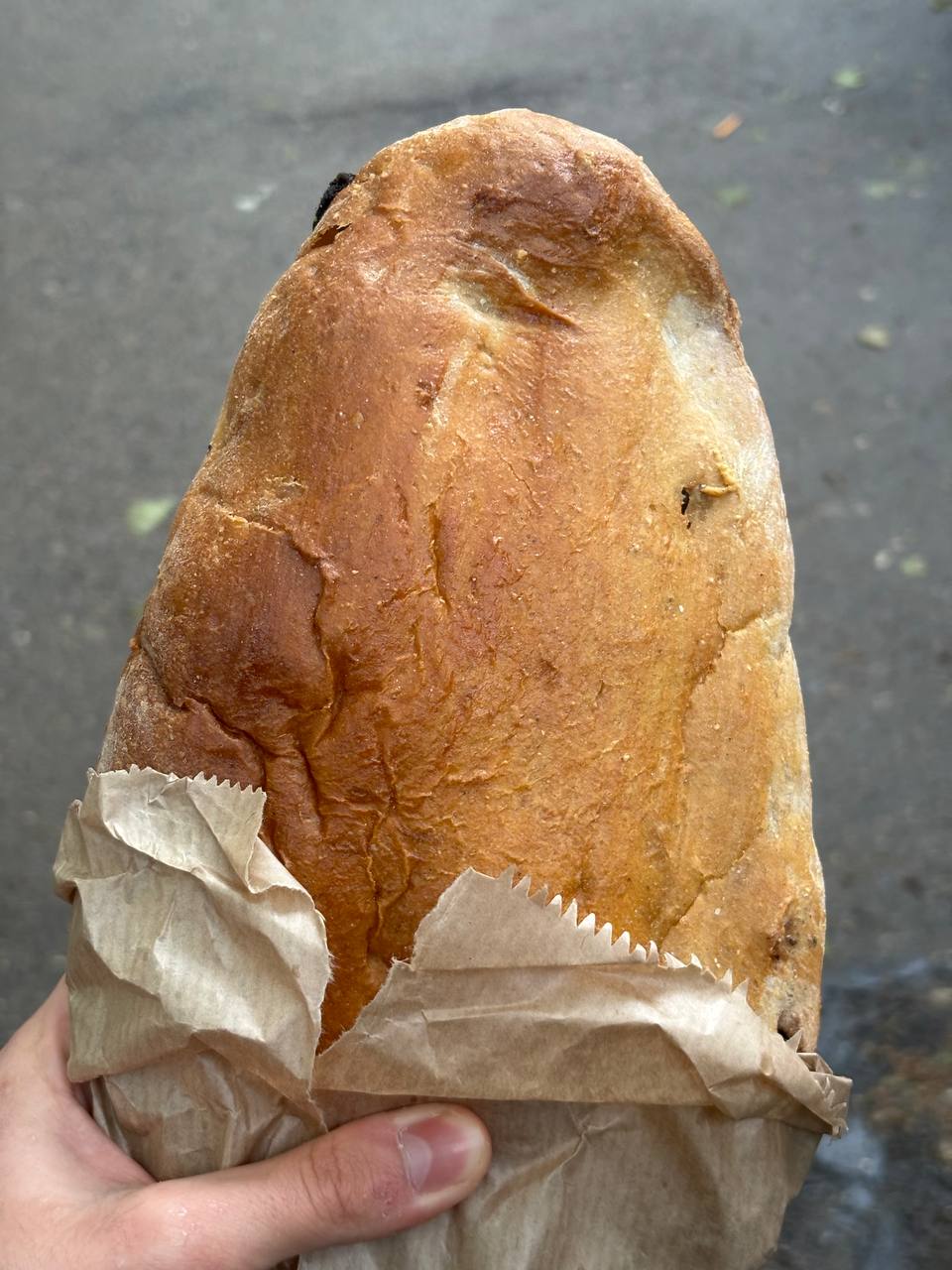
Nazuki is a sweet loaf with raisins, spiced with cinnamon, clove, cardamom and nutmeg, glazed and baked against the walls of a tone oven. It belongs to Surami, a small town on the highway west toward Kutaisi, where a row of roadside bakeries sells it to passing drivers. Few Tbilisi bakeries make it, so stop in Surami if you're driving west. A loaf keeps for 3 to 4 days.
Pakhlava
Pakhlava is Georgia's baklava: thin layers of pastry with a walnut filling, soaked in honey syrup and spiced with cinnamon and clove. It's walnut, never pistachio, and it's made for holidays in eastern Georgia, Adjara and the Pankisi valley. Most bakeries sell it by the piece. At Easter the bakeries switch to paska, a round, fluffy sweet bread dusted with sugar or topped with icing.
Kaklucha, honey cake and other cafe desserts
A Georgian meal rarely ends with a big plated dessert. Fruit, a few sweets and another glass of wine do the job, so for dessert I go to a cafe instead.
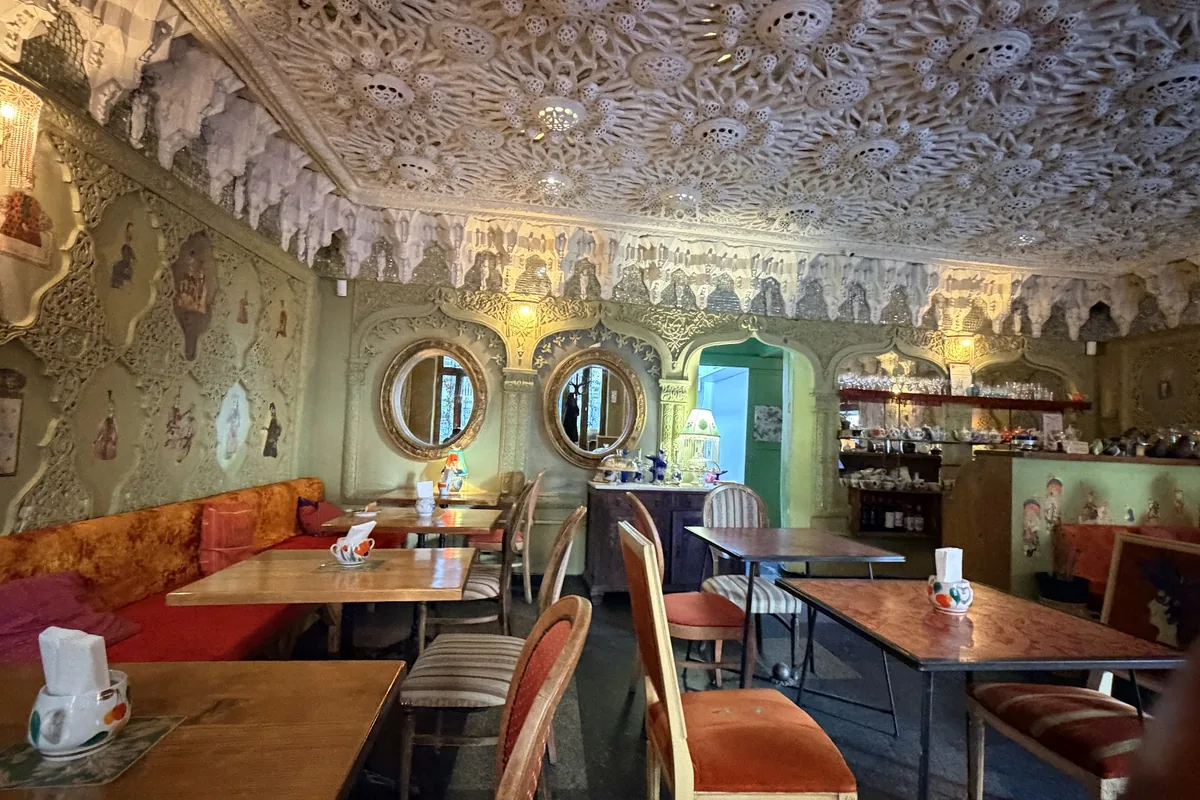
Kaklucha is my favorite of them. Also called Orbeliani's candy, after Princess Mariam Jambakur-Orbeliani, it's walnuts bound in caramelized sugar, served in small pieces. Cafe Leila in the Old Town and Shemomechama both have it on the menu, and it's the dessert I order after a big lunch.
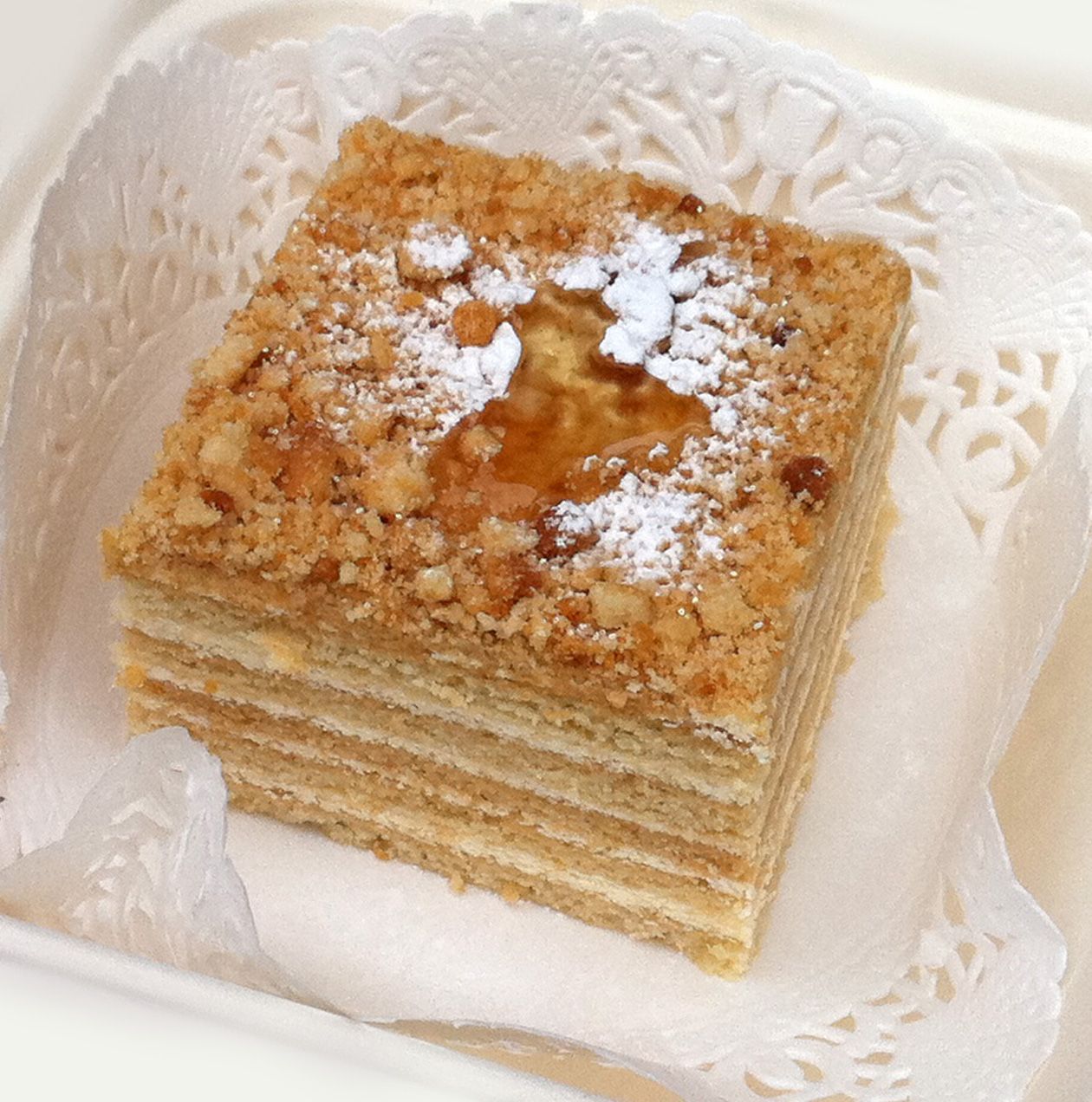
Medoki is honey cake: thin sponge layers made with burnt honey and butter, filled with a milk cream. It came from the Russian medovik and it's sold all year in cafes and bakeries. The prettiest place to eat it is Matasse 1822.
Bird's milk cake is the other Soviet classic: a thin sponge under a thick layer of airy mousse and a chocolate glaze. It reached Georgia in the Soviet era and never left.
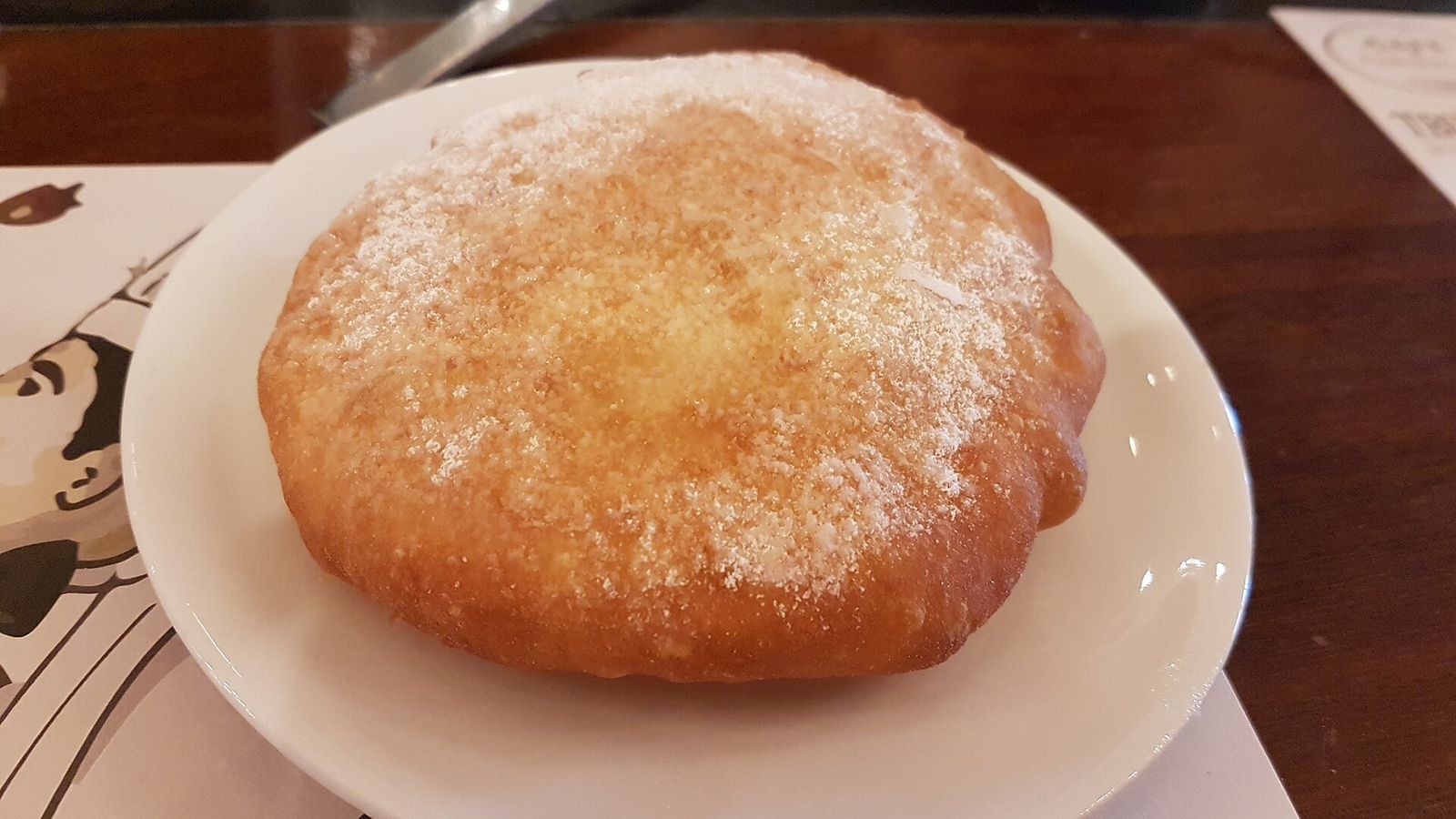
Ponchiki are custard-filled doughnuts dusted with powdered sugar. Puri Guliani makes the ones I'd go for, at its branch by the Dry Bridge Market and on the ground floor of the funicular building up on Mtatsminda.
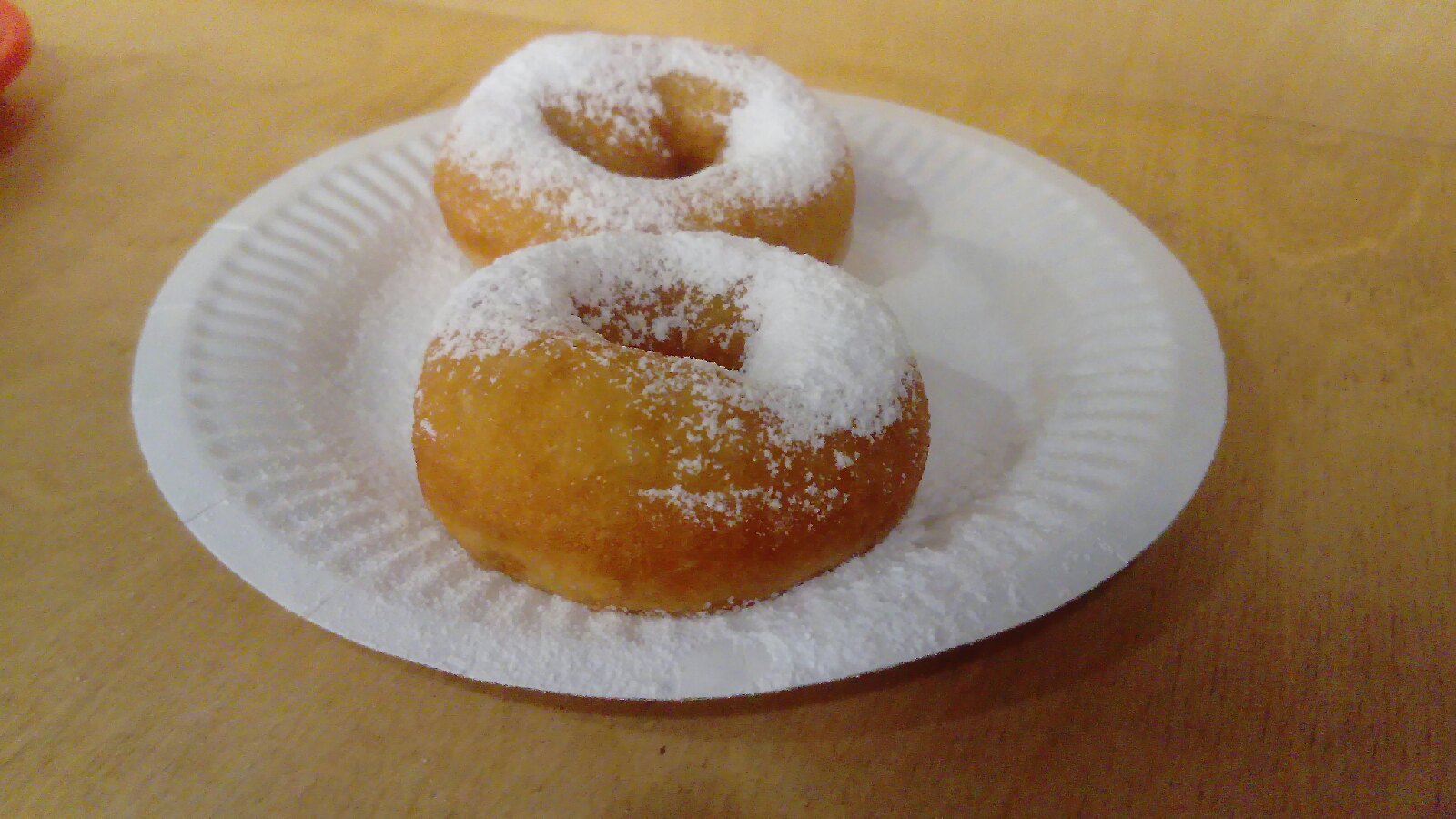
Pishki are small ring doughnuts, fried and dusted with sugar, with no filling. Modu's Pishka on Aghmashenebeli Avenue, near Marjanishvili metro, is the place for them.
Sokhumi ice cream and Georgian ice cream
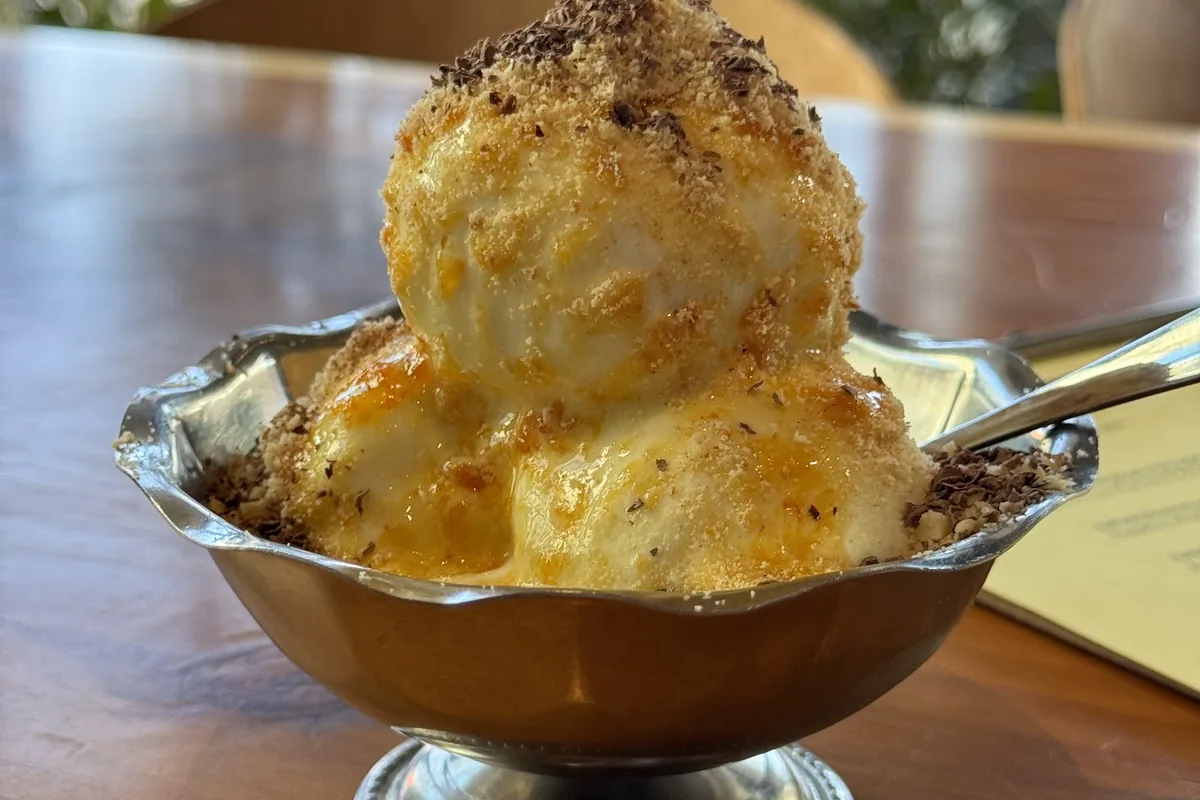
Sokhumi ice cream is the dessert most visitors never hear of. It's plombir, a rich Soviet-style vanilla ice cream, topped with tangerine jam and grated nuts and served in a small silver dish and named after Sokhumi, in Abkhazia. Amra, the Abkhazian restaurant on Danelia Street in Saburtalo, a few minutes' walk from State University metro, is the only place I know that serves it.
For a cone on a hot afternoon, Luca Polare, below, sells Georgian flavors next to the usual gelato, and it's the first shop I'd try on a hunt for the best ice cream in Tbilisi.
Home-style sweets: matsoni, muraba, baked pumpkin and quince
Some of the best Georgian sweets turn up at a guesthouse table rather than in a shop.
Matsoni with honey. Matsoni is thick fermented milk, close to a set yogurt, and with honey and walnuts on top it's the simplest Georgian dessert of all. Supermarkets sell it in jars, and nadughi, a soft whey cheese, gets the same honey treatment.
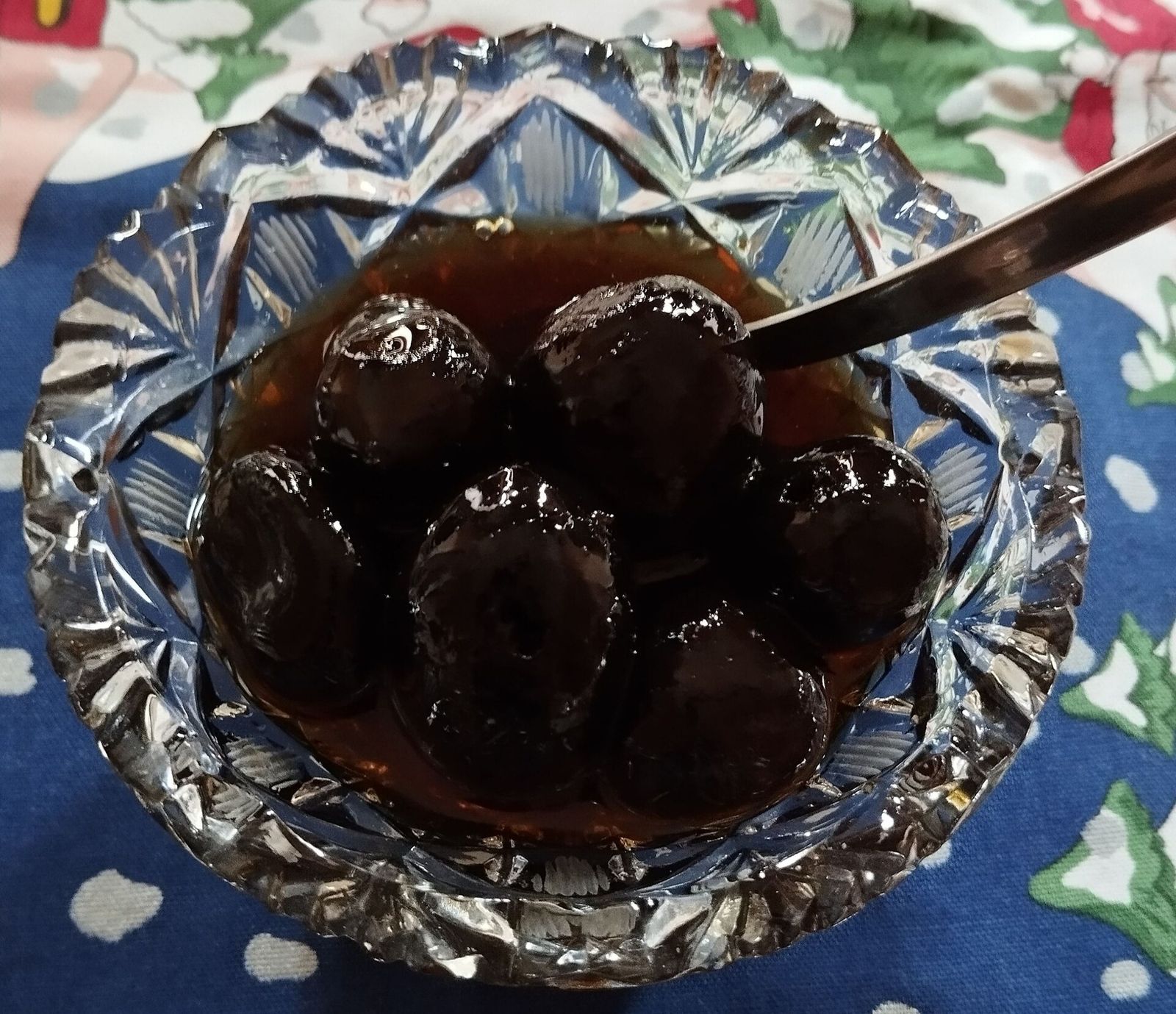
Muraba. These are whole-fruit preserves in syrup: cherry, fig, quince, plum and, most surprisingly, green walnut and watermelon rind. You'll get a saucer of muraba at guesthouse breakfasts and with a pot of Georgian tea, and supermarkets carry jars.
Baked pumpkin. In Guria, pumpkin is baked in the fireplace and served with honey and walnuts. In Adjara it's stuffed with rice, raisins and dried fruit. It's a guesthouse dish rather than a restaurant one.
Baked quince. An autumn dessert in Tbilisi, baked with spices and served with custard. Pur Pur on Gudiashvili Square makes the one I'd order.
Where to buy Georgian sweets in Tbilisi
For sweets to eat now or take home, these are the places I use.
Dezerter Bazaar

Dezerter Bazaar, the big food market near Station Square, is the cheapest and best place in the city for churchkhela, tklapi, dried fruit and honey. Buy churchkhela from the stalls that make their own, where the strings are uneven and the signs are handwritten, and expect to pay about 3 GEL a piece. Go before noon.
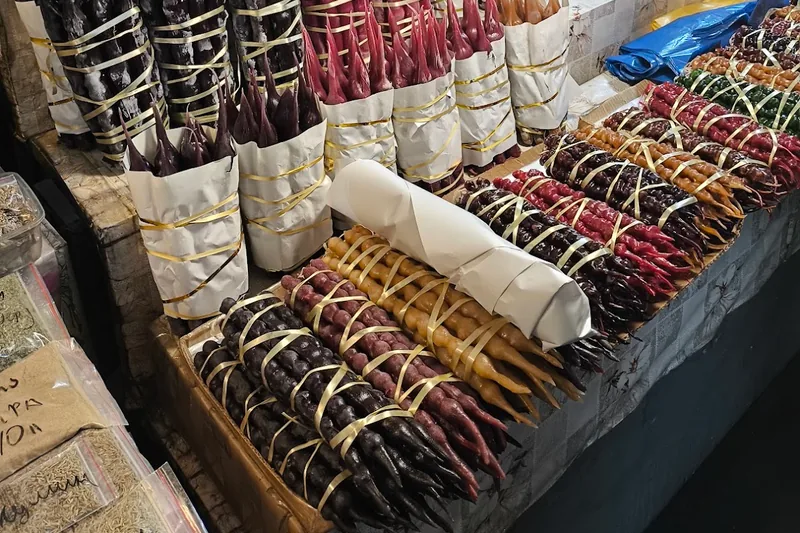
The same market sells cheese, spices, pickles and fruit, so it's also the place to shop for a picnic. Bring small notes, since the stalls take cash only.
Badagi
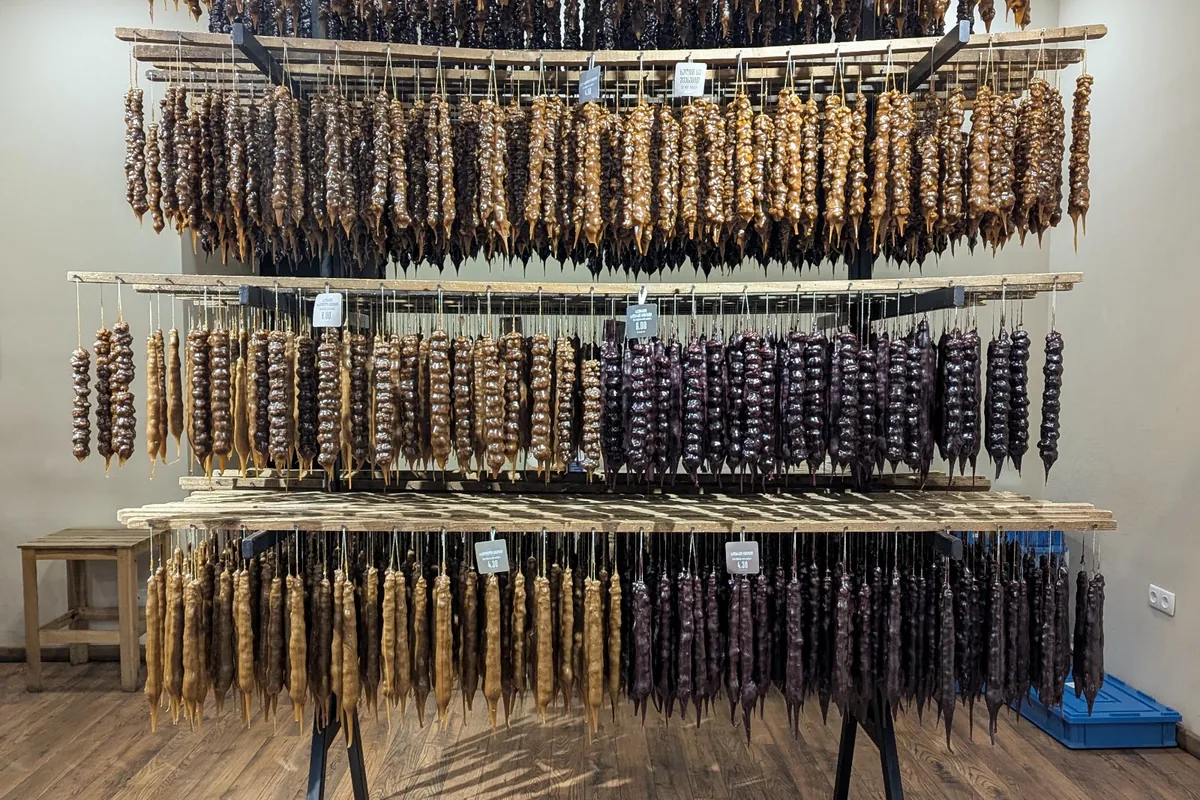
Badagi, at 2 Roman Miminoshvili Street just off Rustaveli Avenue, is a small churchkhela shop and the one I'd use for gifts. It has the biggest range in town, walnut, extra-nutty and hazelnut, all made with no added sugar, plus tklapi and gift bags that make a few strings of churchkhela look like a proper present. It's tiny and easy to walk past, so watch the numbers.
Matasse 1822
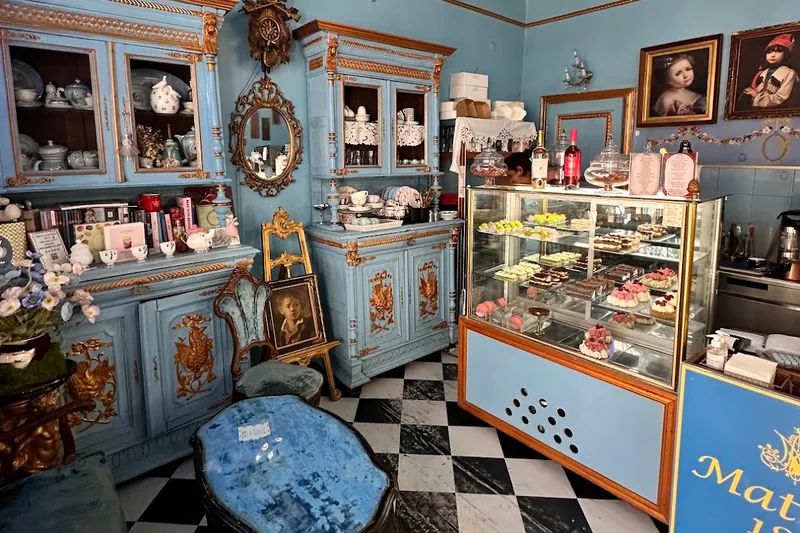
Matasse 1822, at 40 Vertskhli Street in the Old Town, is a Tiffany-blue patisserie with gilded cabinets, old portraits and a glass case full of cakes. Order the honey cake. A cappuccino runs 10 to 15 GEL, which is the top of the city's range, and you're paying for the room as much as the cake.
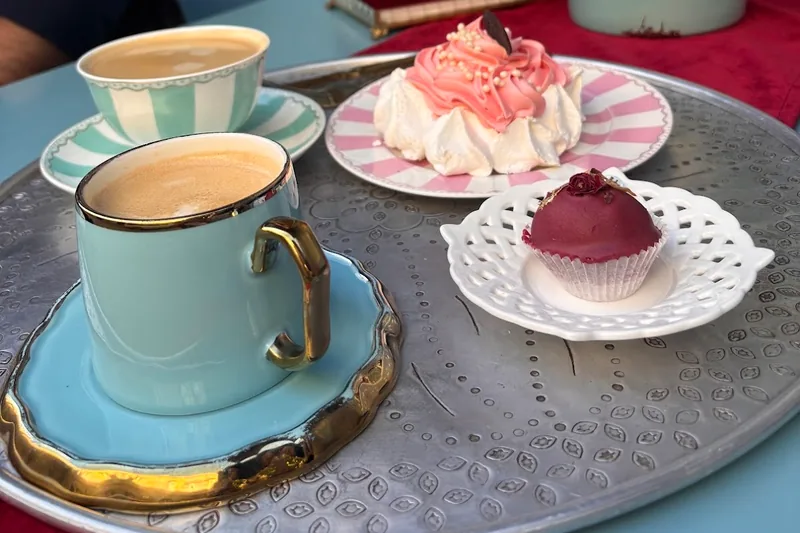
It's a place to sit for half an hour, not to work: laptops aren't allowed. Of the cafes in Tbilisi, it's the one I'd pick purely for cake.
Luca Polare
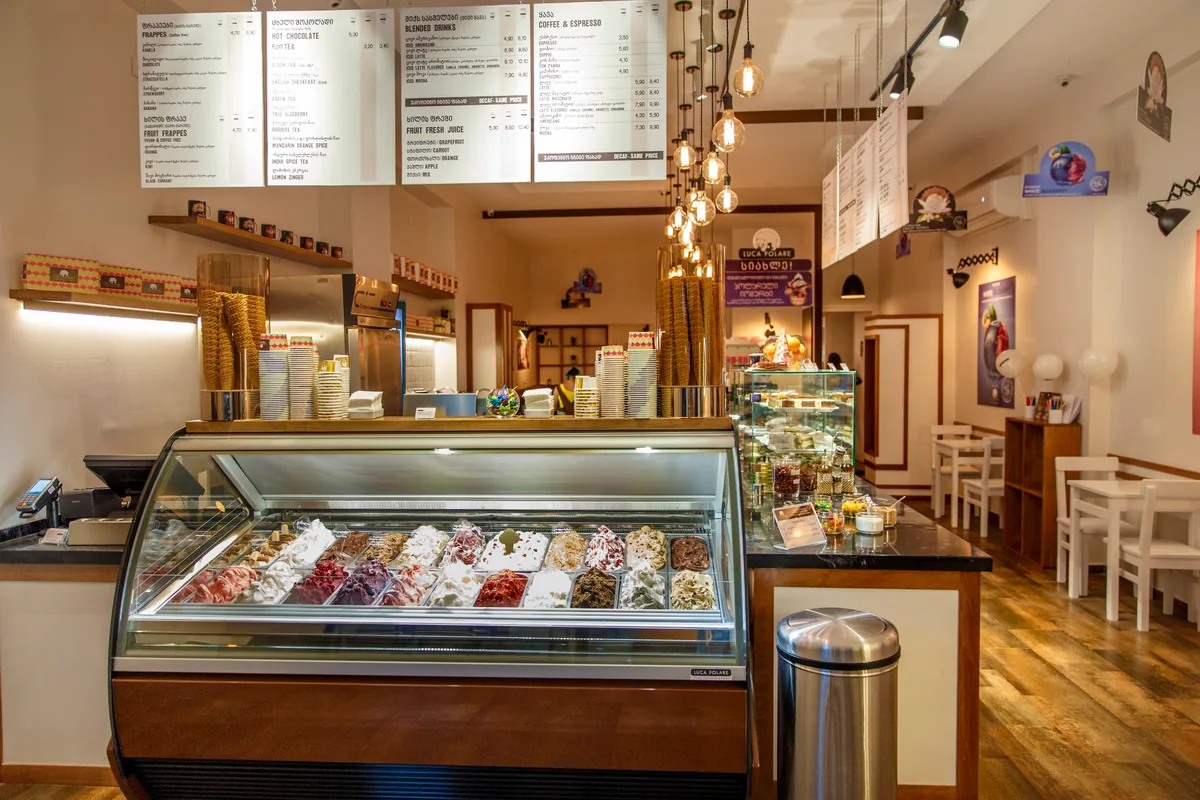
Luca Polare is a gelato chain with branches across the city, and the place I'd go for ice cream with Georgian flavors next to the familiar ones. The counter is long, there are tables to sit at, and it's the one I'd use for an after-dinner cone.

It's the easy option in summer, when the traditional grape and walnut sweets feel too heavy for a 35°C afternoon.
Supermarkets and bakeries
Goodwill, Nikora, Carrefour and Agrohub all stock packaged gozinaki, churchkhela, honey, muraba and matsoni, and they're the easiest place to find gozinaki outside the holidays. The supermarket churchkhela is fine for a taste, but the market's is better. Neighborhood bakeries are where to find qada and pakhlava by the piece.
Where to order Georgian desserts in restaurants
| Place | Neighborhood | Order |
|---|---|---|
| Cafe Leila | Old Town, 18 Shavteli St | Kaklucha |
| Shemomechama | Vera and Old Town | Kaklucha |
| Amra | Saburtalo, Danelia St | Sokhumi ice cream |
| Puri Guliani | By the Dry Bridge | Ponchiki |
| Pur Pur | Gudiashvili Square | Baked quince in autumn |
| Modu's Pishka | Aghmashenebeli Ave | Pishki |
Taking Georgian sweets home
Churchkhela is the sweet I always pack. It's dry and solid, so it goes in hand or checked luggage, and it keeps for weeks. Wrap each string in paper and then a bag of its own, because the grape coat sticks to everything and stains clothes. Gozinaki keeps for several weeks too, and tklapi weighs almost nothing.
Pelamushi, matsoni and anything with custard won't travel, so eat those in Tbilisi. For the rest of the bag, wine, spices and tea sit with the sweets among the Georgian souvenirs I'd bring home.
Key takeaways
- Churchkhela is Georgia's signature sweet: walnuts or hazelnuts dipped in grape must, about 3 GEL a piece at Dezerter Bazaar.
- Pelamushi is the autumn grape pudding and gozinaki the New Year walnut and honey sweet, so what you find depends on the season.
- For desserts in a sit-down setting, order kaklucha at Cafe Leila or Shemomechama, honey cake at Matasse 1822 and Sokhumi ice cream at Amra.
- Buy sweets to take home at Dezerter Bazaar or Badagi, and skip the Leselidze Street markup.
Frequently asked questions
What is the most famous Georgian dessert?
Churchkhela is the most famous Georgian dessert. It's a string of walnuts or hazelnuts dipped again and again in grape must thickened with flour, then dried for weeks, and you'll see it hanging in every market and souvenir stall in Tbilisi.
What is churchkhela made of?
Churchkhela is made of nuts, grape must and flour. Walnut halves or hazelnuts are threaded on a string and dipped 3 to 5 times into tatara, grape must boiled down and thickened with wheat or corn flour, then hung to dry for 2 to 3 weeks. It has no added sugar and it's vegan.
How much does churchkhela cost in Tbilisi?
Churchkhela costs about 3 GEL a piece at Dezerter Bazaar, and up to 5 GEL for a big one from a good maker. In the tourist shops on Leselidze Street in the Old Town, the same piece costs 5 to 7 GEL.
Are Georgian desserts very sweet?
Most traditional Georgian desserts are less sweet than they look. Churchkhela and pelamushi get all their sweetness from grapes, with no added sugar, while gozinaki, kaklucha and the bakery cakes are the properly sweet ones.
When do Georgians eat gozinaki?
Georgians eat gozinaki at New Year and Orthodox Christmas, from New Year's Eve through 7 January. Homemade gozinaki is easiest to find in December and January, though supermarkets sell packaged bars all year.
What is pelamushi?
Pelamushi is a Georgian pudding made from grape must thickened with flour and set in a mold, then topped with crushed walnuts. It's an autumn dessert made fresh at the grape harvest, and in eastern Georgia it's often called tatara.
Can you take churchkhela on a plane?
Yes. Churchkhela is a dry, solid sweet, so it can go in hand or checked luggage. Wrap it in paper and its own bag, because the grape coating stains clothes.
Tbilisi Food Guide: What to Eat, Where to Eat It and What It Costs
Tbilisi is known for khinkali and khachapuri. Here's my food guide: what to eat, where to find it and what it costs.
Read the guide
Georgian Food: The Dishes to Try in Tbilisi
Georgia is known for khachapuri and khinkali. Here is what else to order, what it costs and where to eat it in Tbilisi.
Read the guide
The Best Restaurants in Tbilisi
Tbilisi is known for khinkali and khachapuri. Here are the restaurants I pick, what dinner costs and how to order.
Read the guide