Travel Insurance for Georgia in 2026: The Rules and What to Buy
Georgia is known for letting most visitors in on a passport alone, but since 2026 there's a second document every traveler needs: travel insurance. Here's what you need to know about the rule, what your policy has to show, what it costs, and the extra cover I'd buy for mountain hikes, ski slopes and road trips.
Is travel insurance mandatory for Georgia?
Yes. Since 1 January 2026, every foreign national entering Georgia as a tourist needs health and accident insurance for the whole stay. The rule sits in Georgia's tourism law, and it covers the visa-free passports too, so Americans, Brits, Europeans and Australians are all included. A tourist, for this rule, is anyone staying at least one night and up to a year, which covers everyone reading this.
The rule itself is short. Your policy must cover medical treatment and accidents, it must run from the day you land to the day you leave, and it must cover at least 30,000 GEL for treatment and hospitalization. It can come from a Georgian insurer or one at home, and you can show it on paper or on your phone.
It's the one new item among Georgia's entry requirements, and the one that catches out people who visited a few years ago and assume nothing has changed. Everything else at the border works the way it always did.
What your insurance policy has to show
The border doesn't care which company you use. It cares what the document says. A policy that passes shows these things in writing:
- Who is insured and who the insurer is, with your name as it appears on your passport.
- The territory covered, which has to include Georgia. A worldwide policy, or one for Europe that lists Georgia, is fine.
- Start and end dates that cover your arrival day, your departure day and every day between.
- The insured risks: medical treatment, hospitalization and accidents.
- The cover limit as a number, at least 30,000 GEL or the equivalent in another currency.
- The premium and payment details, which every normal policy certificate already lists.
Currency trips people up more than it should. 30,000 GEL is roughly $11,000 or 9,500 euros, so a policy with $50,000 or 30,000 euros of medical cover clears the bar with room to spare. I'd still aim for $50,000 or more on any trip that leaves the city, and the medical costs table further down shows why.
If your insurer sends a long policy wording plus a one-page certificate, the certificate is the page that matters. I keep it as the first page of the PDF so I'm not scrolling through 40 pages of terms in front of an officer.
Who is exempt from the insurance rule
The exemptions are narrow, and almost no tourist falls under them:
- Holders of diplomatic or special visas.
- Holders of diplomatic, official, service or special passports.
- Accredited staff of embassies, consulates and international organizations, plus their accredited family members.
- People entering under an international treaty that sets its own terms.
- Drivers working on international freight and passenger transport.
Georgian citizens don't need it, since the rule applies to foreigners. Holders of a Georgian residence permit are treated as exempt in practice, but the written rule doesn't name them yet, so I'd carry a policy on every re-entry until it does.
How insurance checks work at the airport and land borders
Your airline is the first and most likely checkpoint. Carriers flying into Tbilisi, Kutaisi and Batumi can ask for the policy at check-in or at the gate, and they can refuse to board you without one. That moves the check to your home airport, before you've spent anything on the trip.
At passport control in Georgia, officers have the right to ask for proof of insurance at air, land and sea crossings. In practice it's patchy: some travelers are asked, many are waved through, and land borders ask less often than the airports. The obligation is the same everywhere, and a check on the way out is possible too, so the policy has to stay valid to your last day.

I treat it like a passport: have it ready, show it if asked, and never count on the officer skipping it. Once you're through, the rest of the arrival is easy, from the ATMs in the hall to the bus and Bolt options for getting from the airport to the city.
What happens if you arrive without insurance
No official penalty schedule has been published, so the outcomes come from travelers' reports. Three come up: the airline refuses to board you, the border refuses entry, or you pay a fine, with reported amounts starting at 300 GEL. None of them is a good start to a holiday, and the first one costs you a flight.
There's no insurance counter at Tbilisi airport to fix it on arrival, and no official way to buy a policy at the border. Some land crossings have private kiosks selling cover, but they take cash in lari, charge well above online prices and come with a queue. I wouldn't plan around them.
The fix takes about 3 minutes online, with the policy emailed as soon as you pay. If you realize at the departure gate that you forgot, buy one on your phone before boarding.
How much travel insurance for Georgia costs
Insurance is the cheapest line in a Georgia trip budget. A basic week of cover costs less than a dinner for two in Tbilisi, and even the sports add-ons barely move the total.
| Type of cover | Typical price | Typical medical limit | Best for |
|---|---|---|---|
| Basic online travel policy | From about $4 a week, $8 for 2 weeks, $18 a month | $30,000 to $50,000 | City breaks and wine country |
| Georgian insurer's tourist policy | About 2 to 5 GEL a day | Set to meet the 30,000 GEL rule | Short trips, paying in lari |
| Policy with adventure sports | About $1 to $3 extra for the trip, or about $6 to $7 a week | $50,000 to $100,000 | Hiking, skiing, rafting |
| Monthly nomad subscription | About $45 per 4 weeks | Up to $250,000 | Long, open-ended trips |
| Local health plan for residents | About $18 to $30 a month | Varies by plan | Stays of 6 months or more |
Georgian insurers sell tourist cover too. Imedi L starts at about 2 GEL a day and TBC Insurance at about 5 GEL, ARDI has a policy built for foreign visitors, and Aldagi sells local health plans. Several local companies focus on Georgians traveling abroad rather than visitors coming in, so check the policy is meant for inbound tourists. For a short trip I'd still buy at home, where the policy, the claim forms and the assistance line all come in a language you read fluently.
The cheapest policy that clears 30,000 GEL is enough for a city break. Where cheap policies fall short is the fine print, so read three things before you pay: the excess you cover yourself on each claim, the exclusions, and the sports list. The usual exclusions are injuries while drunk, pre-existing conditions you didn't declare, pregnancy past 12 weeks, sports without the add-on and planned dental work.
Credit card and home health insurance in Georgia
You may already have cover, but it has to work at the border as well as at the hospital.
Credit card travel insurance often covers medical costs abroad, and some premium cards include it. The catch is proof: many cards don't issue a certificate with your name, Georgia, your dates and a cover limit, and that certificate is what the airline and the border want. If your card provider can send one, it counts. If it can't, a cheap standalone policy is the simpler paperwork.
Home health insurance is a different product from travel insurance. Many private plans reimburse costs after you get home rather than paying a Georgian clinic directly, and they rarely produce a document that names Georgia and a limit. Plenty of European plans do cover Georgia as a non-EU destination, so check yours, and check the paperwork as closely as the cover.
Employer plans for work visas are the easy case. Health insurance from your employer that starts on your arrival date is generally treated as enough, even when its limit sits below 30,000 GEL. Confirm it with your employer before you fly.
Which cover to buy for your trip
The legal minimum is a floor for a city break. Once your plans leave Tbilisi for the mountains it stops being the right number, because a rescue from a high valley can cost more than the whole 30,000 GEL. This is how I'd match the cover to the trip:
| Your trip | Cover I'd buy | Why |
|---|---|---|
| Tbilisi, Mtskheta, Kakheti wineries | Any standard policy, 30,000 GEL ($11,000) or more | Hospitals are close and routine care is cheap |
| Day hikes around Kazbegi, up to 3,000 m | $50,000 with hiking included | Twisted ankles on mountain trails are a classic claim |
| Multi-day treks in Juta, Tusheti or Svaneti, 3,000 to 5,000 m | $100,000 with high-altitude trekking | A helicopter evacuation starts at about 15,000 GEL |
| Skiing or snowboarding in Gudauri, Bakuriani or Mestia | $50,000 with winter sports | Standard policies exclude the slopes |
| Rafting or paragliding | $50,000 with adventure sports | Both sit on almost every exclusions list |
| Road trip in a rental car | A standard policy, plus the rental's own cover | Road accidents are the biggest real risk in Georgia |
The walk up to Gergeti Trinity Church is the hike most visitors do in Kazbegi, and a policy with hiking included covers it. Treks over high passes are where the fine print changes. The trail to Juta crosses Sadzele Pass at about 3,056 m, and a policy capped at 3,000 m stops covering you somewhere near the top.
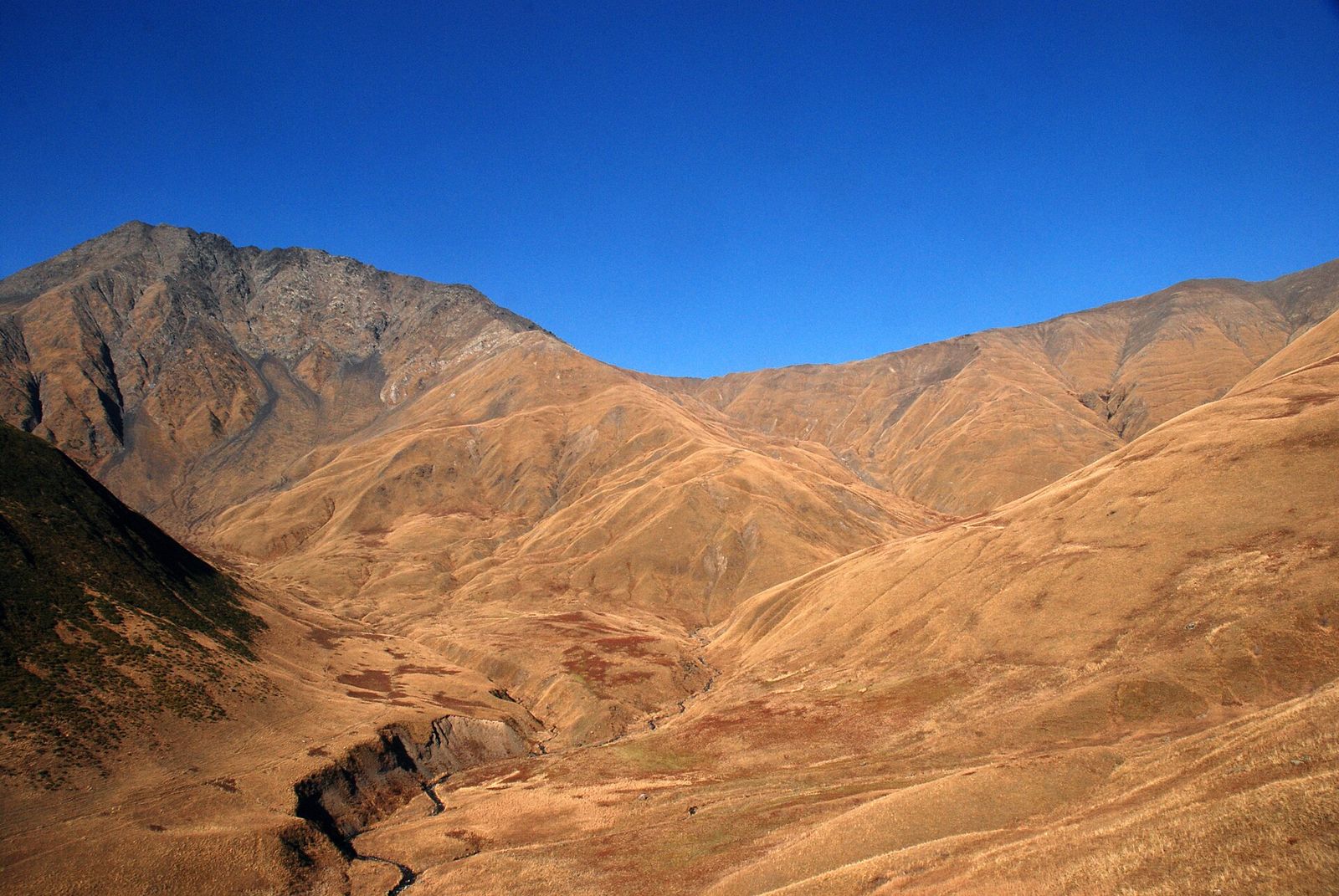
Distance matters as much as altitude. In Kazbegi, Svaneti, Tusheti and Khevsureti, the nearest serious hospital is 3 to 5 hours away by road, and Stepantsminda and Mestia have only small first-aid posts. Bad weather on the passes can stretch that further, which is why evacuation cover belongs on any mountain policy.
Ski trips need the same care. Winter sports cover is an add-on on most policies, and skiing in Gudauri on a standard policy leaves you paying for any fall on the slopes yourself.
Medical costs in Georgia without insurance
Healthcare for foreigners in Georgia is private and paid by the patient. The ambulance on 112 is free; everything after it goes on your bill. Prices are low by Western standards for small things and still serious for big ones.
| Treatment | Price in GEL | About in USD |
|---|---|---|
| GP consultation | 50 to 100 | $18 to $36 |
| Specialist consultation | 80 to 150 | $29 to $54 |
| X-ray | 40 to 80 | $14 to $29 |
| MRI scan | 300 to 600 | $109 to $218 |
| A day on a hospital ward | 200 to 800 | $72 to $290 |
| Surgery for a fracture | 3,000 to 15,000 | $1,090 to $5,450 |
| Helicopter evacuation from the mountains | 15,000 to 50,000 | $5,450 to $18,180 |
The bottom two rows explain my $50,000 rule for mountain trips. A fracture, a few days on a ward and an evacuation from a high valley can use up the 30,000 GEL minimum between them.
The things that actually send visitors to a clinic are less dramatic: stomach bugs, twisted ankles on mountain paths and heat exhaustion in a Tbilisi summer, when the city can reach 38 to 40°C. Those are cheap to treat, and they're also the claims a basic policy handles well.
Hospitals, pharmacies and claims in Tbilisi
Tbilisi has good private hospitals, and the ones visitors end up in usually have English-speaking coordinators. The names you'll hear are Evex, a network of clinics across Georgia, MediClub Georgia, Todua Clinic and the National Center of Surgery. Most accept international insurance once your insurer's assistance line has been in touch, and Kutaisi and Batumi have private care of the same kind.
Order matters with a claim. Unless it's an emergency, call the 24-hour assistance number on your policy before you go to a clinic, with your policy number, your location and what happened. They'll tell you where to go and usually settle the bill with the clinic directly. Pay nothing large without their go-ahead, keep every receipt, prescription and medical report, and photograph them the same day, because a claim you file from home lives or dies on that paperwork.
Pharmacies are where most minor problems end. The two big chains are PSP, with blue signs, and GPC, with green ones, and you'll pass several on any walk through the center. Many stay open until 22:00 or midnight, most medicines are sold without a prescription, and prices run 20 to 40% below Western Europe. For a stomach bug or a sore throat, the pharmacist is usually quicker than a clinic.
Tbilisi is a safe city for visitors, and for most travelers a pharmacy counter is as close as they get to its health system. I pack a small kit anyway: painkillers, rehydration salts, an antihistamine, high-SPF sunscreen for the strong mountain sun and motion sickness tablets for the bends of the Georgian Military Highway.
Driving into Georgia: the Green Card
Health insurance isn't the only policy a driver needs. If you drive into Georgia in your own car, or a car rented in another country, you also need a Green Card: third-party motor insurance that covers damage and injury you cause to others. The minimum liability is $20,000 per injured person, and it doesn't cover your own vehicle, which takes a separate comprehensive policy.
| Green Card period | Price |
|---|---|
| 15 days | 30 GEL |
| 1 month | 50 GEL |
| 3 months | 85 GEL |
| 1 year | 130 GEL |
You can buy it online at TPL.ge and get the policy by email before you reach the border, which is how I'd do it.
If you rent a car in Tbilisi, Kutaisi or Batumi instead, third-party liability is already in the rental price and no Green Card is needed. Damage to the car itself isn't, so compare the excess and the full-cover options when renting a car in Georgia. Your travel policy covers you, not the car.
Long stays, digital nomads, kids and older travelers
Most passports get up to 365 days visa-free, and the policy has to cover all of it. For a stay of 6 months or more, a monthly nomad subscription or an annual policy is simpler than stacking short ones, and local Georgian health plans start at about $18 to $30 a month. Check a local plan before you rely on it at the border: some are sold only to people already in the country, and many don't print a limit that satisfies the entry rule.
A border run resets your 365 days but not your insurance. Every re-entry is a fresh entry, so you need a valid policy to come back in, whatever you've arranged locally.
Kids need their own policy, one per child, and children's policies usually cost 30 to 40% less than an adult's. I'd pick one with no excess, since small claims for scrapes and fevers are the likely ones.
Older travelers pay more and have fewer options. Premiums for travelers over 65 often run 2 to 4 times the base rate, some insurers stop at 70, and several Georgian insurers stop at 60 or 65. Among local companies, UNISON, Liberty and Aldagi are the ones that take older travelers.
Key takeaways
- Travel insurance has been mandatory for every foreign visitor to Georgia since 1 January 2026, visa-free passports included.
- Your policy needs health and accident cover of at least 30,000 GEL, about $11,000, for every day from arrival to departure.
- The limit has to appear as a number on the certificate, which can be a printout or a PDF on your phone.
- Buy before you fly, because airlines check at boarding and there's no insurance desk at Tbilisi airport.
- Add sports cover and aim for $50,000 or more if you're hiking, skiing or heading into the high mountains.
Frequently asked questions
Is travel insurance mandatory for Georgia in 2026?
Yes. Since 1 January 2026, every foreign tourist needs health and accident insurance covering the whole stay, visa-free travelers included. Airlines and border officers can ask to see it.
How much travel insurance do I need for Georgia?
The legal minimum is 30,000 GEL of cover for medical treatment and hospitalization, about $11,000. Any policy with $50,000 or 30,000 euros of medical cover clears it, and $50,000 or more is what I'd buy for a trip into the mountains.
Can I buy travel insurance at Tbilisi airport?
No. There's no insurance desk at the airport and no official way to buy a policy at the border, so buy online before you fly. It takes a few minutes and the policy arrives by email.
What happens if I don't have travel insurance in Georgia?
Your airline can refuse to board you, the border can refuse entry, or you can be fined, with reported fines starting at 300 GEL. No official penalty schedule has been published, and none of the outcomes is worth risking for the price of a policy.
Does credit card travel insurance count for Georgia?
It counts if the card provider gives you a certificate with your name, Georgia, your travel dates and a cover limit of at least 30,000 GEL. Many cards can't produce that document, and without it a cheap standalone policy is the simpler proof.
How much does travel insurance for Georgia cost?
A basic policy starts at about $4 a week online, about $8 for 2 weeks and about $18 for a month. Georgian insurers sell tourist cover from about 2 to 5 GEL a day, and sports cover adds about $1 to $3 for the trip.
Is healthcare expensive in Georgia without insurance?
Small things are cheap and big things are not. A GP visit costs 50 to 100 GEL and an X-ray 40 to 80 GEL, but surgery for a fracture runs 3,000 to 15,000 GEL and a helicopter evacuation 15,000 to 50,000 GEL.
Do children need travel insurance for Georgia?
Yes, and each child needs a policy of their own. Children's policies usually cost 30 to 40% less than an adult's, and I'd choose one with no excess.
Tbilisi Travel Tips: What I'd Tell You Before a First Trip to Georgia
Tbilisi is known for wine, sulfur baths and long dinners. Here's what to know about entry, money, transport and safety.
Read the guide
Tbilisi Itinerary: How I'd Spend 1 to 5 Days in Tbilisi
Tbilisi is best over 3 full days. Here is how to spend 1 to 5, with routes, meals, day trips and costs.
Read the guide
The Best Time to Visit Tbilisi, Month by Month
Tbilisi is known for golden autumns and hot summers. Here is the weather by month, the crowds, and when I would go.
Read the guide