Street Art in Tbilisi: Where to Find the Best Murals
Tbilisi is known for its murals: well over 100 painted walls, most of them on Soviet apartment blocks outside the old center rather than in it. Here's where to find the best street art in the city, which districts are worth the metro ride, who painted the big walls and how I'd plan a day around them.
Where to find street art in Tbilisi
Street art in Tbilisi is spread across the city, so the first decision is which districts to pick. The Old Town has very little. The good walls are on the left bank around Fabrika and Station Square, and in the Soviet-era districts further out, where whole gable ends of apartment blocks became canvases.
This is how the main areas compare, and how much time I'd give each one on foot.
| Area | What you'll see | Getting there | Time I'd give it |
|---|---|---|---|
| Fabrika and Chughureti | Fabrika's painted facade and courtyard, plus about a dozen walls in the streets around it | Marjanishvili metro, 2 stops from Liberty Square | 1 to 2 hours |
| Station Square and Didube | Big walls on Tsereteli Avenue, Avtandil Ioseliani Street and behind the Dezerter Bazaar | Station Square or Tsereteli metro | About 1 hour |
| Varketili and Vazisubani | The largest murals in the city, on Soviet apartment blocks | Varketili metro, the end of Line 1 | About 2 hours |
| Saburtalo | About 20 murals on Vazha Pshavela Avenue, at Maglivi and up on the Nutsubidze plateau | Technical University or Medical University metro | About 2 hours |
| Vake and Vera | Painted underpasses at Vake Park and Heroes Square, festival walls in the side streets | Bus or Bolt; Vake has no metro | 1 to 2 hours |
| Old Town and the center | A handful of pieces: Frida Kahlo, the Baratashvili Bridge underpass, the Metekhi caricature | On foot | Fold it into your Old Town walk |
If I had one afternoon, I'd do Fabrika and the streets around it. If I had a full day and a real interest in murals, I'd add Varketili, because nothing in the center comes close to the scale of those walls.
Murals, graffiti and street art: what you'll see
Three kinds of painted wall share the city. Murals are the big commissioned pieces, painted with the building's permission, usually during a festival, often across the whole side of a 10-story block. Graffiti and street art are the tags, stencils, stickers and small hand-painted pieces that go up without anyone asking.
Most visitors come for the murals, and that's where Tbilisi stands out. Georgian painters work alongside artists from across Europe, and the subjects are local: Georgian legends like Amirani, Medea and Jason, and the poem The Knight in the Panther's Skin; national figures like the chess champion Nona Gaprindashvili, the poet Vazha Pshavela and King Davit Aghmashenebeli; and a lot of Niko Pirosmani, the painter half the city's artists seem to quote.
The walls have grown more political too. Stop War, War Will End (2022) and Abkhazia Is Georgia share the streets with pieces that are pure fun, like a Simpsons-style Pirosmani and a pair of zebras on a Saburtalo hillside.
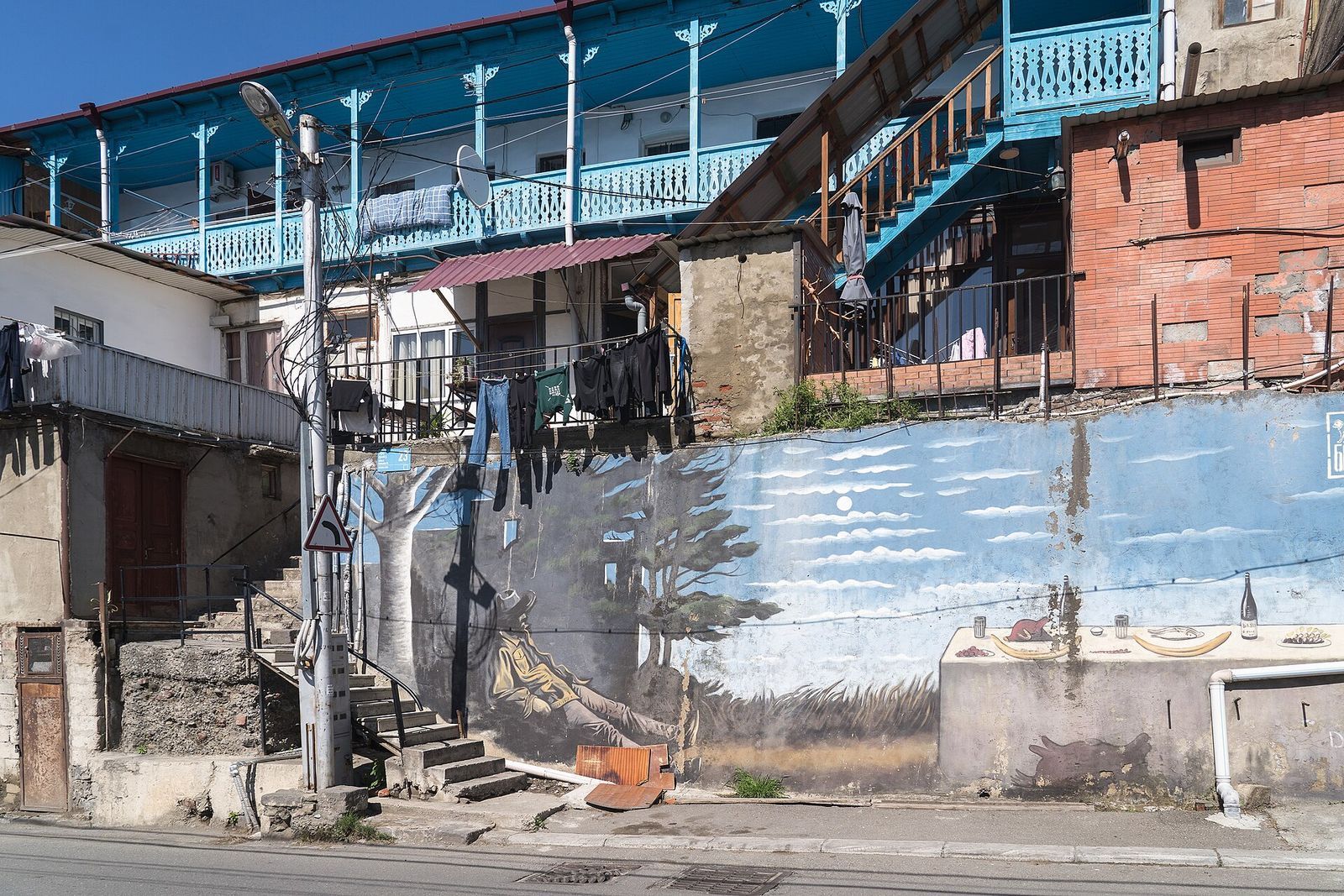
A handful of Georgian names keep coming up as you walk: Dante (David Mchedlishvili), Musya Qeburia, Tamoonz, David Samkharadze, Sasha Korban, Afzan Pirzade and Kade90. Among the visiting artists, look for Case Maclaim, Innerfields, El Bocho, Fintan Magee and Faith47.
Street art festivals in Tbilisi
Almost every big wall in the city came out of one of three festivals. This is why the map changes every autumn, and why a wall you saw online two years ago may have been painted over.
| Festival | Running since | When | Where its walls are |
|---|---|---|---|
| Tbilisi Mural Fest (now Georgia Mural Fest) | 2019 | Usually autumn | Saburtalo, Varketili, Vazisubani, Vake, Chughureti |
| Niko Movement | 2018 | Yearly, usually autumn | All over the city, with Maglivi as its practice wall |
| Fabrikaffiti | 2017 | October | Fabrika's facade and courtyard |
The Mural Fest brings Georgian and European artists together and runs talks and workshops alongside the painting; it paused after 2020 and came back in September 2022, with new walls in 2023 and 2025. Fabrikaffiti ran as a full festival in 2017, 2018 and 2019, and Fabrika keeps the idea alive with new work on its facade and courtyard wall each October.
Fabrika, Chughureti and Station Square
The left bank of the river is the best street art area you can reach on foot from the center, and the one I'd start with. It runs from Fabrika and Marjanishvili up to Station Square, all of it within 2 metro stops of Liberty Square.
Fabrika
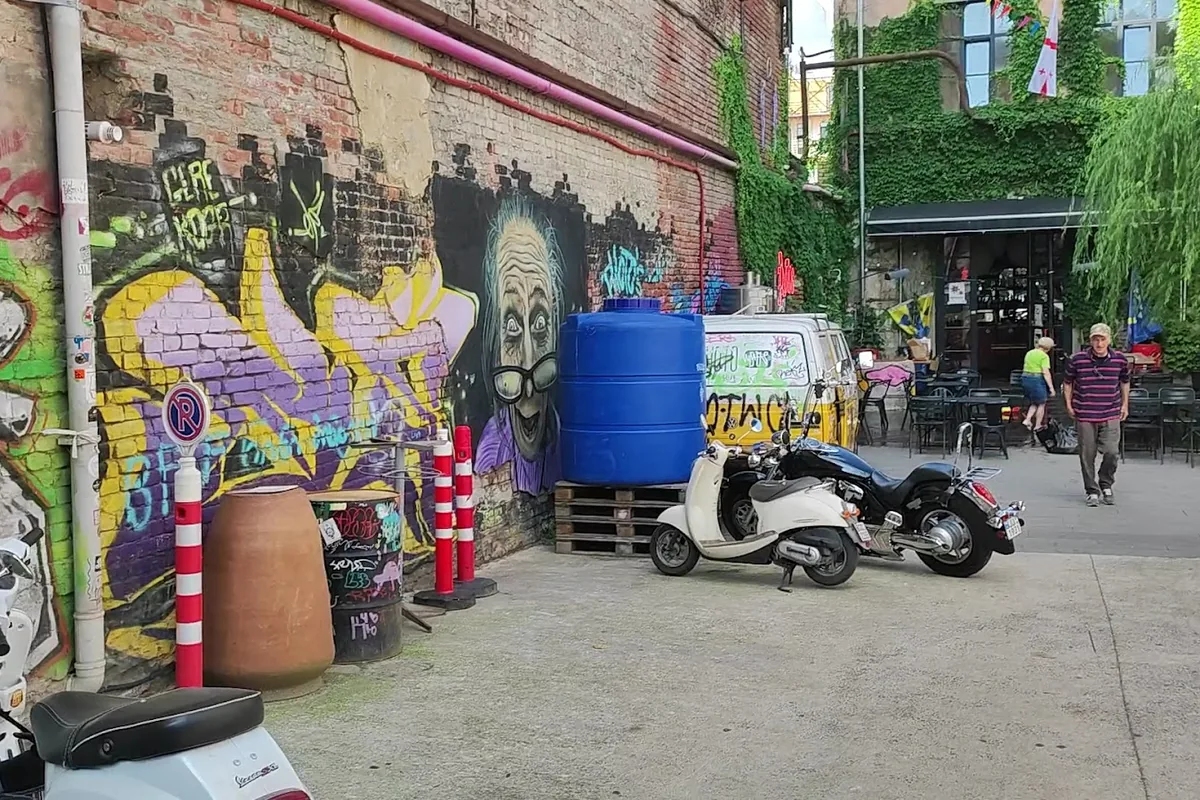
Fabrika is a former Soviet sewing factory at 8 Egnate Ninoshvili Street, an 8 to 10 minute walk from Marjanishvili metro, and it's the reason most people come to this side of the river. The gate is an arch covered in paint, the facade and the long courtyard walls are covered too, and the stairwells and the back courtyard hold older, rougher work most visitors walk past.
Around a dozen bars and cafes share the courtyard with the art, which makes Fabrika in Tbilisi the easiest mural stop to combine with a coffee or an evening drink. For the walls, walk past the last cafe terrace into the side wings, and come back in late October if you can, when the new facade work is fresh. Fabrika is the best known of the converted factories in Tbilisi, and the only one where the paint is the main attraction.
Around Marjanishvili
The streets around Fabrika hold about a dozen more walls, and this is where I'd spend the second hour. The ones I'd look for:
- Flying Painter by Dilk and Feros, based on a sketch by Petre Otskheli.
- White Rhino and Polar Bear by Dante; the bear (Niko 2019) has been partly painted over.
- Squid by Kuba (Niko 2019).
- Girl Swimming in Plastic by Musya, a girl in a sea of plastic waste.
- The Simpsons-style Pirosmani by Gamez (Niko 2018).
- A Girl by El Bocho, across a 13 m wall (Mural Fest 2019).
- A Girl by Tamoonz (Niko 2020), and an untitled wall by Monkeybird (2021).
- Pirosmani by David Samkharadze.
The side streets toward Markarashvili and Eliava Streets carry some of the most ambitious walls in the district. The district is flat and easy to walk, and dinner in Marjanishvili and Chughureti still costs what locals pay, which makes it the natural place to finish.
Station Square and the Dezerter Bazaar
North of Marjanishvili, the streets around Station Square hold a cluster of big festival walls. Look on Avtandil Ioseliani Street (Google Maps calls it Rkinigza Street), on Tsereteli Avenue and on the wall behind the Dezerter Bazaar, which makes the market a good breakfast stop before a mural walk.

The walls here: Carry On by the Dutch duo Telmo and Miel, Hold Me Tight by JDL (Judith de Leeuw), Swans by Luca Ledda (Niko 2021), Imagine Peace by Christian Böhmer on Tsereteli Avenue, Girl on a Scooter by Kade and Beka (2024), and Abkhazia Is Georgia! by Afzan Pirzade.
Varketili and Vazisubani: the biggest murals in Tbilisi
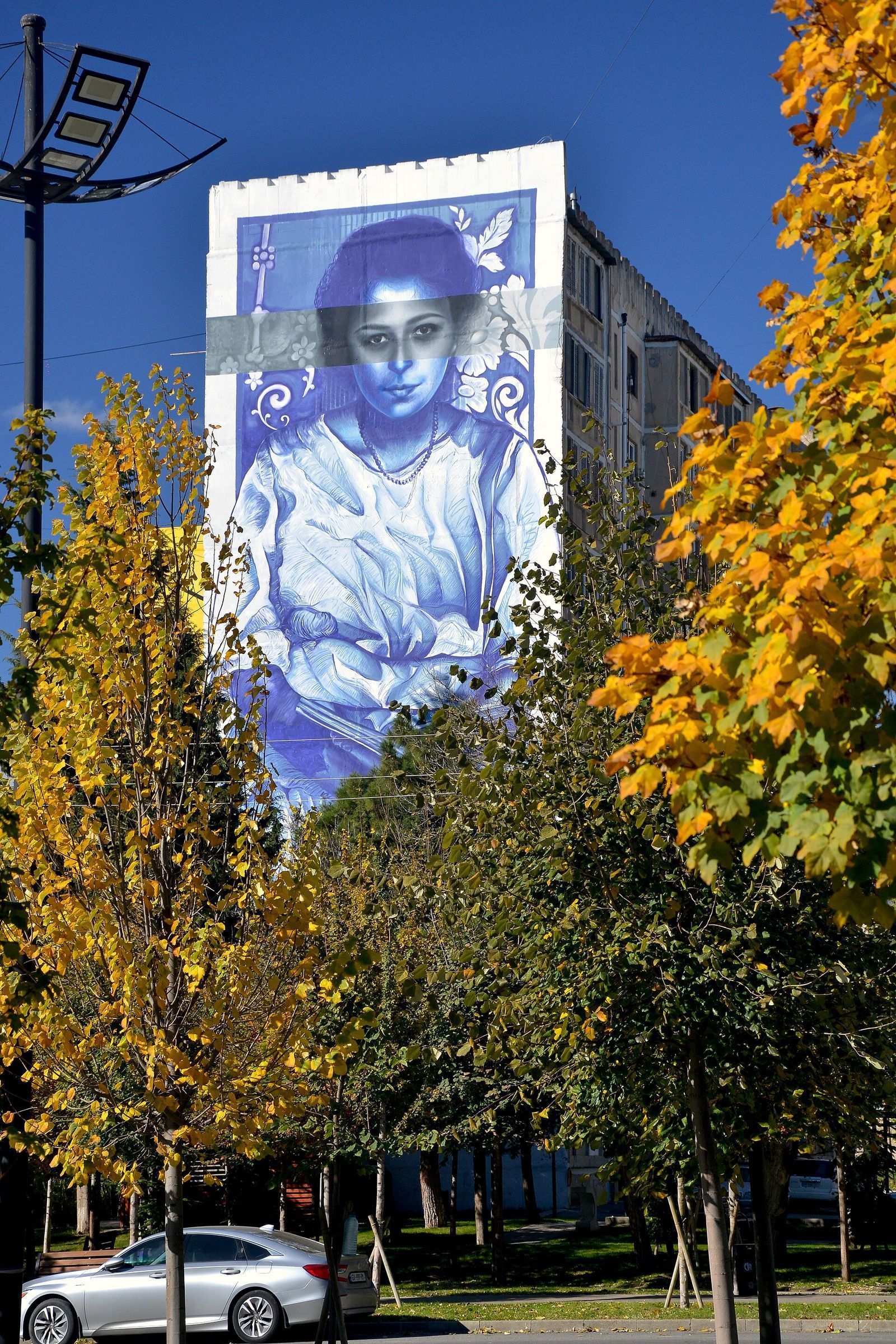
Varketili is a Soviet microdistrict in the east of the city, a grid of apartment blocks around a main avenue shaped like a question mark. It has more than 20 big murals, more than any other district, and they are the largest in the city. If you only make one trip out of the center for street art, make it this one.
Varketili station sits at the end of Line 1 of the Tbilisi metro, and the ride from Liberty Square costs 1 GEL. By car it's 20 to 30 minutes from the center, and a Bolt back saves your legs at the end.
The walls I wouldn't miss:
| Mural | Artist | Why it's worth the walk |
|---|---|---|
| Changing the Bulb | Slim Safont and WEDO (Mural Fest 2023) | A 45 m wall, painted in 11 days |
| Joestar | Nuno Viegas | A 35 m wall |
| Nona Gaprindashvili | David Samkharadze | Georgia's chess champion, a block high |
| War Will End | Sasha Korban (Niko 2022) | One of the strongest of the post-2022 walls |
| Mokheve | Gera (Mural Fest 2023) | A highlander from the Khevi region |
| Georgian Football Players | Afzan Pirzade | A tribute to the national team at Euro 2024 |
| Georgian Dancer | Afzan Pirzade (Georgia Mural Fest 2025) | One of the newest walls in the district |
| Conductor of Autumn | Primal | Hard to photograph, worth seeing in person |
There's more: Our Roof by Fabien (Niko 2023), a boy catching bubbles by Kade90 and Zaza Chipchiuri (2021), Peace by Linda Stein and Axel Schindler (Niko 2024) and Trust by Artez.
Vazisubani, next door, adds three newer walls: Girl in Mirrors by Fintan Magee and Girls with a Plant by Edoardo Ettorre (both Georgia Mural Fest 2025), and Tita by Giorgi "Pablo" Kalandarishvili (2023). Walk over from Varketili rather than making a separate trip.
Saburtalo: Vazha Pshavela Avenue, Maglivi and Nutsubidze
Saburtalo has about 20 murals, the second biggest collection after Varketili, and they're easier to reach: take the metro to Technical University or Medical University and walk. Most sit along Vazha Pshavela Avenue and in the blocks behind it, and the rest of Saburtalo district is offices, universities and apartment blocks rather than sights.
The walls I'd look for:
- Zebras by Snyder (Mural Fest 2019) and Peacemakers by Innerfields, both on a hillside and hard to photograph from below.
- Portal by 1010, the 3D circles that seem to sink into the wall.
- A Portrait by Fintan Magee (2022).
- Amirani by Musya Qeburia (Niko 2022), the Georgian Prometheus.
- Sukhishvilebi (Khorumi) by Dante and Acho Khutsishvili, the national dance company's war dance.
- Phoenix Carpet by Ju Mu and Vazha Pshavela by David Samkharadze, both on Vazha Pshavela Avenue.
- Blue Tablecloth by Tina Chertova (Mural Fest 2022), Coyote by Nasca One and Stop War by Goga Katsarava.
- Concrete Air and In Love (Niko 2021) by David Kelber.
Maglivi, the branch of Tbilisi State University with the central library, has about 20 murals in one spot. The Niko Movement uses it as a practice wall for newcomers, so the art changes every year, which makes it the best place to see what's new.
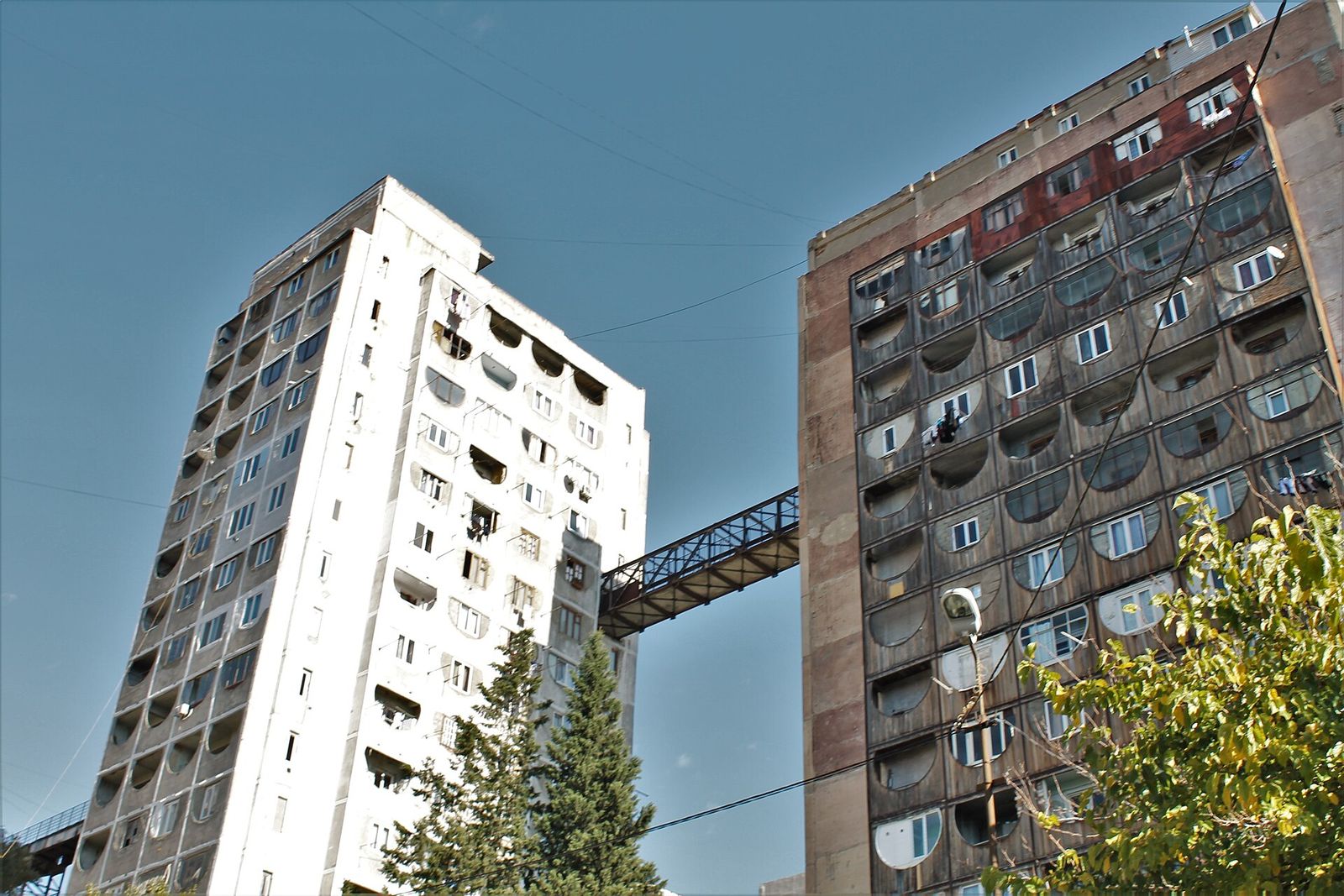
From Maglivi, the Nutsubidze plateau is close, with its brutalist towers and the Sky Bridge linking them, one of the strangest buildings in the city. I'd add it if Soviet architecture in Tbilisi interests you as much as the murals do, because the two sit side by side here.
Vake and Vera
These two central districts don't have the scale of Varketili, but they're close, they're pleasant to walk, and their best pieces are underground.
Vake
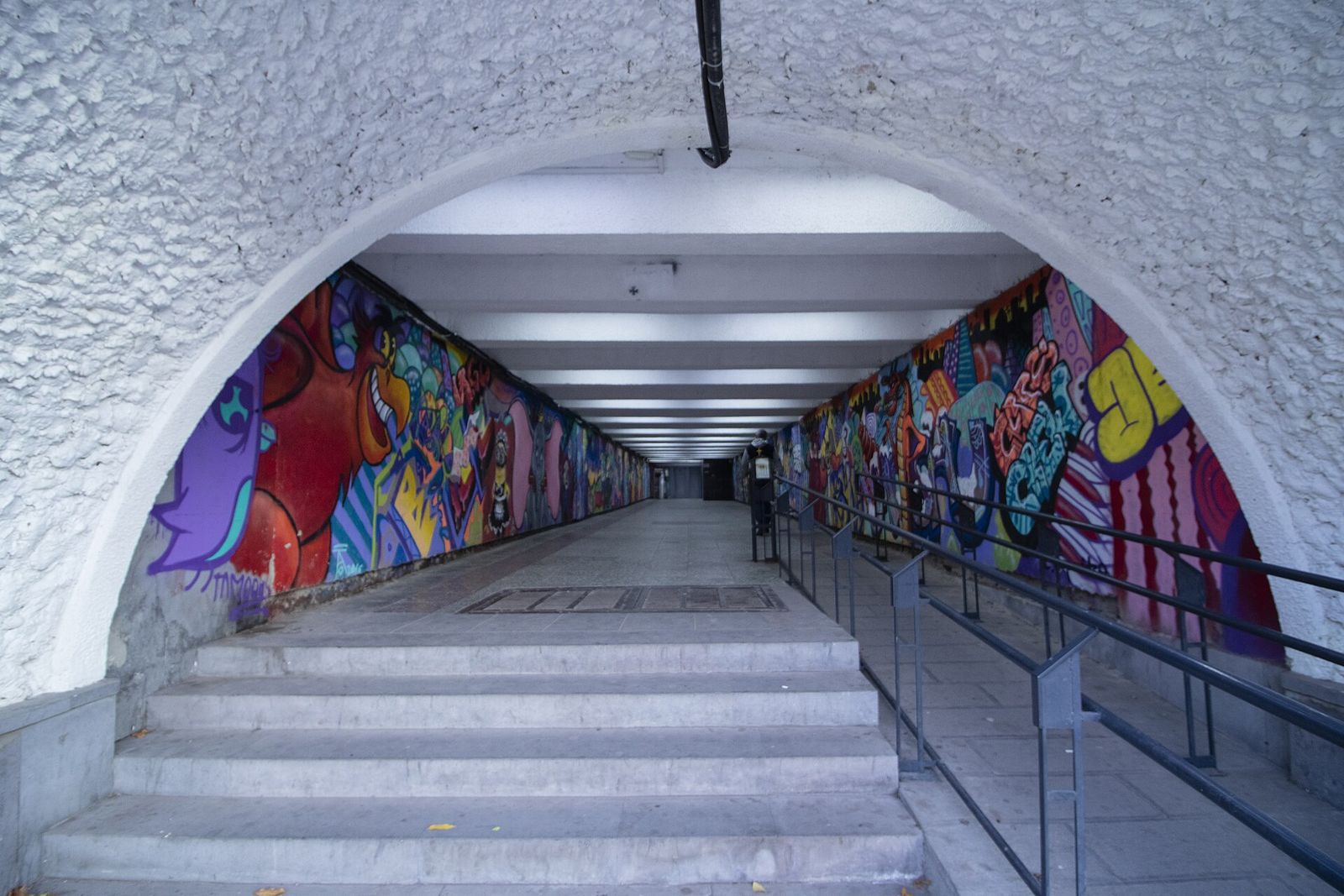
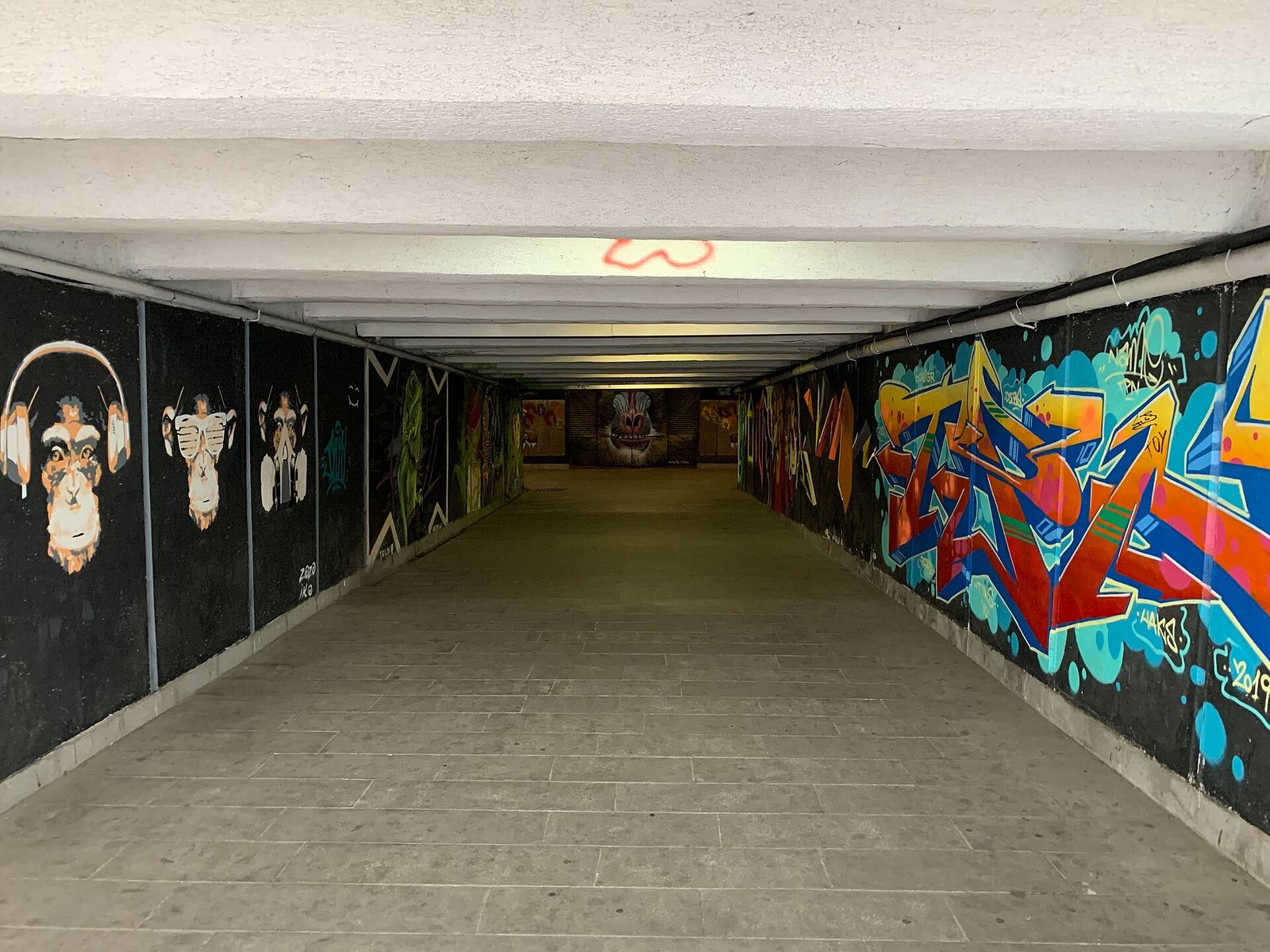
The underpass by Vake Park, under the main road at the park entrance, is lined wall to wall with graffiti and is the photo on top of this page. The festival walls are in the streets around the park and toward Bagebi:
- Locked Down (Living in a Golden Cage) by Innerfields and Horse by Dante, both Mural Fest 2020.
- Little Red Riding Hood by Williann (Niko 2024), covering 205 square meters on the wall between Bagebi and Vake.
- A Pink Floyd tribute by Dante, after the album Animals.
- Pumpkin Lady by ApheNoah and Kiss by Otooo.
- A 2024 piece by Case Maclaim, painted over his older wall Hands.
Vake has no metro, so come by bus or Bolt, and pair the walls with a walk in the park or lunch on Chavchavadze Avenue in leafy, well-off Vake.
Heroes Square underpass
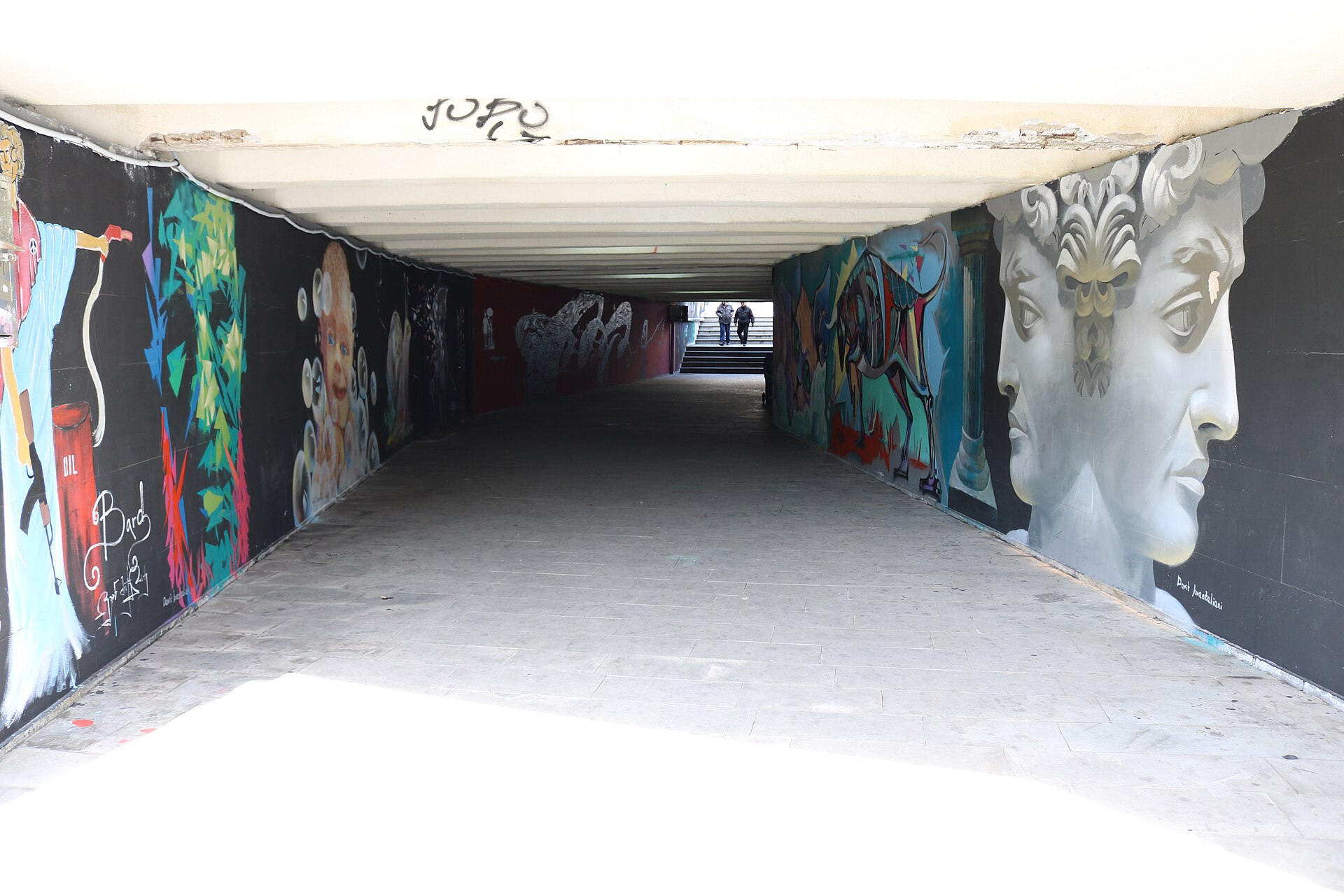
Between Vake and Vera, the long underpass under Heroes Square was cleaned up by the city in 2017 and repainted, and it now holds some of the best work by local muralists. You'll pass through it anyway on the way to the Heroes Square monument.
Vera
Vera's walls are scattered through the hilly streets above Rustaveli Avenue, around the building of the Tbilisi State Academy of Arts:
- Seraphite by Case Maclaim (2020).
- A Man with a Mustache by Jokonda (Niko 2019).
- Nature by Dilk and Feros (Niko 2018).
- King Rostevan and Tinatin, from The Knight in the Panther's Skin, sketched by David Machavariani and painted by Irakli Kadeishvili.
- Pixel City by Musya.
Street art in the Old Town and the center
The historic center has very little street art. The city works to keep the old quarter clean, so big walls are rare, and what you find tends to be on building-site hoardings that change with the construction.
There are still a few pieces worth knowing about, most of them a short detour from a walk through Old Tbilisi:
| Mural | Artist | Where |
|---|---|---|
| Frida Kahlo | Not signed | On Hotel Check Point |
| Putin and Trump playing chess over wine | Caricature, not signed | 2 Metekhi Rise, near Metekhi Church |
| Scenes from The Knight in the Panther's Skin | Repainted in 2022 | The Baratashvili Bridge underpass, pillars included |
| Motherhood | Afzan Pirzade and Besik Maziashvili | Avlabari |
| Davit Aghmashenebeli and the Battle of Didgori (1121) | Peter Skensved with 4 local artists | City center, for the Georgian Street Art Federation |
| Solar Logos | Faith47 | City center |
The Baratashvili Bridge underpass is the one I'd make a point of. It's right by the Old Town, it's free, and it's the closest thing in the center to the scale of the outer districts. Last Bell by Sasha Korban (2023), Hanging Laundry by WEDO and Medea and Jason by VESOD round out the center.
Small street art: stencils, stickers and underpasses
The big murals get the photos, but the smaller work is everywhere once you start looking. Underpasses, big and small, are the main canvas: most of the ones in the center and in Vake carry something, and some hold sharp social and political messages. Stencils, stickers and paste-ups cover drainpipes, electricity boxes and the backs of road signs.
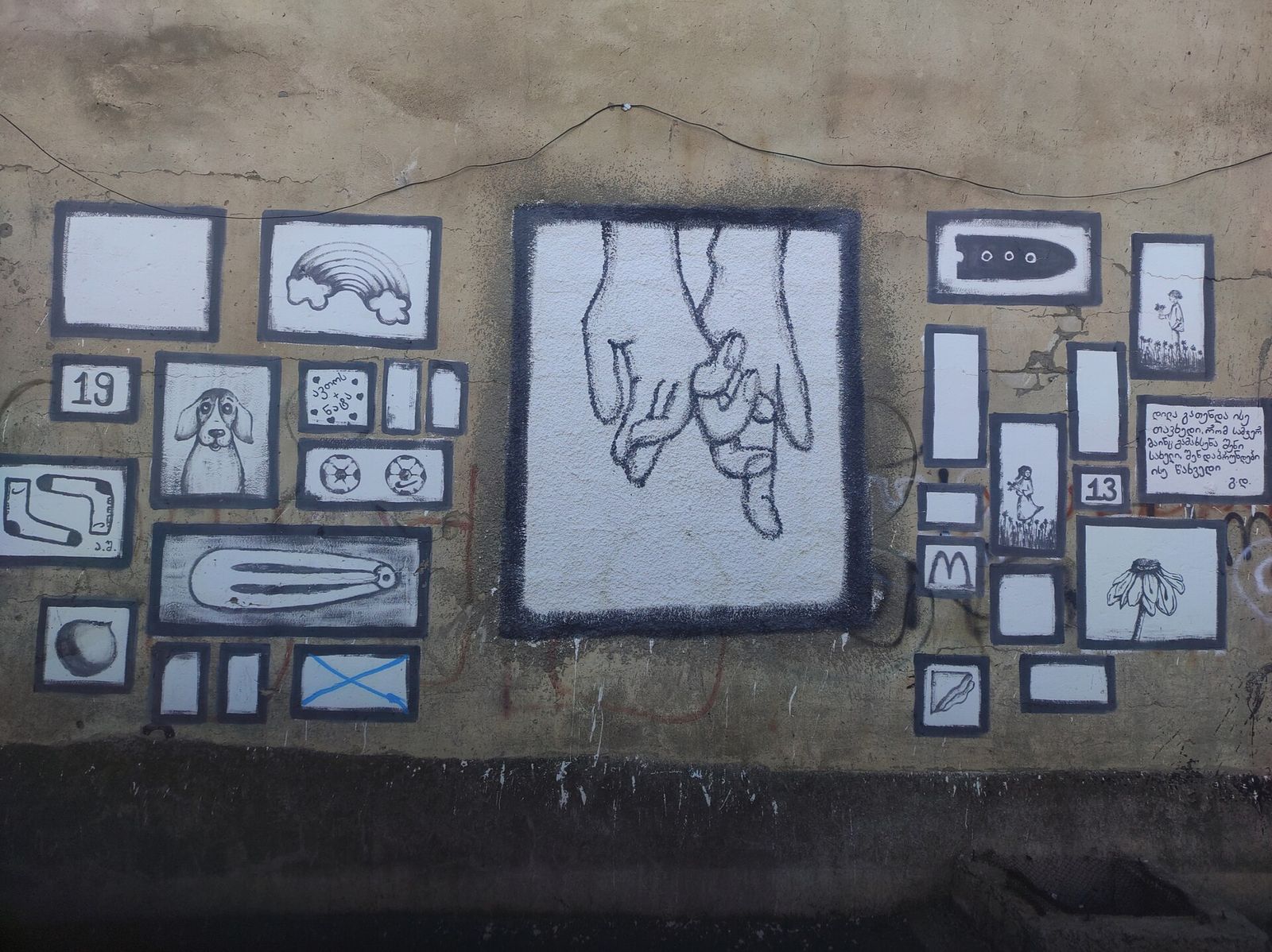
This work is temporary by nature. Walls get painted over, buildings get renovated, and even festival murals don't last forever: Dante's polar bear in Chughureti is already partly covered, and Case Maclaim's Hands in Vake was replaced by a new piece in 2024. If there's one wall you came to see, check a recent photo before you cross town for it.
How to plan a street art day in Tbilisi
You don't need a tour, a ticket or a plan beyond a map. Both the Niko Movement and the Mural Fest keep online maps of their walls, and the Street Art Cities app pins most of the big ones. Save the area offline before you set out, because the outer districts are a grid of identical blocks.
Two routes I'd recommend:
| Route | Stops | How long |
|---|---|---|
| The left bank on foot | Fabrika, the streets around Marjanishvili, then Station Square and the Dezerter Bazaar wall | Half a day, all within 2 metro stops of Liberty Square |
| The big walls | Metro to Varketili, the blocks and Vazisubani, then back on Line 1 and across to Saburtalo on Line 2 | A full day |
The two metro lines meet at Station Square, so the left-bank route and Saburtalo join up easily. Vake and Vera are better done separately, on foot or by Bolt, and the taxis in Tbilisi you order in an app cost a few lari for those short hops.
If you only have 2 or 3 days in the city, the Fabrika loop fits into a single afternoon of a Tbilisi itinerary without costing you an Old Town sight. If you'd rather have someone explain the walls, guided street art walks start at Fabrika and cover the Niko Movement murals, and they sit among the best tours in Tbilisi for anyone into contemporary art.
Is graffiti legal in Tbilisi?
No, not without permission. The big murals are painted with the building's permission, and painting a wall without it counts as vandalism. Artists who want a wall go through the festivals: the Niko Movement runs open calls for newcomers, and its practice wall at Maglivi is where many local muralists started.
Key takeaways
- Tbilisi's best street art is outside the Old Town: Fabrika and Chughureti, Varketili, Saburtalo, Vake and Vera.
- Start at Fabrika, a 10-minute walk from Marjanishvili metro, then walk the streets around it.
- For scale, take Line 1 to Varketili, where murals of 35 and 45 m cover whole Soviet blocks.
- The festivals add new walls every autumn, so October is the best month and recent photos beat old lists.
- Everything is free; carry an offline map and respect the people who live behind the walls.
Frequently asked questions
Where is the best street art in Tbilisi?
The best street art in Tbilisi is in Varketili, Saburtalo and around Fabrika in Chughureti. Varketili has the largest murals, Saburtalo has about 20 walls along Vazha Pshavela Avenue, and Fabrika is the easiest place to start from the center.
Is there street art in Tbilisi Old Town?
Very little. The city keeps the historic center clean, so the Old Town has only a few pieces, such as the Frida Kahlo mural on Hotel Check Point, the caricature on Metekhi Rise and the painted Baratashvili Bridge underpass.
Is Fabrika worth visiting for street art?
Yes. Fabrika's gate, facade and courtyard walls are covered in murals, and new work goes up every October. It's also the best base for the dozen or so walls in the streets of Chughureti around it.
When is the Tbilisi mural festival?
The Tbilisi Mural Fest, now Georgia Mural Fest, usually paints in the autumn, and the Niko Movement does the same. Fabrika adds new work to its facade each October, which makes autumn the best season for fresh walls.
Is graffiti legal in Tbilisi?
No, not without permission. The big murals are painted with the building's consent, usually through a festival, and painting a wall without permission counts as vandalism.
Is there a street art tour in Tbilisi?
Yes. Guided street art walks start at Fabrika and cover the Niko Movement murals, and some combine the walls with galleries and artist studios. You can also do it yourself for free with the festivals' online maps.
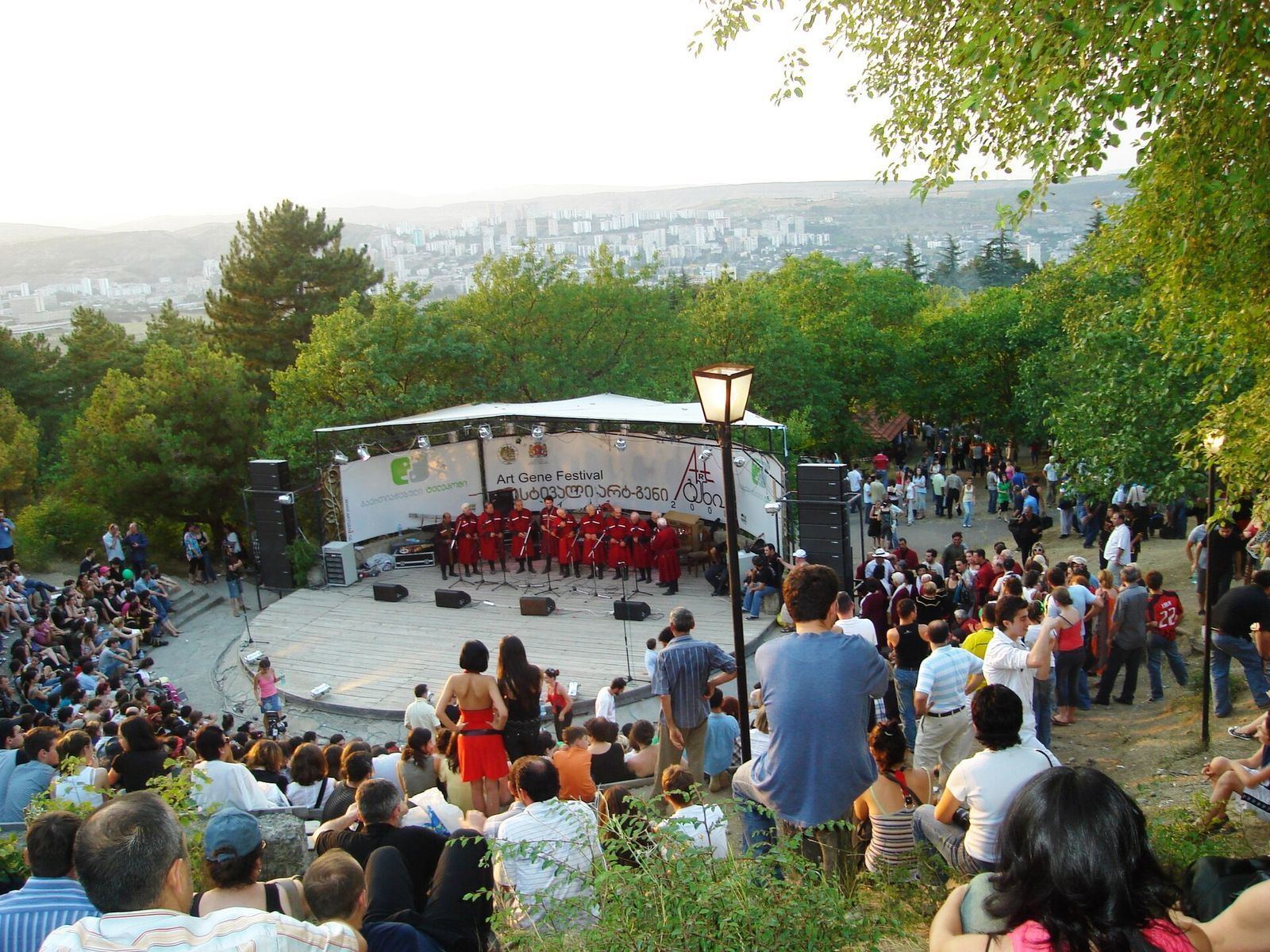
Georgian Culture and Traditions: A Visitor's Guide to Customs, Feasts, Faith and Song
Georgian culture is known for feasts, wine and song. Here's what visitors should know about its customs and traditions.
Read the guide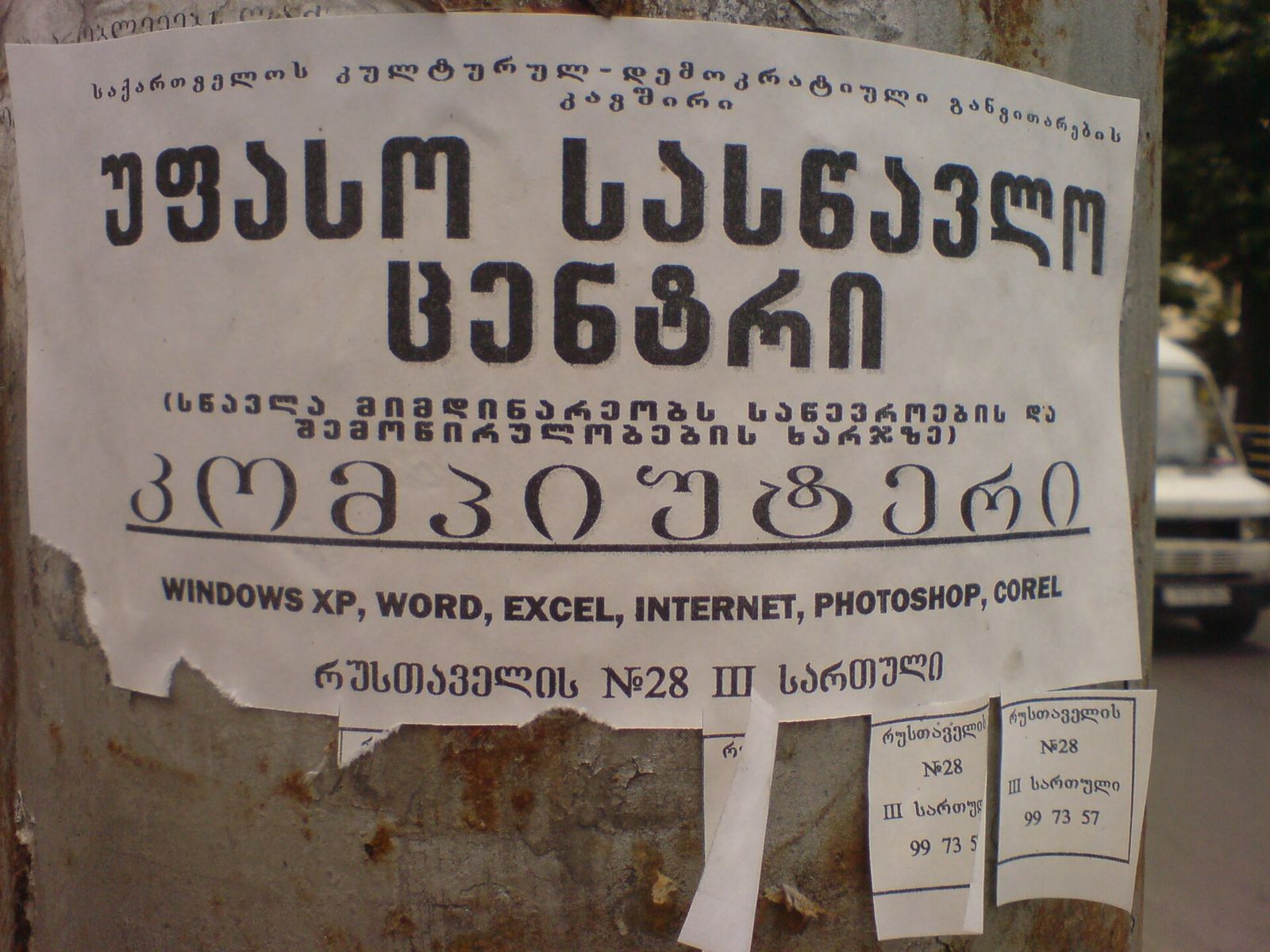
Basic Georgian Phrases for Travelers, with Pronunciation
Georgian has its own alphabet and a hello that means victory. Here are the phrases to learn and how to say them.
Read the guide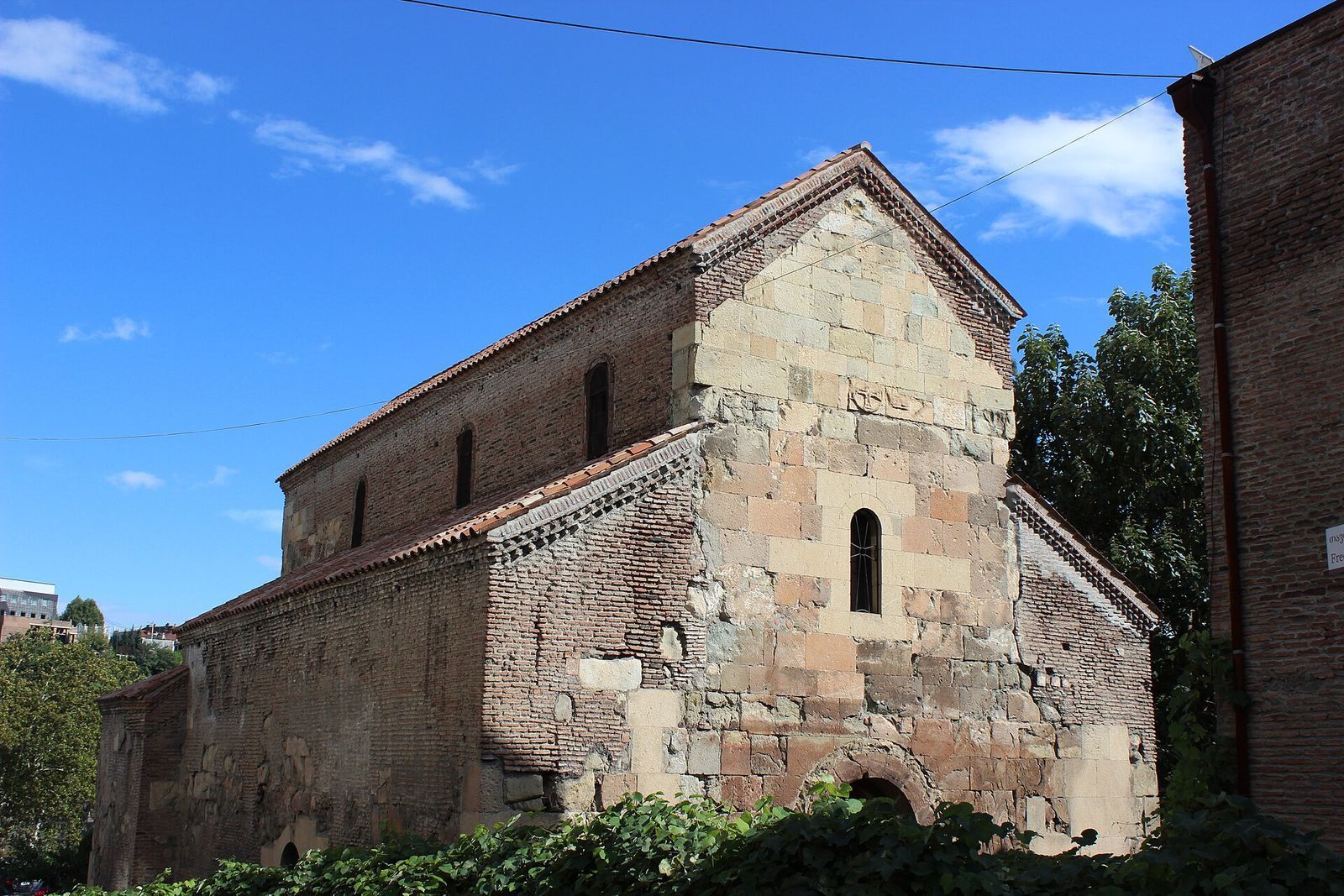
A Short History of Georgia and Tbilisi, From the Falcon Legend to Today
Tbilisi has been burned and rebuilt for 1,500 years. Here is Georgia's story in short, and where to see it today.
Read the guide