Getting Around Georgia: Marshrutkas, Buses, Trains and Stations
Georgia is known for its marshrutkas, the white minibuses that link almost every town in the country to Tbilisi for a few lari. Here's what you need to know about the vans, the coaches and the trains, which of Tbilisi's bus stations serves which part of the country, what each ride costs in 2026, and when a driver for the day beats all of them.
The ways to get around Georgia, compared
Georgia has no single transport network. One main railway runs west from Tbilisi to the Black Sea, marshrutkas fill in almost everything else, and the mountain roads are where a driver earns his fee. My rule of thumb: the train for Batumi and the west, a marshrutka for anything under about 3 hours, and a driver whenever the stops on the way matter as much as the place you're going.
| Mode | Best for | Sample fare | Comfort | Booking |
|---|---|---|---|---|
| Marshrutka | Day trips and towns off the railway | 2 GEL to Mtskheta, 20 GEL to Kutaisi | Cramped, often no air conditioning | None; cash to the driver |
| Coach | Batumi, Kutaisi Airport | 40 GEL to Batumi | Reclining seats, air conditioning, drinks | Online or at the office |
| Train | Batumi, Kutaisi, Zugdidi | 35 GEL to Batumi in second class | The most comfortable seat in Georgia | TKT.ge, about 20 days ahead |
| Shared taxi | The van's routes, faster | 50 to 60 GEL a seat to Batumi | A car that leaves when full | At the bus station |
| Private driver | Mountain roads with stops | About 210 GEL a car to Kazbegi | Door to door | Fixed price per car, booked online |
| Rental car | Kakheti and the countryside at your own pace | From 80 GEL a day | Your own | Online, international license needed |
Most visitors end up using three of these on one trip: a train west, a couple of marshrutka day trips from Tbilisi, and one day with a driver in the mountains. That mix is also how I'd do it.
How marshrutkas work
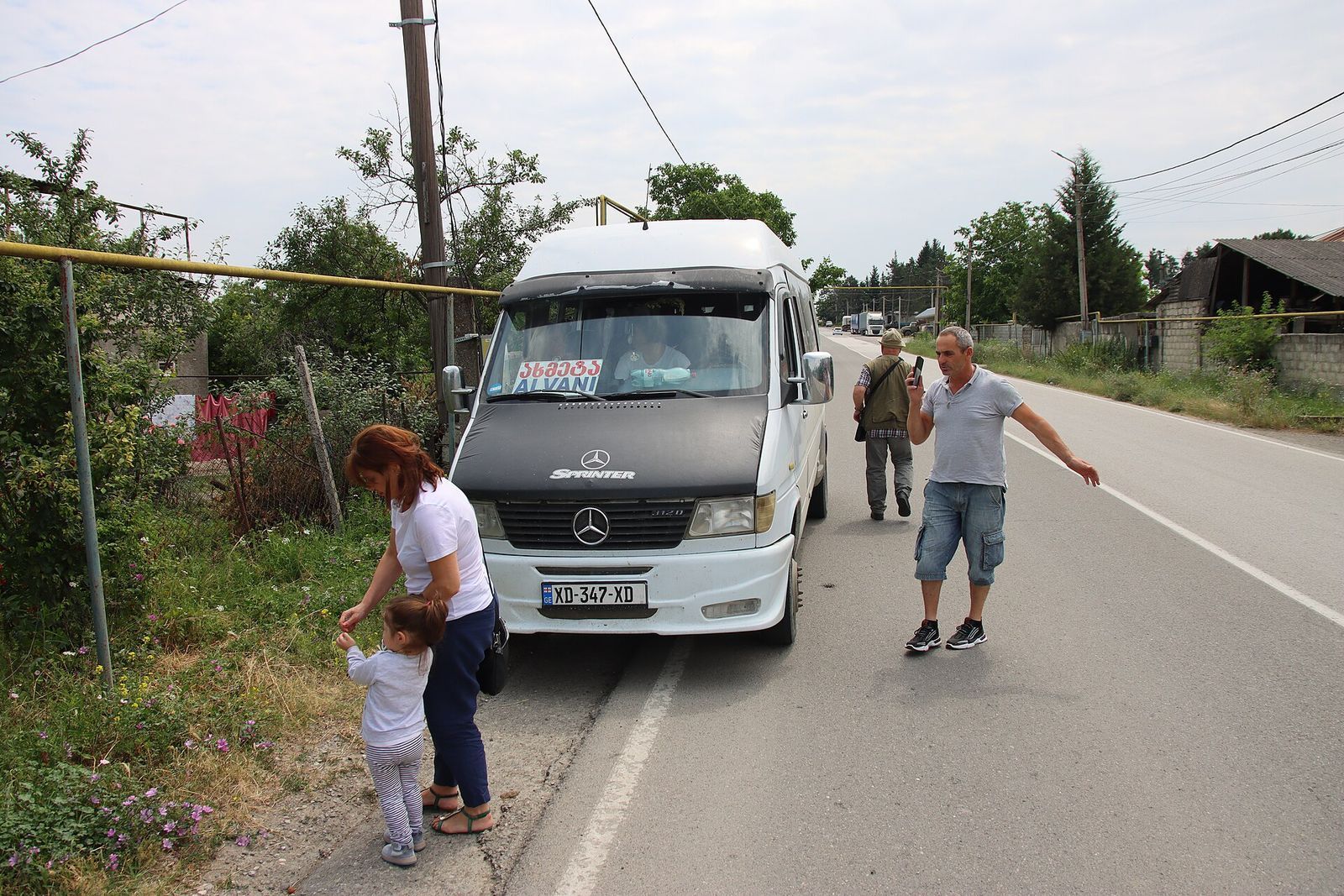
A marshrutka is a shared minibus, usually a white Mercedes Sprinter with a destination card propped in the windscreen. They run from a bus station yard in every town, and on most routes the van leaves when it's full rather than at a set time. The busy lines, like Kazbegi, Kutaisi and Batumi, also run roughly on the hour, so you're rarely waiting long.
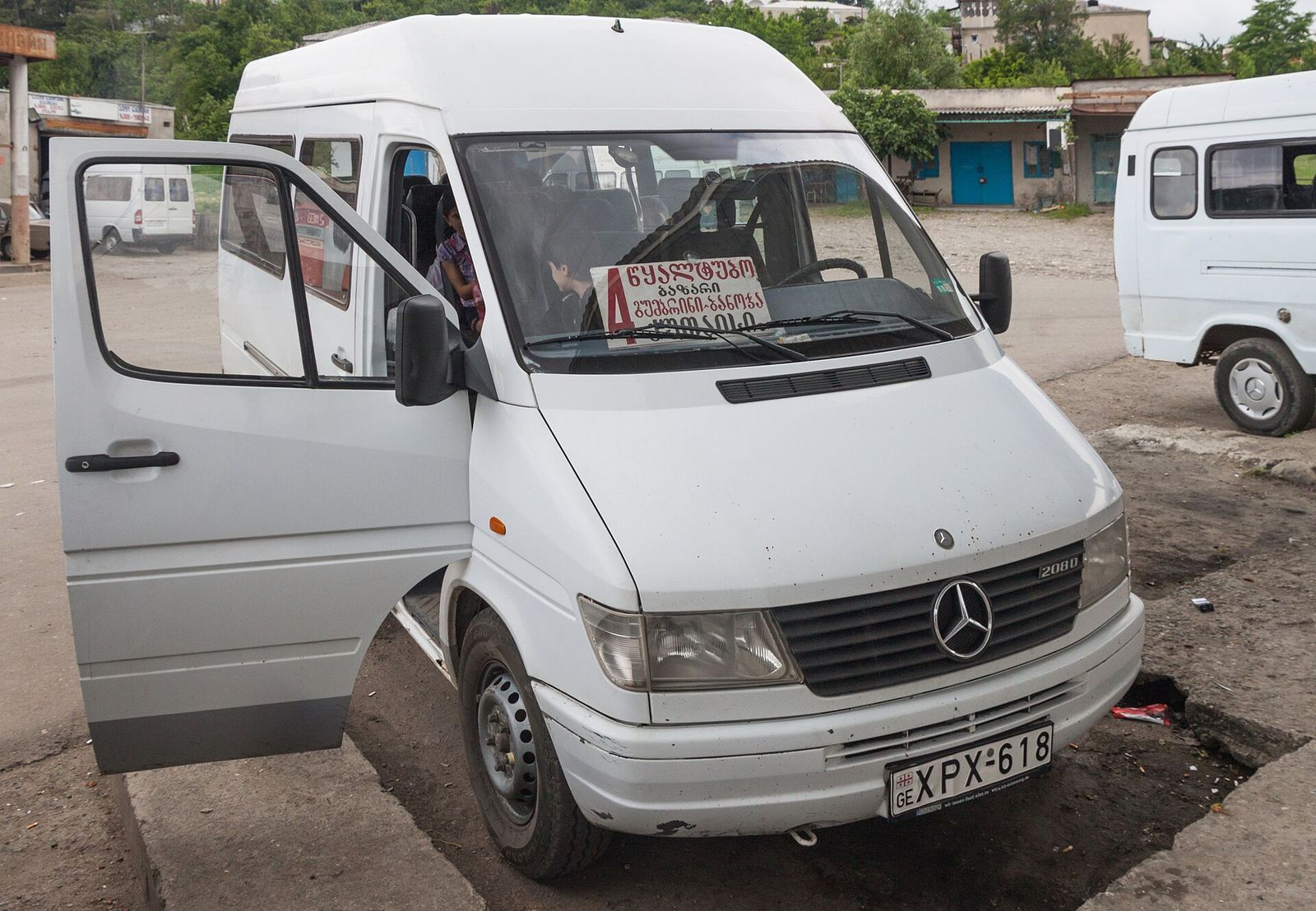
You pay in cash. On most routes you hand the fare to the driver; at a few stations, such as the Zugdidi yard for Mestia, you buy a ticket from the cashier before boarding. Big bags go in the back or on your lap, and some routes charge for a large one: the Kazbegi van asks 5 GEL extra.
The ride is honest and basic. Seats are packed close with little legroom, many vans have no air conditioning, only windows that slide open, and the drivers are quick. Long routes usually stop once along the way; on the Batumi run the break lasts about 30 minutes. Along the way the van picks up and drops off passengers by the road, so you can ask to get out anywhere on the route, and flag one down from the roadside on the way back.
What a marshrutka won't do is stop for sightseeing. The Kazbegi van drives straight past Ananuri fortress and the Jvari Pass viewpoint, and the Sighnaghi van doesn't stop at wineries. That's the single best reason to pay for a driver instead.
Tbilisi bus stations: which one for where
Tbilisi has four places where long-distance transport leaves, and turning up at the wrong one is the classic first-trip mistake. The split is roughly geographic: the north and west from Didube, the east from Samgori, the coaches and the south from Ortachala, and the trains plus a few vans from Station Square.
| Station | Nearest metro | Serves | Sample routes |
|---|---|---|---|
| Didube | Didube, Line 1 | North and west | Mtskheta, Kazbegi, Gori, Kutaisi, Batumi |
| Samgori (Navtlughi) | Samgori, Line 1 | East and Kakheti | Sighnaghi, Telavi, the 07:00 van to Mestia |
| Ortachala | None; Bolt or city bus | Coaches and the south | Coaches to Batumi, vans to Marneuli and Yerevan |
| Station Square (Central Station) | Station Square, both lines | Trains and some vans | Trains to Batumi, Kutaisi and Zugdidi; the 09:00 van to Yerevan |
Three of the four sit on the Tbilisi metro, a 1 GEL ride from the center, and Ortachala is a short Bolt ride away.
Didube bus station
Didube is the big one: a sprawling yard next to Didube metro on Line 1, with a busy market on the same patch and several smaller stations nested inside the main one. It serves the north and west of the country: Mtskheta, Gori, Kazbegi, Kutaisi, Batumi and most of western Georgia. It doesn't serve Armenia; those vans leave from Station Square and Ortachala.
It looks chaotic and works better than it looks. Most signs are in Georgian, the popular destinations are signposted in English too, and drivers stand by their vans calling out the town they're heading for. Say the name of the place and someone will point you to the right van.
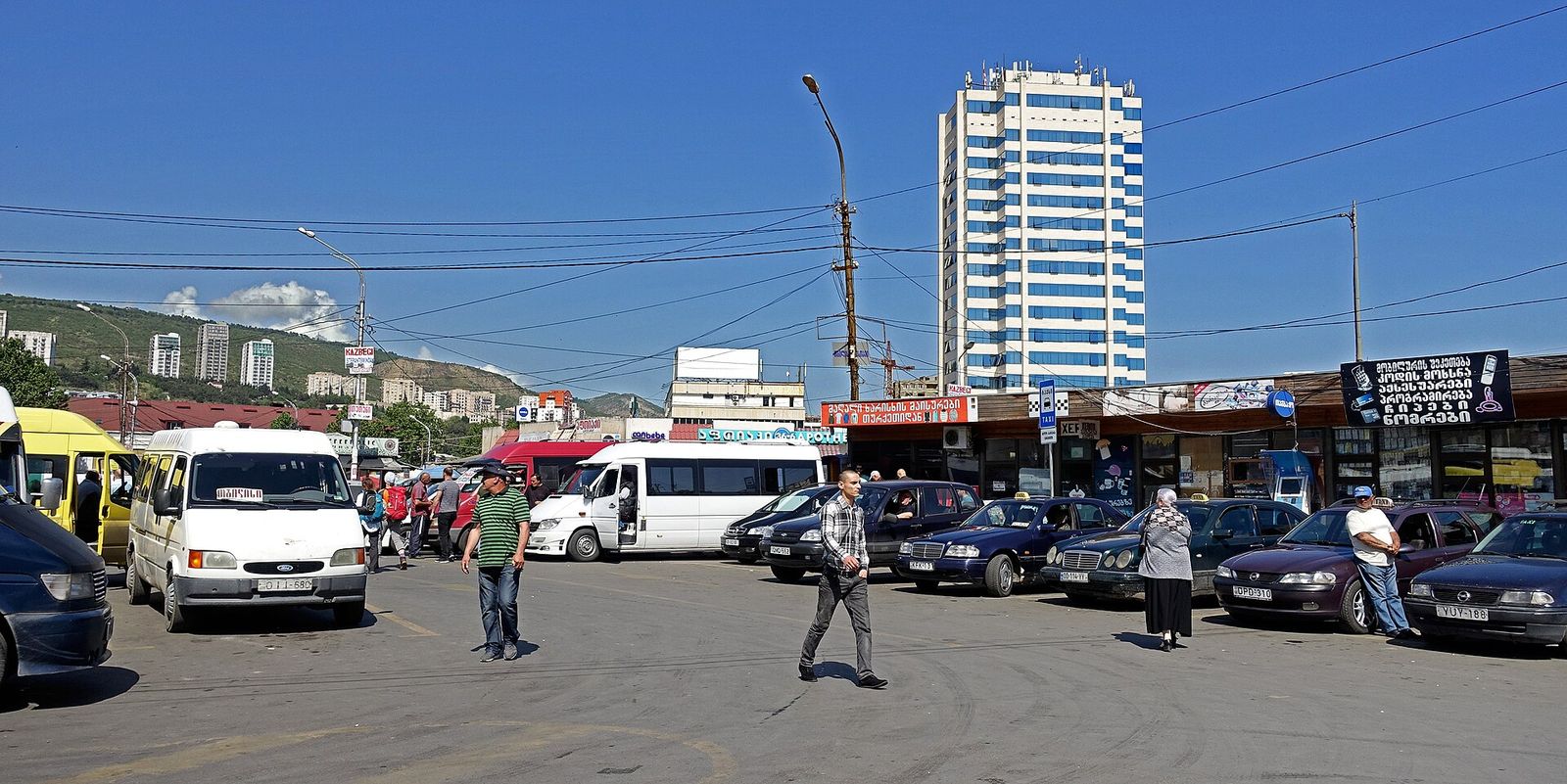
The 2026 fares from Didube are low: 2 GEL to Mtskheta, 15 to 20 GEL to Kazbegi, 20 GEL to Kutaisi and 35 GEL to Batumi. Shared taxis wait here as well, with the destination on a sign behind the windscreen, and a seat to Batumi runs 50 to 60 GEL.
Samgori bus station (Navtlughi)
Kakheti's vans leave from a yard by Samgori metro, also on Line 1. You'll see it called Samgori, Navtlughi or Navtlughi bus station, and it's all the same place. Come here for Sighnaghi (10 to 15 GEL, about 2 hours, several departures between 09:00 and 18:00), for Telavi and the rest of the wine region, and for the one direct van to Mestia, which leaves at 07:00 and takes 8 to 9 hours for 50 GEL.
Sighnaghi is the classic ride from this yard, and the van works well for it, as long as you watch the clock on the way back: the last van to Tbilisi leaves Sighnaghi at about 18:00.
Ortachala bus station
Ortachala sits south of the center with no metro nearby. A Bolt from the Old Town costs about 5 GEL, and city buses 350, 301 and 371 run there from Baratashvili Street. This is the coach station: Metro Georgia and Omnibus run their Batumi coaches from here, and vans leave for Marneuli and south toward the Armenian border.
It's quieter and easier to read than Didube. If you're heading to Yerevan from here, look for the van with Yerevan on its sign; they usually fill and leave within 2 hours.
Station Square and the Central Station
Station Square is the only metro stop where the two lines meet, and it sits right by Tbilisi Central Station. The trains to Batumi, Kutaisi and Zugdidi all leave from here, with the platforms on the upper floor, and there are luggage lockers for 15 GEL a day (07:30 to 20:00).
Outside on the square, the most punctual van to Yerevan leaves at 09:00 for 35 GEL, then picks up more passengers at Avlabari. Some coaches also leave from the square.
Marshrutka fares and times from Tbilisi
These are the routes visitors ride most, with October 2026 fares. Prices creep up a lari or two most years, so carry a little more than the table says.
| Destination | Leaves from | Fare | Time | How often |
|---|---|---|---|---|
| Mtskheta | Didube | 2 GEL | About 20 minutes | Every 15 to 20 minutes |
| Kazbegi (Stepantsminda) | Didube | 15 to 20 GEL | About 3 hours | About hourly, 08:00 to 19:00 in autumn |
| Kutaisi | Didube | 20 GEL | 3.5 to 4 hours | Hourly, 07:00 to 20:00 |
| Batumi | Didube | 35 GEL | 6.5 to 7 hours | About hourly, last around midnight |
| Sighnaghi | Samgori | 10 to 15 GEL | About 2 hours | Several a day, 09:00 to 18:00 |
| Mestia | Samgori | 50 GEL | 8 to 9 hours | One van at 07:00 |
| Yerevan | Station Square | 35 GEL | 5 to 6 hours | First at 09:00 |
| Mestia from Zugdidi | Zugdidi station | 35 to 40 GEL | About 4 hours | First at 06:00, then when full |
Mtskheta is the easy first ride: 20 minutes, 2 GEL and a van every 15 to 20 minutes, so there's no timetable to worry about. Jvari Monastery on the hill above town has no bus, so add a taxi from Mtskheta, about 10 to 15 GEL return.
The Kazbegi van is the one most visitors ride. In winter the road to Kazbegi can close between Gudauri and Kobi after snow, so I'd head back from Stepantsminda by 14:30 between December and March.
Intercity buses and coaches
Georgia's coaches are the step up from a marshrutka: full-size buses with reclining seats, air conditioning, hot drinks and water, seat-back screens and Wi-Fi that comes and goes. Three companies matter to visitors: Metro Georgia, Omnibus and Georgian Bus.
- Tbilisi to Batumi. Metro Georgia and Omnibus both leave from Ortachala, cost 40 GEL and take 6.5 to 7 hours. Omnibus runs twice a day; Metro Georgia runs once or twice a day in winter and more often in summer. In peak season I'd book a couple of days ahead on the Metro Georgia app or at its office. Coming back, Metro Georgia stops in central Tbilisi before Ortachala.
- Kutaisi Airport. Georgian Bus and Omnibus run 25 GEL one way, 45 GEL return, timed to the flights and willing to wait for a late one. Georgian Bus drops at Pushkin Park by Freedom Square, Omnibus on Javakhishvili Street near Rustaveli metro, and the Kutaisi Airport bus takes 3.5 to 4 hours.
- Kutaisi Airport to Batumi and Kutaisi town. Georgian Bus also runs from the airport to Batumi (20 GEL, about 2 hours 20 minutes) and into Kutaisi itself (10 GEL).
For Kutaisi town, the train to Rioni station or the hourly Didube van are the usual picks, and both cost less than the airport coach.
Trains in Georgia
Georgia's railway is one main line from Tbilisi west to the Black Sea, plus a few branches, and the Swiss-built Stadler double-deckers on it are the most comfortable way to cross the country. They have air conditioning (bring a layer, it runs cold), power sockets and a vending machine, but no dining car and unreliable Wi-Fi.
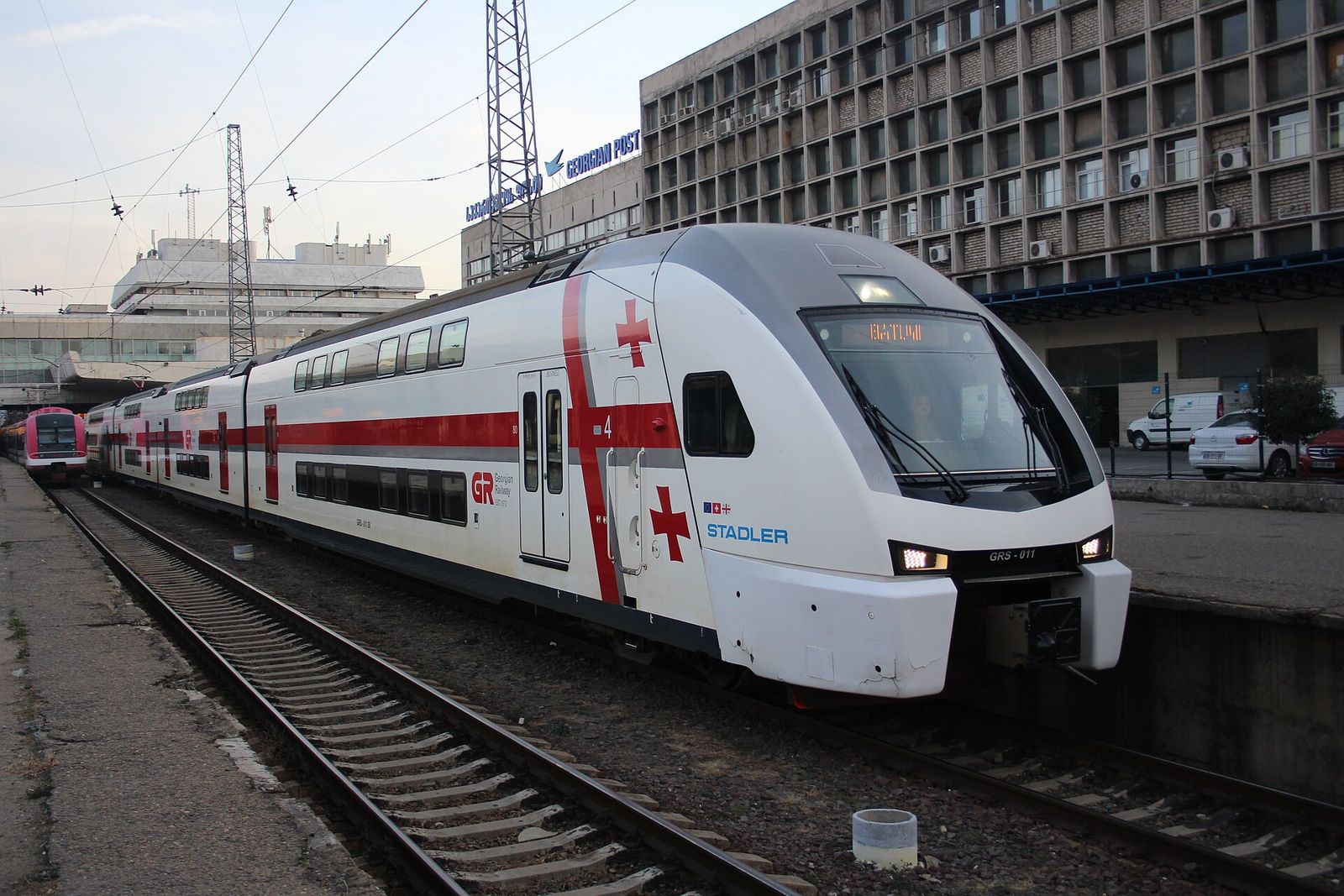
- Tbilisi to Batumi. About 5 hours, at least two trains a day all year and more in summer. Second class costs 35 GEL, first 75 GEL and business 125 GEL. The train stops at Kutaisi International Airport station, Ureki and Kobuleti, and the Batumi train beats every road option on comfort.
- Tbilisi to Kutaisi. The fast Batumi trains stop at the airport station (33 GEL in second class), and 4 trains a day run to Rioni station, 10 km outside Kutaisi, from 14 GEL in economy.
- Tbilisi to Zugdidi. One train a day at 08:15, arriving about 14:30 to 15:00, with an afternoon van waiting outside the station for Mestia. The old night train to Zugdidi stopped in 2020, so the day train is how the trip to Mestia splits most comfortably.
- Tbilisi to Yerevan. An overnight train runs every other night outside summer and nightly from June to September. The daytime alternative is the 09:00 van, which makes Yerevan by road a 5 to 6 hour trip.
Tickets for the domestic trains are sold on TKT.ge: sales open about 20 days ahead, the card fee is 1 GEL, the QR ticket comes by email, and you need your passport on board. Seats are assigned automatically except on the Batumi fast trains, and when booking Georgian trains online you pick Tbilisi-pass as the name of the Tbilisi station.
Shared taxis, Bolt and private drivers
Shared taxis wait at Didube and Ortachala for the popular routes, with the destination on a card in the windscreen. Like the vans, they leave when every seat is sold, but they're faster: a seat to Batumi costs 50 to 60 GEL against 35 GEL in the van.
Bolt works well for short hops out of the city. Tbilisi to Mtskheta costs about 30 to 45 GEL in a Bolt, and the app shows the price before you book. In the mountain towns, Kazbegi and Svaneti among them, street taxis are the main option, and the rules for Tbilisi taxis apply there too: agree the price before you get in.
Private drivers charge a fixed price per car, which is where the sums turn in your favor as a group.
| Trip from Tbilisi | Driver, per car | Marshrutka, per person |
|---|---|---|
| Mtskheta | 81 GEL | 2 GEL |
| Sighnaghi | 191 GEL | 10 to 15 GEL |
| Kazbegi | 210 GEL | 15 to 20 GEL |
| Kutaisi | 244 GEL | 20 GEL |
For four people, a driver to Kazbegi comes to about 53 GEL each, and the car stops at Ananuri, the Zhinvali Reservoir and the Jvari Pass on the way. Add a tip for the driver of 20 to 50 GEL for a full day.
Renting a car and driving in Georgia
A rental car costs from about 80 GEL a day for a sedan to 150 GEL for an SUV, and you need an international driving license. Petrol runs 3.2 to 3.5 GEL a liter.
The driving itself is the catch. Speeding and aggressive overtaking are normal, drivers rarely stop at zebra crossings, and the mountain roads are no place to be after dark. Some of them close in winter. I wouldn't drive in Tbilisi at all, where traffic and parking eat the day, but a car makes sense for Kakheti, where the wineries and monasteries are spread across the valley. For the high mountains, a rental car in Georgia is worth it only if you're comfortable on steep, narrow roads; otherwise hire a driver.
Domestic flights in Georgia
Vanilla Sky flies small planes from Natakhtari airfield, about 30 km north of Tbilisi past Mtskheta, to Mestia in Svaneti. The flight takes about 1 hour, there are up to two a day in summer, each plane holds 17 people, and the ticket includes a free shuttle from Tbilisi. Book early, and plan around weather cancellations, which are common: never count on the flight back from Mestia the day before you fly home.
There are no flights between Tbilisi and Kutaisi. Batumi has flights from Tbilisi, but domestic flights are weather-dependent and often cancelled, and the 5-hour train is the more reliable choice.
Which way to go: my pick for each route
This is how I'd cover the routes most visitors ride, and when I'd change my mind.
| Route | My pick | Why | Switch if |
|---|---|---|---|
| Tbilisi to Batumi | Stadler train | About 5 hours, 35 GEL, the best seat in Georgia | It's sold out: the 40 GEL coach from Ortachala |
| Tbilisi to Kutaisi | Train to Rioni, or the Didube van | 14 GEL by train, 20 GEL and hourly by van | You're flying out: the train to the airport station |
| Tbilisi to Kazbegi | A driver | Stops at Ananuri and the Jvari Pass | You only want Stepantsminda and Gergeti: the 15 to 20 GEL van |
| Tbilisi to Sighnaghi | Van from Samgori | About 2 hours for 10 to 15 GEL | You want wineries on the way: a driver |
| Tbilisi to Mtskheta | Van from Didube | 2 GEL, every 15 to 20 minutes | You want Jvari Monastery: Bolt there and back |
| Tbilisi to Mestia | 08:15 train to Zugdidi, then the van | Breaks a 9-hour day in two | You want one seat all day: the 07:00 van from Samgori |
| Tbilisi to Yerevan | 09:00 van from Station Square | 35 GEL, the most punctual departure | You'd rather sleep: the overnight train |
If you're stringing several of these into one trip, the order matters more than the mode. Kazbegi, Mtskheta and Sighnaghi are easy out-and-back trips from Tbilisi, while Kutaisi, Batumi and Svaneti sit along the western line and work best as one loop in a Georgia itinerary.
Tips for marshrutkas and buses in Georgia
- Arrive 20 to 30 minutes early. Popular vans fill before they're due, and the next one may be an hour away.
- Plan the way back before you go. The last van from Sighnaghi leaves at about 18:00 and the Kutaisi vans stop around 20:00, so check the last departure when you arrive.
- Keep your wallet in a front pocket at Didube. The market around the station is the kind of crowd where pickpockets work.
- Bring water and a layer. Vans can be hot in summer with no air conditioning, while the trains run cold.
- Get to the stations on city transport. Tbilisi's buses and metro cost 1 GEL a ride on a Metromoney card, so reaching Didube or Samgori costs almost nothing.
- In winter, watch the mountain roads. Snow can close the road to Kazbegi past Gudauri and other mountain routes, so check before you leave and start early.
Key takeaways
- Marshrutkas are cheap and everywhere: 2 GEL to Mtskheta, 20 GEL to Kutaisi, 35 GEL to Batumi, cash only.
- Pick the station by direction: Didube for the north and west, Samgori for Kakheti, Ortachala for coaches and the south, Station Square for trains.
- Take the train to Batumi (35 GEL, about 5 hours) and book on TKT.ge as soon as sales open in summer.
- Coaches from Ortachala (40 GEL to Batumi) are the comfortable road option.
- Hire a driver for Kazbegi or Kakheti when you want to stop on the way; split four ways, Kazbegi comes to about 53 GEL each.
Frequently asked questions
What is a marshrutka?
A marshrutka is a shared minibus, usually a white Mercedes Sprinter, that runs fixed routes between towns and inside cities. On intercity routes it leaves when it's full or roughly on the hour, and you pay the driver in cash.
How much does a marshrutka cost in Georgia?
Most intercity marshrutkas from Tbilisi cost 2 to 50 GEL. Mtskheta is 2 GEL, Sighnaghi 10 to 15 GEL, Kazbegi 15 to 20 GEL, Kutaisi 20 GEL, Batumi 35 GEL and the direct van to Mestia 50 GEL.
Which bus station in Tbilisi goes to Kazbegi?
Didube. The Kazbegi vans leave from Didube bus station, next to Didube metro, about every hour from 08:00 to 19:00 in autumn, for 15 to 20 GEL. The ride takes about 3 hours when the road is open.
Where is Didube bus station?
Didube bus station is north of the center, right next to Didube metro station on Line 1. The easiest way there is the metro for 1 GEL.
Do marshrutkas in Georgia run on a schedule?
Some do, most don't. Busy routes like Kazbegi, Kutaisi and Batumi run roughly hourly, while most others leave when every seat is taken, so arrive 20 to 30 minutes early.
Is the train or the bus better from Tbilisi to Batumi?
The train. The Stadler train takes about 5 hours for 35 GEL in second class, against 6.5 to 7 hours by coach (40 GEL) or marshrutka (35 GEL). Book it early in summer, when it sells out.
Can you travel around Georgia without a car?
Yes. Marshrutkas reach almost every town, the train covers the line to Batumi, and private drivers fill the gaps on mountain roads. A car only pays off if you want to explore Kakheti or the countryside at your own pace.
Tbilisi Travel Tips: What I'd Tell You Before a First Trip to Georgia
Tbilisi is known for wine, sulfur baths and long dinners. Here's what to know about entry, money, transport and safety.
Read the guide
Tbilisi Itinerary: How I'd Spend 1 to 5 Days in Tbilisi
Tbilisi is best over 3 full days. Here is how to spend 1 to 5, with routes, meals, day trips and costs.
Read the guide
The Best Time to Visit Tbilisi, Month by Month
Tbilisi is known for golden autumns and hot summers. Here is the weather by month, the crowds, and when I would go.
Read the guide